Department of Biological Sciences, Dartmouth College, Hanover, New Hampshire, United States of America.
PLoS One. 2010 Aug 10;5(8):e12061. doi: 10.1371/journal.pone.0012061.
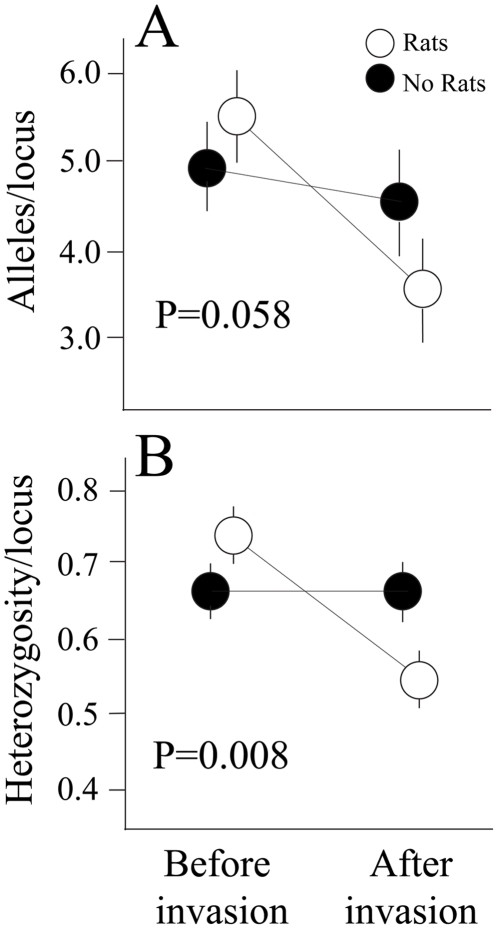
Invasive species can dramatically impact natural populations, especially those living on islands. Though numerous examples illustrate the ecological impact of invasive predators, no study has examined the genetic consequences for native populations subject to invasion. Here we capitalize on a natural experiment in which a long-term study of the brown anole lizard (Anolis sagrei) was interrupted by rat invasion. An island population that was devastated by rats recovered numerically following rat extermination. However, population genetic analyses at six microsatellite loci suggested a possible loss of genetic diversity due to invasion when compared to an uninvaded island studied over the same time frame. Our results provide partial support for the hypothesis that invasive predators can impact the genetic diversity of resident island populations.
入侵物种会对自然种群产生巨大影响,特别是那些生活在岛屿上的种群。尽管有许多例子说明了入侵捕食者对生态的影响,但没有研究检查过受入侵影响的本地种群的遗传后果。在这里,我们利用了一个自然实验,在这个实验中,对棕色鬣蜥(Anolis sagrei)的长期研究被老鼠入侵打断了。一个被老鼠严重破坏的岛屿种群在老鼠被消灭后数量上有所恢复。然而,与在同一时间段内研究的未受入侵的岛屿相比,在六个微卫星基因座上的种群遗传分析表明,由于入侵,遗传多样性可能有所丧失。我们的研究结果部分支持了这样一种假设,即入侵捕食者可能会影响居住在岛屿上的种群的遗传多样性。