Katagiri Yukiko, Aoki Chizu, Tamaki-Ishihara Yuko, Fukuda Yusuke, Kitamura Mamoru, Matsue Yoichi, So Akiko, Morita Mineto
Reproduction Center, Department of Obstetrics and Gynecology, Toho University Omori Medical Center, 6-11-1 Omori-Nishi, Ota-ku, Tokyo 143-8541, Japan.
Obstet Gynecol Int. 2010;2010. doi: 10.1155/2010/437528. Epub 2010 Jul 12.
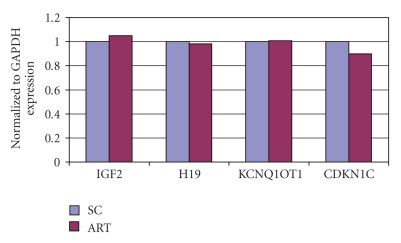
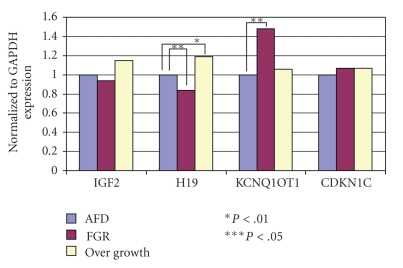
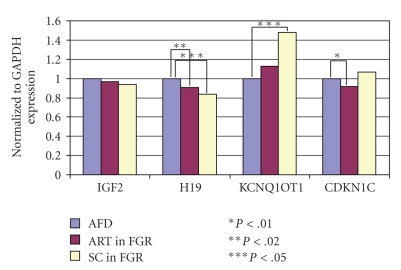
We used placental tissue to compare the imprinted gene expression of IGF2, H19, KCNQ1OT1, and CDKN1C of singletons conceived via assisted reproduction technology (ART) with that of spontaneously conceived (SC) singletons. Of 989 singletons examined (ART n = 65; SC n = 924), neonatal weight was significantly lower (P < .001) in the ART group than in the SC group, but placental weight showed no significant difference. Gene expression analyzed by real-time PCR was similar for both groups with appropriate-for-date (AFD) birth weight. H19 expression was suppressed in fetal growth retardation (FGR) cases in the ART and SC groups compared with AFD cases (P < .02 and P < .05, resp.). In contrast, CDKN1C expression was suppressed in FGR cases in the ART group (P < .01), while KCNQ1OT1 expression was hyperexpressed in FGR cases in the SC group (P < .05). As imprinted gene expression patterns differed between the ART and SC groups, we speculate that ART modifies epigenetic status even though the possibilities always exist.
我们使用胎盘组织,比较了通过辅助生殖技术(ART)受孕的单胎与自然受孕(SC)单胎的胰岛素样生长因子2(IGF2)、H19、KCNQ1OT1和细胞周期蛋白依赖性激酶抑制剂1C(CDKN1C)印记基因表达。在检查的989名单胎中(ART组65名;SC组924名),ART组新生儿体重显著低于SC组(P <.001),但胎盘重量无显著差异。两组中出生体重与孕周相符(AFD)的单胎,通过实时定量聚合酶链反应(PCR)分析的基因表达相似。与AFD病例相比,ART组和SC组胎儿生长受限(FGR)病例中的H19表达均受到抑制(分别为P <.02和P <.05)。相反,ART组FGR病例中的CDKN1C表达受到抑制(P <.01),而SC组FGR病例中的KCNQ1OT1表达过表达(P <.05)。由于ART组和SC组的印记基因表达模式不同,我们推测ART会改变表观遗传状态,尽管这种可能性始终存在。