Department of Molecular Biology, College of Natural Science, Pusan National University, Busan, Republic of Korea.
PLoS One. 2010 Aug 12;5(8):e12109. doi: 10.1371/journal.pone.0012109.
Aberrant activation of the canonical Wnt/beta-catenin pathway occurs in almost all colorectal cancers and contributes to their growth, invasion and survival. Phopholipase D (PLD) has been implicated in progression of colorectal carcinoma However, an understanding of the targets and regulation of this important pathway remains incomplete and besides, relationship between Wnt signaling and PLD is not known.
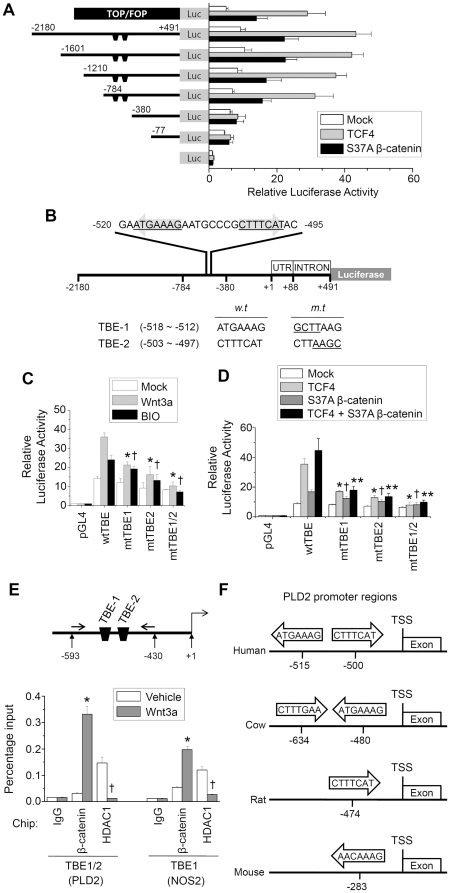
METHODOLOGY/PRINCIPAL FINDINGS: Here, we demonstrate that PLD isozymes, PLD1 and PLD2 are direct targets and positive feedback regulators of the Wnt/beta-catenin signaling. Wnt3a and Wnt mimetics significantly enhanced the expression of PLDs at a transcriptional level in HCT116 colorectal cancer cells, whereas silencing of beta-catenin gene expression or utilization of a dominant negative form of T cell factor-4 (TCF-4) inhibited expression of PLDs. Moreover, both PLD1 and PLD2 were highly induced in colon, liver and stomach tissues of mice after injection of LiCl, a Wnt mimetic. Wnt3a stimulated formation of the beta-catenin/TCF complexes to two functional TCF-4-binding elements within the PLD2 promoter as assessed by chromatin immunoprecipitation assay. Suppressing PLD using gene silencing or selective inhibitor blocked the ability of beta-catenin to transcriptionally activate PLD and other Wnt target genes by preventing formation of the beta-catenin/TCF-4 complex, whereas tactics to elevate intracellular levels of phosphatidic acid, the product of PLD activity, enhanced these effects. Here we show that PLD is necessary for Wnt3a-driven invasion and anchorage-independent growth of colon cancer cells.
CONCLUSION/SIGNIFICANCE: PLD isozyme acts as a novel transcriptional target and positive feedback regulator of Wnt signaling, and then promotes Wnt-driven anchorage-independent growth of colorectal cancer cells. We propose that therapeutic interventions targeting PLD may confer a clinical benefit in Wnt/beta-catenin-driven malignancies.
经典的 Wnt/β-连环蛋白信号通路在几乎所有结直肠癌中都异常激活,并促进其生长、侵袭和存活。磷脂酶 D(PLD)已被牵连到结直肠癌的进展中。然而,人们对这一重要途径的靶点和调控机制的理解仍然不完整。此外,Wnt 信号与 PLD 之间的关系尚不清楚。
方法/主要发现:在这里,我们证明 PLD 同工酶 PLD1 和 PLD2 是 Wnt/β-连环蛋白信号的直接靶点和正反馈调节剂。Wnt3a 和 Wnt 模拟物在 HCT116 结直肠癌细胞中显著增强了 PLD 的转录水平表达,而β-连环蛋白基因表达的沉默或 T 细胞因子-4(TCF-4)的显性负形式的利用抑制了 PLD 的表达。此外,在用 Wnt 模拟物 LiCl 注射后,PLD1 和 PLD2 在小鼠的结肠、肝脏和胃组织中均高度诱导。Wnt3a 通过染色质免疫沉淀测定评估,刺激β-连环蛋白/TCF 复合物形成到 PLD2 启动子内的两个功能性 TCF-4 结合元件。通过阻止β-连环蛋白/TCF-4 复合物的形成,使用基因沉默或选择性抑制剂抑制 PLD 可阻断β-连环蛋白转录激活 PLD 和其他 Wnt 靶基因的能力,而升高 PLD 活性产物磷脂酸的细胞内水平的策略则增强了这些作用。在这里,我们表明 PLD 是 Wnt3a 驱动的结肠癌细胞侵袭和无锚定生长所必需的。
结论/意义:PLD 同工酶作为 Wnt 信号的新型转录靶标和正反馈调节剂,促进 Wnt 驱动的结直肠癌细胞无锚定生长。我们提出,针对 PLD 的治疗干预可能会为 Wnt/β-连环蛋白驱动的恶性肿瘤带来临床益处。