Department of Biomedical Engineering, Biophysics Graduate Group, University of California Davis, Davis, California, United States of America.
PLoS One. 2010 Aug 11;5(8):e11930. doi: 10.1371/journal.pone.0011930.
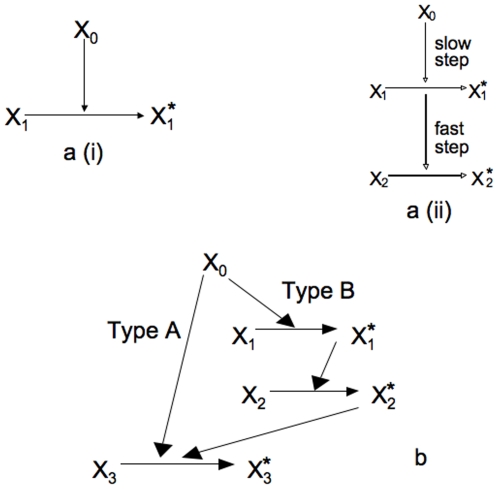
Signaling networks are designed to sense an environmental stimulus and adapt to it. We propose and study a minimal model of signaling network that can sense and respond to external stimuli of varying strength in an adaptive manner. The structure of this minimal network is derived based on some simple assumptions on its differential response to external stimuli.
We employ stochastic differential equations and probability distributions obtained from stochastic simulations to characterize differential signaling response in our minimal network model. Gillespie's stochastic simulation algorithm (SSA) is used in this study.
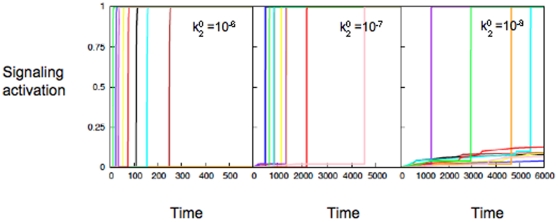
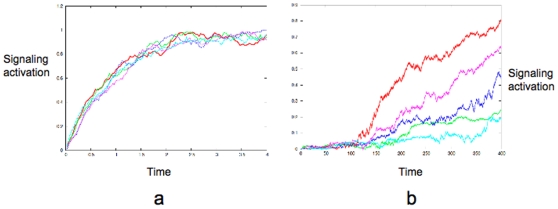
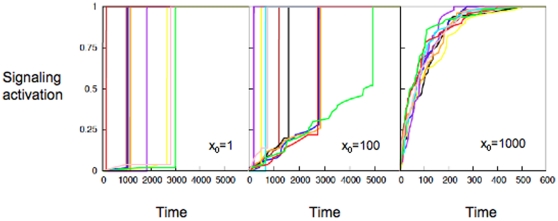
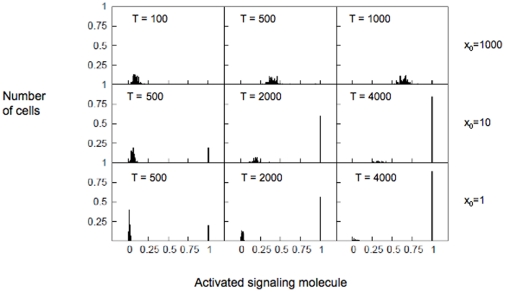
CONCLUSIONS/SIGNIFICANCE: We show that the proposed minimal signaling network displays two distinct types of response as the strength of the stimulus is decreased. The signaling network has a deterministic part that undergoes rapid activation by a strong stimulus in which case cell-to-cell fluctuations can be ignored. As the strength of the stimulus decreases, the stochastic part of the network begins dominating the signaling response where slow activation is observed with characteristic large cell-to-cell stochastic variability. Interestingly, this proposed stochastic signaling network can capture some of the essential signaling behaviors of a complex apoptotic cell death signaling network that has been studied through experiments and large-scale computer simulations. Thus we claim that the proposed signaling network is an appropriate minimal model of apoptosis signaling. Elucidating the fundamental design principles of complex cellular signaling pathways such as apoptosis signaling remains a challenging task. We demonstrate how our proposed minimal model can help elucidate the effect of a specific apoptotic inhibitor Bcl-2 on apoptotic signaling in a cell-type independent manner. We also discuss the implications of our study in elucidating the adaptive strategy of cell death signaling pathways.
信号网络旨在感知环境刺激并做出适应。我们提出并研究了一种信号网络的最小模型,该模型能够以自适应的方式感知和响应不同强度的外部刺激。这个最小网络的结构是基于对其对外界刺激的微分响应的一些简单假设而推导出来的。
我们使用随机微分方程和随机模拟得到的概率分布来描述我们的最小网络模型中的微分信号响应。本研究中使用了 Gillespie 的随机模拟算法(SSA)。
结论/意义:我们表明,所提出的最小信号网络在刺激强度降低时表现出两种不同类型的响应。信号网络具有确定性部分,当受到强刺激时会迅速激活,在这种情况下可以忽略细胞间的波动。随着刺激强度的降低,网络的随机部分开始主导信号响应,此时会观察到缓慢的激活,并且具有特征性的大细胞间随机可变性。有趣的是,这个提出的随机信号网络可以捕捉到已经通过实验和大规模计算机模拟研究过的复杂细胞凋亡信号网络的一些基本信号行为。因此,我们声称所提出的信号网络是细胞凋亡信号的适当最小模型。阐明复杂细胞信号通路(如细胞凋亡信号)的基本设计原则仍然是一项具有挑战性的任务。我们展示了我们提出的最小模型如何能够帮助阐明特定凋亡抑制剂 Bcl-2 对细胞类型独立的细胞凋亡信号的影响。我们还讨论了我们的研究在阐明细胞死亡信号通路的自适应策略方面的意义。