Ooi Hsu Kiang, Ma Lan
Department of Bioengineering, The University of Texas at Dallas, 800 W, Campbell Rd, Richardson, TX 75080, USA.
BMC Syst Biol. 2013 Jul 23;7:65. doi: 10.1186/1752-0509-7-65.
Apoptosis is a cell suicide mechanism that enables multicellular organisms to maintain homeostasis and to eliminate individual cells that threaten the organism's survival. Dependent on the type of stimulus, apoptosis can be propagated by extrinsic pathway or intrinsic pathway. The comprehensive understanding of the molecular mechanism of apoptotic signaling allows for development of mathematical models, aiming to elucidate dynamical and systems properties of apoptotic signaling networks. There have been extensive efforts in modeling deterministic apoptosis network accounting for average behavior of a population of cells. Cellular networks, however, are inherently stochastic and significant cell-to-cell variability in apoptosis response has been observed at single cell level.
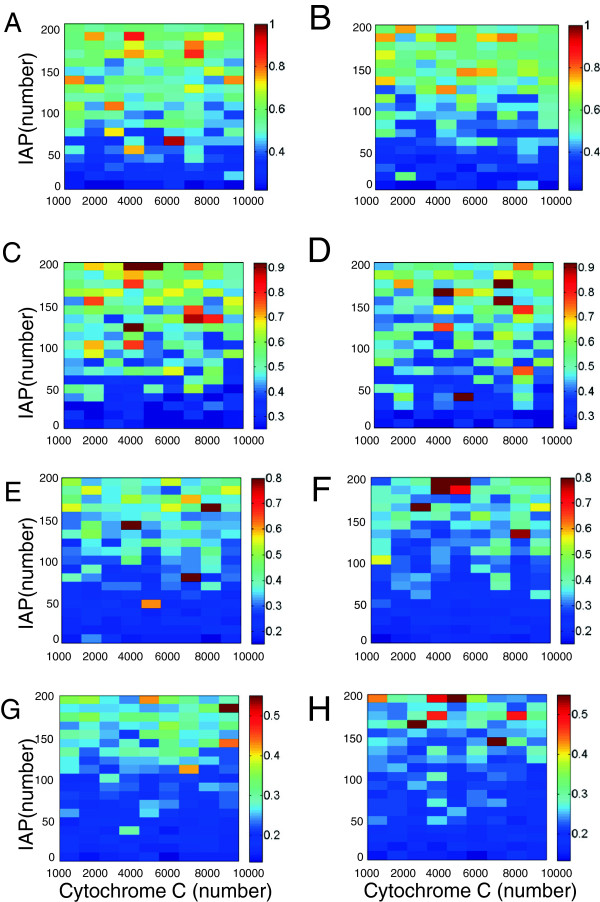
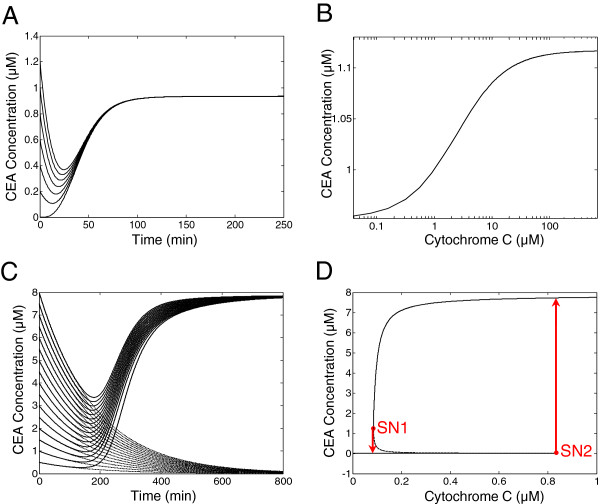
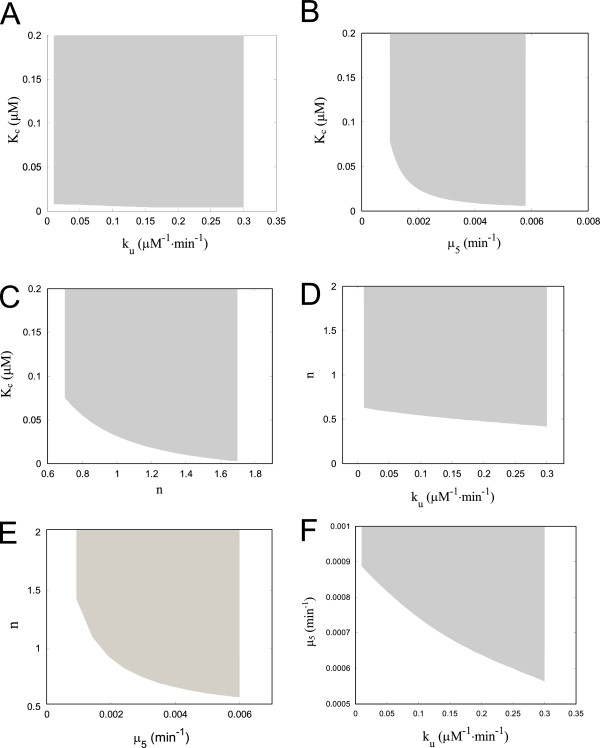
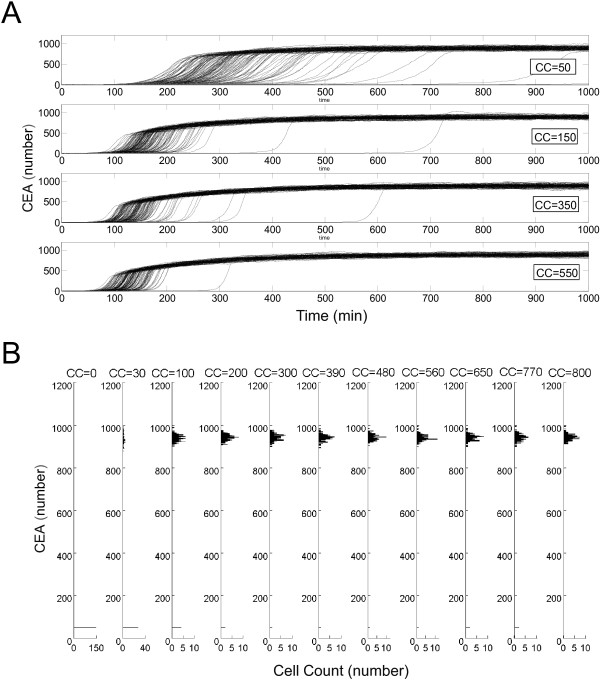
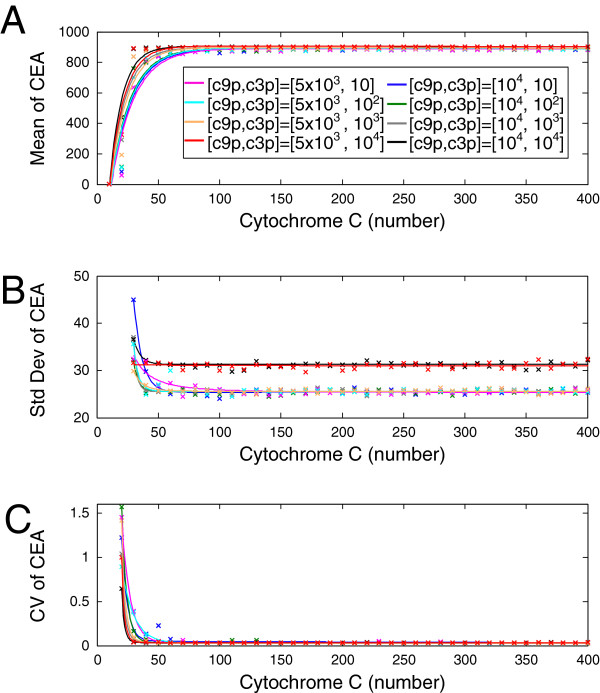
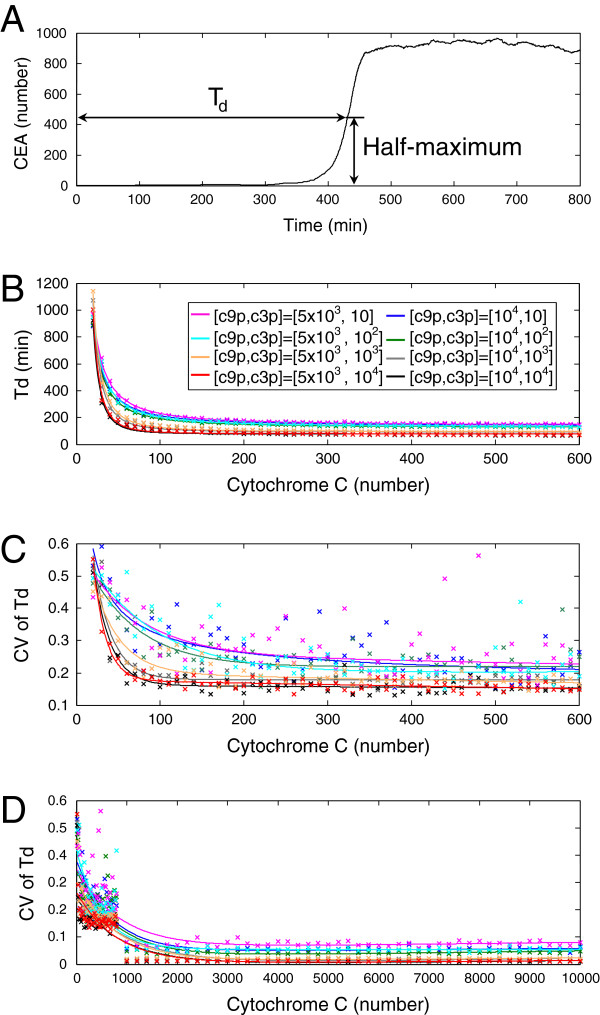
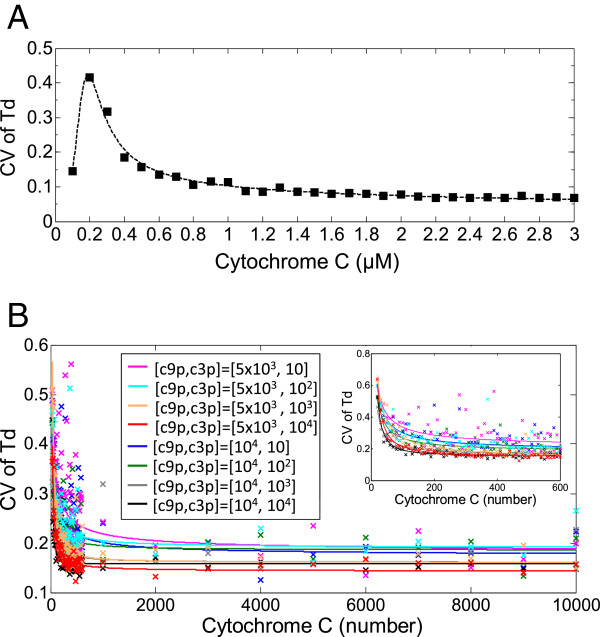
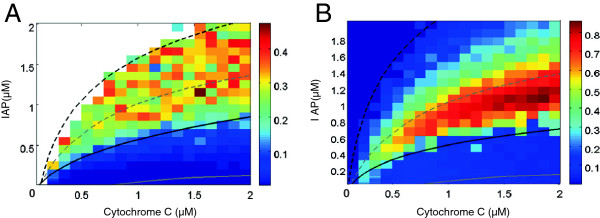
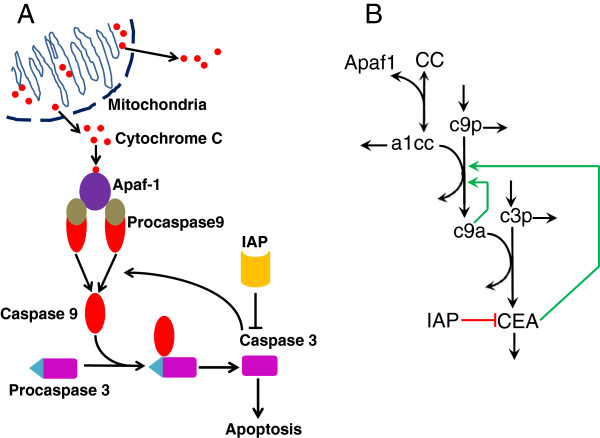
To address the inevitable randomness in the intrinsic apoptosis mechanism, we develop a theoretical and computational modeling framework of intrinsic apoptosis pathway at single-cell level, accounting for both deterministic and stochastic behavior. Our deterministic model, adapted from the well-accepted Fussenegger model, shows that an additional positive feedback between the executioner caspase and the initiator caspase plays a fundamental role in yielding the desired property of bistability. We then examine the impact of intrinsic fluctuations of biochemical reactions, viewed as intrinsic noise, and natural variation of protein concentrations, viewed as extrinsic noise, on behavior of the intrinsic apoptosis network. Histograms of the steady-state output at varying input levels show that the intrinsic noise could elicit a wider region of bistability over that of the deterministic model. However, the system stochasticity due to intrinsic fluctuations, such as the noise of steady-state response and the randomness of response delay, shows that the intrinsic noise in general is insufficient to produce significant cell-to-cell variations at physiologically relevant level of molecular numbers. Furthermore, the extrinsic noise represented by random variations of two key apoptotic proteins, namely Cytochrome C and inhibitor of apoptosis proteins (IAP), is modeled separately or in combination with intrinsic noise. The resultant stochasticity in the timing of intrinsic apoptosis response shows that the fluctuating protein variations can induce cell-to-cell stochastic variability at a quantitative level agreeing with experiments. Finally, simulations illustrate that the mean abundance of fluctuating IAP protein is positively correlated with the degree of cellular stochasticity of the intrinsic apoptosis pathway.
Our theoretical and computational study shows that the pronounced non-genetic heterogeneity in intrinsic apoptosis responses among individual cells plausibly arises from extrinsic rather than intrinsic origin of fluctuations. In addition, it predicts that the IAP protein could serve as a potential therapeutic target for suppression of the cell-to-cell variation in the intrinsic apoptosis responsiveness.
细胞凋亡是一种细胞自杀机制,使多细胞生物能够维持体内平衡,并清除威胁生物体生存的单个细胞。根据刺激类型的不同,细胞凋亡可通过外在途径或内在途径进行。对凋亡信号传导分子机制的全面理解有助于开发数学模型,旨在阐明凋亡信号网络的动力学和系统特性。在对考虑细胞群体平均行为的确定性凋亡网络进行建模方面已经做出了广泛努力。然而,细胞网络本质上是随机的,并且在单细胞水平上已经观察到细胞凋亡反应中存在显著的细胞间变异性。
为了解决内在凋亡机制中不可避免的随机性,我们开发了一个单细胞水平的内在凋亡途径的理论和计算建模框架,同时考虑了确定性和随机行为。我们的确定性模型改编自广泛接受的富斯纳格模型,表明执行 caspase 与起始 caspase 之间的额外正反馈在产生所需的双稳态特性中起基本作用。然后,我们研究了生化反应的内在波动(视为内在噪声)和蛋白质浓度的自然变化(视为外在噪声)对内在凋亡网络行为的影响。不同输入水平下稳态输出的直方图表明,内在噪声比确定性模型能引发更广泛的双稳态区域。然而,由于内在波动引起的系统随机性,如稳态响应的噪声和响应延迟的随机性,表明在生理相关的分子数量水平上,内在噪声通常不足以产生显著的细胞间差异。此外,由两种关键凋亡蛋白(即细胞色素 C 和凋亡蛋白抑制剂(IAP))的随机变化所代表的外在噪声,被分别建模或与内在噪声结合建模。内在凋亡反应时间的结果随机性表明,波动的蛋白质变化可以在与实验一致的定量水平上诱导细胞间的随机变异性。最后,模拟表明波动的 IAP 蛋白的平均丰度与内在凋亡途径的细胞随机程度呈正相关。
我们的理论和计算研究表明,单个细胞之间内在凋亡反应中明显的非遗传异质性可能源于外在而非内在的波动来源。此外,它预测 IAP 蛋白可能作为抑制内在凋亡反应性中细胞间变异的潜在治疗靶点。