Duval County Health Department and University of Florida College of Medicine, Jacksonville, FL 32211, USA.
Prev Chronic Dis. 2010 Sep;7(5):A108. Epub 2010 Aug 15.
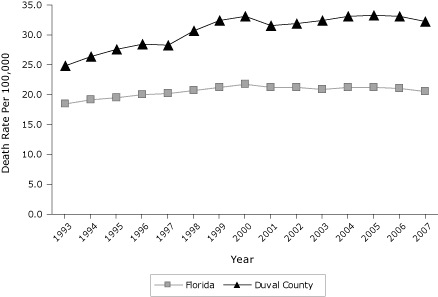
Diabetes rates continue to grow in the United States. Effectively addressing the epidemic requires better understanding of the distribution of disease and the geographic clustering of factors that influence it. Variations in the prevalence of diabetes at the local level are largely unreported, making understanding the disparities associated with the disease more difficult. Diabetes death rates during the past 15 years in Duval County, Florida, have been disproportionately high compared with the rest of the state.
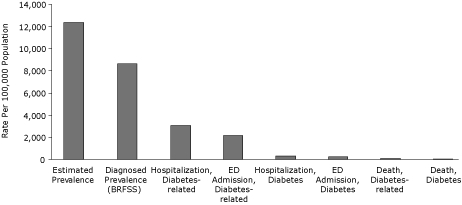
We analyzed multiple sources of secondary data related to diabetes illness and death in Duval County, including data on hospital discharge, emergency department (ED) use, and vital statistics. We accessed diabetes and diabetes-related ED use and hospitalization and death data by using codes from the International Classification of Diseases versions 9 and 10. We analyzed data from the Behavioral Risk Factor Surveillance System survey for Duval County and adapted Centers for Disease Control and Prevention weighting formulas for subcounty analysis. We used relative risk-type disease ratios and geographic information systems mapping to analyze data.
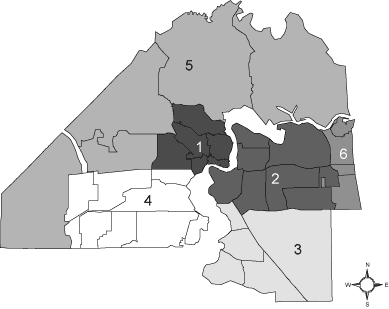
The urban, mostly minority, low-socioeconomic area of Duval County had twice the rate of diabetes-related illness and death as other areas of the county, and the inner-city, poor area of the county had almost 3 times the rate of hospitalization and ED use for diabetes and diabetes-related conditions compared with the other areas of the county.
Our analyses show that diabetes-related disparities affect not only people and their families but also the community that absorbs the costs associated with the disproportionate health care use that results from these disparities. Analyzing data at the subcounty level has implications for health care planning and public health policy development at the local level.
在美国,糖尿病发病率持续上升。要有效应对这一流行病,就需要更好地了解疾病的分布情况,以及影响糖尿病的地理因素的聚集情况。由于地方一级的糖尿病流行情况变化在很大程度上没有得到报告,因此更难以了解与该疾病相关的差异。与该州其他地区相比,过去 15 年来,佛罗里达州杜瓦尔县的糖尿病死亡率一直过高。
我们分析了杜瓦尔县与糖尿病疾病和死亡相关的多种二级数据源,包括医院出院、急诊(ED)使用和生命统计数据。我们通过使用国际疾病分类版本 9 和 10 的代码,访问了糖尿病和糖尿病相关的 ED 使用以及住院和死亡数据。我们分析了杜瓦尔县行为风险因素监测系统调查的数据,并为次县分析改编了疾病控制和预防中心的加权公式。我们使用相对风险型疾病比和地理信息系统制图来分析数据。
杜瓦尔县市区,主要是少数民族,社会经济水平较低的地区,其糖尿病相关疾病和死亡的发病率是该县其他地区的两倍,而该县内城贫困地区的糖尿病住院和 ED 使用率几乎是该县其他地区的三倍,与糖尿病和糖尿病相关疾病有关。
我们的分析表明,与糖尿病相关的差异不仅影响个人及其家庭,还影响吸收因这些差异导致的不成比例的医疗保健使用而产生的相关成本的社区。在次县一级分析数据对地方一级的医疗保健规划和公共卫生政策制定具有影响。