
健康吸烟者和不吸烟者的肿瘤坏死因子-α血清水平。
Tumor necrosis factor-alpha serum levels in healthy smokers and nonsmokers.
机构信息
Department of Internal Medicine, University of Medicine and Pharmacy of Craiova, Craiova, Romania.
出版信息
Int J Chron Obstruct Pulmon Dis. 2010 Aug 9;5:217-22. doi: 10.2147/copd.s8330.
BACKGROUND
Tobacco smoking is the most important risk factor for chronic obstructive pulmonary disease (COPD) development. Inhaled cigarette smoke can induce tumor necrosis factor-alpha (TNF-alpha) production by alveolar macrophages, which in turn may enhance the production of metalloproteinases (MMPs). MMPs have been involved in mediating airway inflammation and lung destruction.
OBJECTIVES
We aimed to measure the TNF-alpha serum levels in healthy heavy smokers and healthy nonsmokers to determine the dose-response relationship based on the cigarette smoke exposure.
SUBJECTS AND METHODS
We included in our study 43 healthy heavy smokers and 19 healthy nonsmokers (the control group). The smokers group was classified as less than one pack, one pack, and more than one pack per day. A clinical and paraclinical evaluation was performed in both groups, without any evidence of infection or COPD. The serum levels of TNF-alpha were assessed by ELISA.
RESULTS
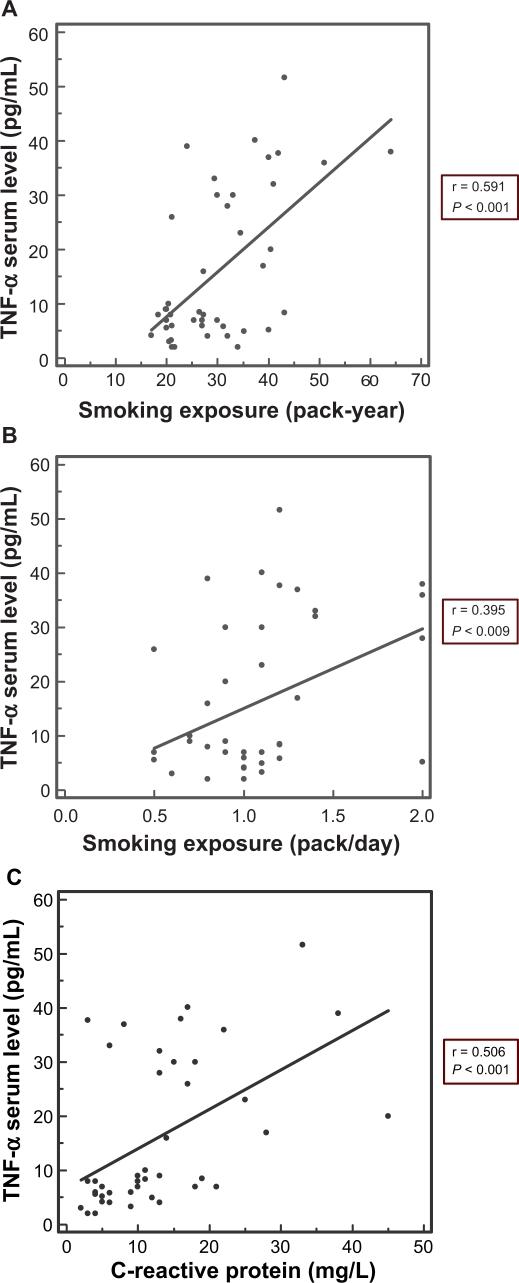
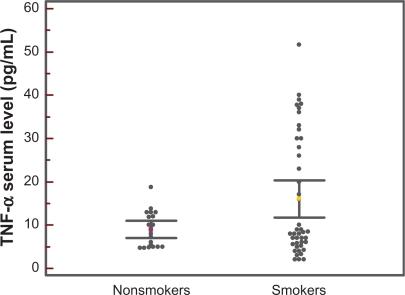
The TNF-alpha serum levels were significantly higher for the group of smokers compared to the group of nonsmokers (P < 0.004). We also noticed an increased TNF-alpha concentration in the serum of smokers with more than one pack per day compared with those with less than one pack per day (P < 0.03). There was a positive correlation between the serum level of TNF-alpha and tobacco smoke exposure.
CONCLUSIONS
The high levels of TNF-alpha in the serum of smokers suggest an imbalance between the proinflammatory and anti-inflammatory factors as a result of tobacco smoke exposure. The concentration of TNF-alpha is elevated in the serum of healthy heavy smokers in a cigarette dose-dependent manner. We speculate that the serum level of TNF-alpha might be a useful biomarker for the selection of heavy smokers with a high risk of developing smoke induced pulmonary diseases.
背景
吸烟是慢性阻塞性肺疾病(COPD)发展的最重要危险因素。吸入的香烟烟雾可以诱导肺泡巨噬细胞产生肿瘤坏死因子-α(TNF-α),而 TNF-α反过来可能增强金属蛋白酶(MMPs)的产生。MMPs 已参与介导气道炎症和肺破坏。
目的
我们旨在测量健康重度吸烟者和健康不吸烟者的 TNF-α血清水平,以根据吸烟暴露量确定剂量反应关系。
受试者和方法
我们纳入了 43 名健康重度吸烟者和 19 名健康不吸烟者(对照组)。吸烟者组分为每天少于一包、一包和多于一包。对两组均进行了临床和临床前评估,均无感染或 COPD 的证据。通过 ELISA 评估 TNF-α 的血清水平。
结果
与不吸烟者相比,吸烟者的 TNF-α血清水平显著升高(P <0.004)。我们还注意到,每天吸烟超过一包的吸烟者的 TNF-α 浓度比每天吸烟少于一包的吸烟者升高(P <0.03)。TNF-α 血清水平与吸烟暴露量呈正相关。
结论
吸烟者血清中 TNF-α水平升高表明,由于吸烟暴露,促炎和抗炎因子之间的平衡被打破。健康重度吸烟者的血清中 TNF-α浓度呈香烟剂量依赖性升高。我们推测,TNF-α 血清水平可能是选择具有发生烟雾诱导性肺部疾病高风险的重度吸烟者的有用生物标志物。


 Zotero 插件