Laboratory of Bio-engineering and Osteo-articular Biomaterial, University Denis Diderot, 10 Avenue de Verdun, Paris, France.
J Cell Mol Med. 2011 Jul;15(7):1505-14. doi: 10.1111/j.1582-4934.2010.01138.x.
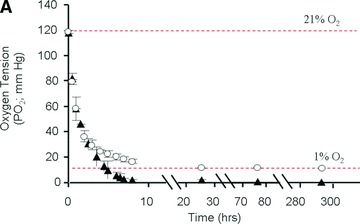
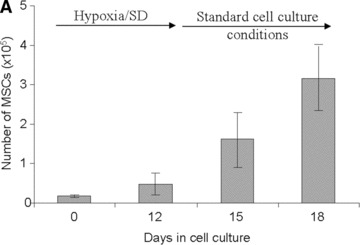
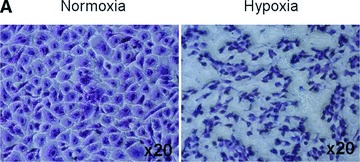
Use of mesenchymal stem cells (MSCs) has emerged as a potential new treatment for various diseases but has generated marginally successful results. A consistent finding of most studies is massive death of transplanted cells. The present study examined the respective roles of glucose and continuous severe hypoxia on MSC viability and function with respect to bone tissue engineering. We hereby demonstrate for the first time that MSCs survive exposure to long-term (12 days), severe (pO(2) < 1.5 mmHg) hypoxia, provided glucose is available. To this end, an in vitro model that mimics the hypoxic environment and cell-driven metabolic changes encountered by grafted sheep cells was established. In this model, the hallmarks of hypoxia (low pO(2) , hypoxia inducible factor-1α expression and anaerobic metabolism) were present. When conditions switched from hypoxic (low pO(2) ) to ischemic (low pO(2) and glucose depletion), MSCs exhibited shrinking, decreased cell viability and ATP content due to complete exhaustion of glucose at day 6; these results provided evidence that ischemia led to the observed massive cell death. Moreover, MSCs exposed to severe, continuous hypoxia, but without any glucose shortage, remained viable and maintained both their in vitro proliferative ability after simulation with blood reperfusion at day 12 and their in vivo osteogenic ability. These findings challenge the traditional view according to which severe hypoxia per se is responsible for the massive MSC death observed upon transplantation of these cells and provide evidence that MSCs are able to withstand exposure to severe, continuous hypoxia provided that a glucose supply is available.
间充质干细胞 (MSCs) 的应用作为一种治疗各种疾病的新方法已经出现,但效果并不理想。大多数研究的一个一致发现是移植细胞大量死亡。本研究考察了葡萄糖和持续严重缺氧对间充质干细胞活力和功能的各自作用,以用于骨组织工程。我们首次证明了 MSCs 在长期(12 天)严重缺氧(pO2 < 1.5 mmHg)条件下可以存活,只要有葡萄糖存在。为此,建立了一个体外模型,模拟了移植绵羊细胞遇到的缺氧环境和细胞驱动的代谢变化。在该模型中,存在缺氧的特征(低 pO2、缺氧诱导因子-1α表达和无氧代谢)。当条件从缺氧(低 pO2)切换到缺血(低 pO2 和葡萄糖耗竭)时,MSCs 在第 6 天由于葡萄糖完全耗尽而表现出收缩、细胞活力和 ATP 含量降低;这些结果提供了证据表明缺血导致了观察到的大量细胞死亡。此外,暴露于严重、持续缺氧但没有任何葡萄糖短缺的 MSCs仍然存活,并在第 12 天模拟血液再灌注后保持其体外增殖能力和体内成骨能力。这些发现挑战了传统观点,即严重缺氧本身是导致这些细胞移植后大量 MSC 死亡的原因,并提供了证据表明,只要有葡萄糖供应,MSCs 就能够耐受严重、持续的缺氧。