Department of Human Genetics, Leiden University Medical Center, 2333 ZA Leiden, Netherlands.
Science. 2010 Sep 24;329(5999):1650-3. doi: 10.1126/science.1189044. Epub 2010 Aug 19.
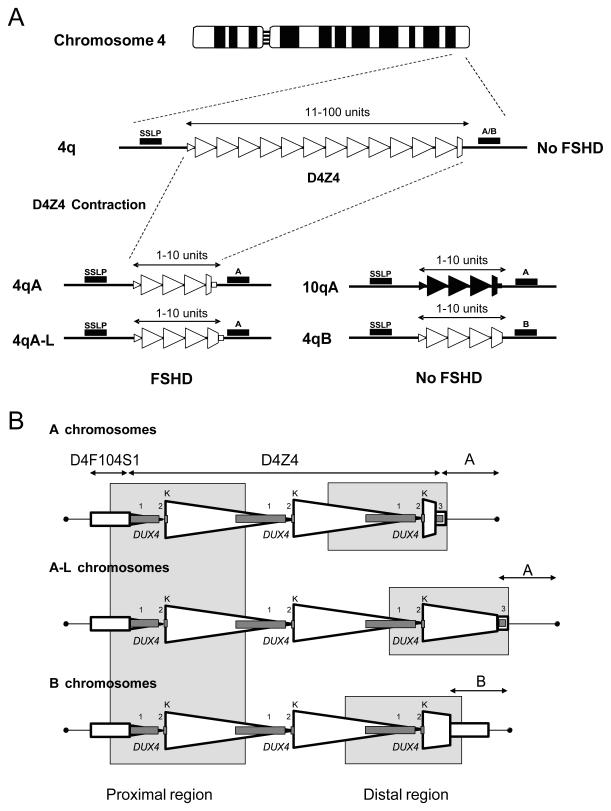
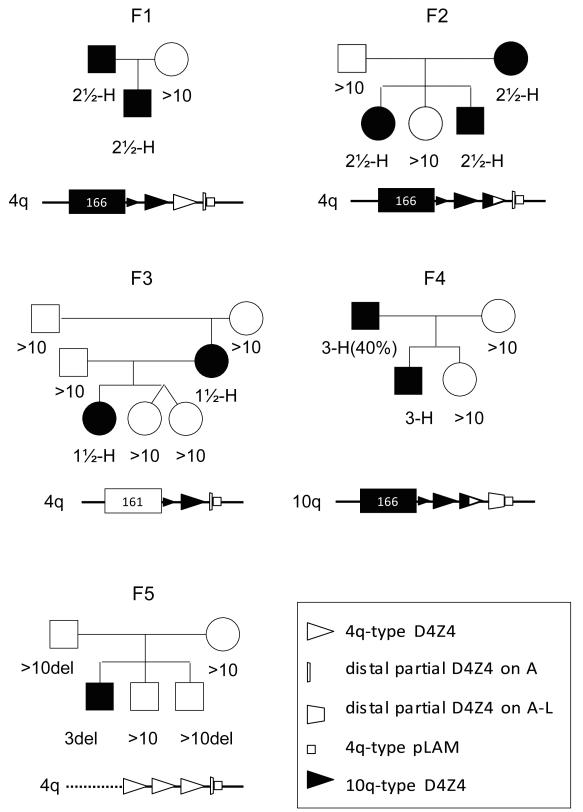
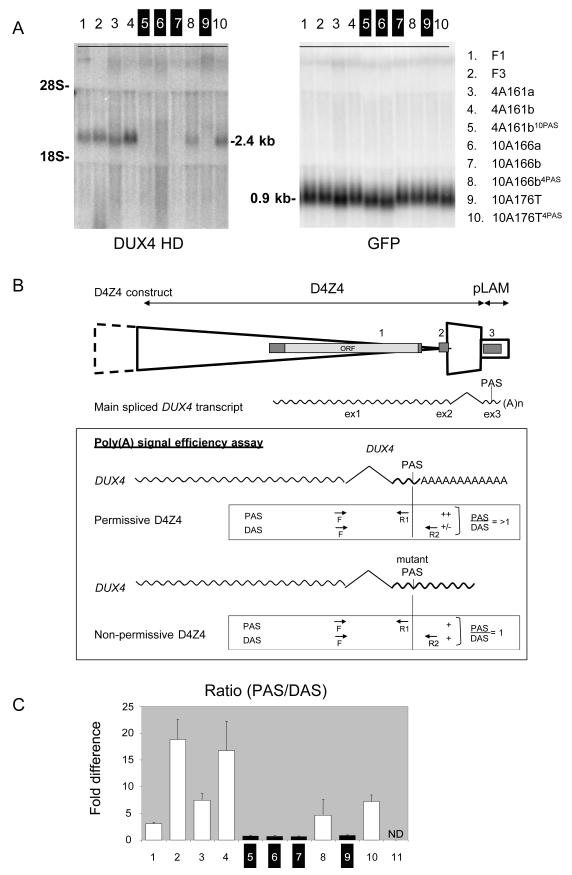
Facioscapulohumeral muscular dystrophy (FSHD) is a common form of muscular dystrophy in adults that is foremost characterized by progressive wasting of muscles in the upper body. FSHD is associated with contraction of D4Z4 macrosatellite repeats on chromosome 4q35, but this contraction is pathogenic only in certain "permissive" chromosomal backgrounds. Here, we show that FSHD patients carry specific single-nucleotide polymorphisms in the chromosomal region distal to the last D4Z4 repeat. This FSHD-predisposing configuration creates a canonical polyadenylation signal for transcripts derived from DUX4, a double homeobox gene of unknown function that straddles the last repeat unit and the adjacent sequence. Transfection studies revealed that DUX4 transcripts are efficiently polyadenylated and are more stable when expressed from permissive chromosomes. These findings suggest that FSHD arises through a toxic gain of function attributable to the stabilized distal DUX4 transcript.
面肩肱型肌营养不良症(FSHD)是一种常见的成人肌肉营养不良症,其主要特征是上半身肌肉进行性萎缩。FSHD 与 4 号染色体 q35 上 D4Z4 大片段重复收缩有关,但这种收缩仅在某些“允许”的染色体背景下具有致病性。在这里,我们发现 FSHD 患者在最后一个 D4Z4 重复的远端染色体区域携带特定的单核苷酸多态性。这种 FSHD 易感性结构为来自 DUX4 的转录本创建了一个典型的多聚腺苷酸化信号,DUX4 是一个双同源盒基因,其功能未知,跨越最后一个重复单元和相邻序列。转染研究表明,当从允许的染色体表达时,DUX4 转录本能够有效地进行多聚腺苷酸化,并且更稳定。这些发现表明,FSHD 是由于稳定的远端 DUX4 转录本引起的毒性获得性功能所致。