Department of Biological Sciences, Columbia University, New York, New York 10027, USA.
Nature. 2010 Aug 19;466(7309):1001-5. doi: 10.1038/nature09302.
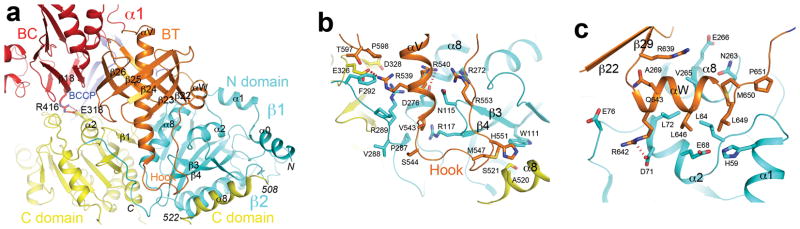
Propionyl-coenzyme A carboxylase (PCC), a mitochondrial biotin-dependent enzyme, is essential for the catabolism of the amino acids Thr, Val, Ile and Met, cholesterol and fatty acids with an odd number of carbon atoms. Deficiencies in PCC activity in humans are linked to the disease propionic acidaemia, an autosomal recessive disorder that can be fatal in infants. The holoenzyme of PCC is an alpha(6)beta(6) dodecamer, with a molecular mass of 750 kDa. The alpha-subunit contains the biotin carboxylase (BC) and biotin carboxyl carrier protein (BCCP) domains, whereas the beta-subunit supplies the carboxyltransferase (CT) activity. Here we report the crystal structure at 3.2-A resolution of a bacterial PCC alpha(6)beta(6) holoenzyme as well as cryo-electron microscopy (cryo-EM) reconstruction at 15-A resolution demonstrating a similar structure for human PCC. The structure defines the overall architecture of PCC and reveals unexpectedly that the alpha-subunits are arranged as monomers in the holoenzyme, decorating a central beta(6) hexamer. A hitherto unrecognized domain in the alpha-subunit, formed by residues between the BC and BCCP domains, is crucial for interactions with the beta-subunit. We have named it the BT domain. The structure reveals for the first time the relative positions of the BC and CT active sites in the holoenzyme. They are separated by approximately 55 A, indicating that the entire BCCP domain must translocate during catalysis. The BCCP domain is located in the active site of the beta-subunit in the current structure, providing insight for its involvement in the CT reaction. The structural information establishes a molecular basis for understanding the large collection of disease-causing mutations in PCC and is relevant for the holoenzymes of other biotin-dependent carboxylases, including 3-methylcrotonyl-CoA carboxylase (MCC) and eukaryotic acetyl-CoA carboxylase (ACC).
丙酰辅酶 A 羧化酶(PCC)是一种线粒体依赖生物素的酶,对于分解氨基酸 Thr、Val、Ile 和 Met、胆固醇和奇数碳原子的脂肪酸至关重要。人类 PCC 活性缺乏与丙酸血症有关,这是一种常染色体隐性遗传病,在婴儿中可能是致命的。PCC 的全酶是一种 alpha(6)beta(6)十二聚体,分子量为 750 kDa。alpha 亚基包含生物素羧化酶(BC)和生物素羧基载体蛋白(BCCP)结构域,而 beta 亚基提供羧基转移酶(CT)活性。本文报道了 3.2-A 分辨率的细菌 PCC alpha(6)beta(6)全酶的晶体结构以及 15-A 分辨率的 cryo-EM 重建,证明了人类 PCC 的类似结构。该结构定义了 PCC 的整体结构,并出人意料地表明 alpha 亚基在全酶中作为单体排列,装饰着中央的 beta(6)六聚体。alpha 亚基中存在一个以前未被识别的结构域,由 BC 和 BCCP 结构域之间的残基组成,对于与 beta 亚基的相互作用至关重要。我们将其命名为 BT 结构域。该结构首次揭示了全酶中 BC 和 CT 活性位点的相对位置。它们之间相隔约 55 A,表明在催化过程中整个 BCCP 结构域必须移位。在当前的结构中,BCCP 结构域位于 beta 亚基的活性位点,为其参与 CT 反应提供了线索。该结构信息为理解 PCC 中大量致病突变提供了分子基础,对于其他依赖生物素的羧化酶的全酶,包括 3-甲基巴豆酰辅酶 A 羧化酶(MCC)和真核乙酰辅酶 A 羧化酶(ACC)也具有重要意义。