Department of Behavioral Neuroscience, L470, 3181 Sam Jackson RD, Oregon Health and Sciences University, Portland, OR 97239, USA.
Neurobiol Learn Mem. 2010 Oct;94(3):353-63. doi: 10.1016/j.nlm.2010.08.001. Epub 2010 Aug 19.
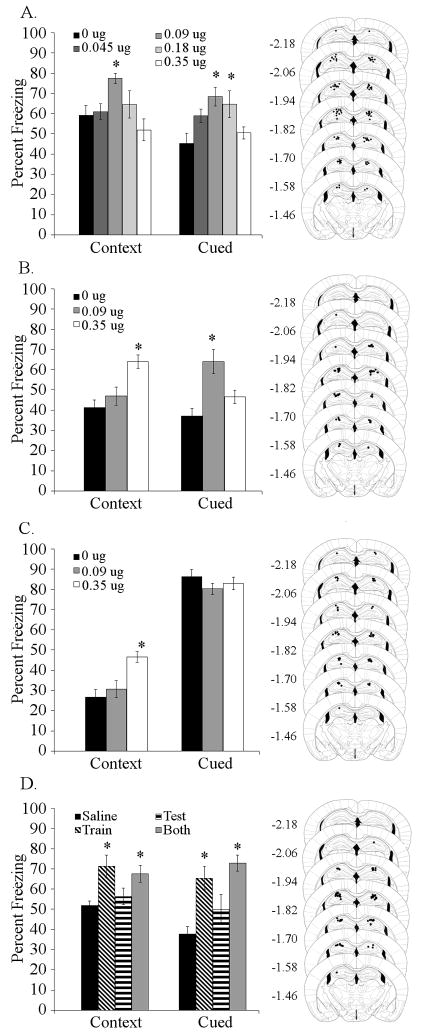
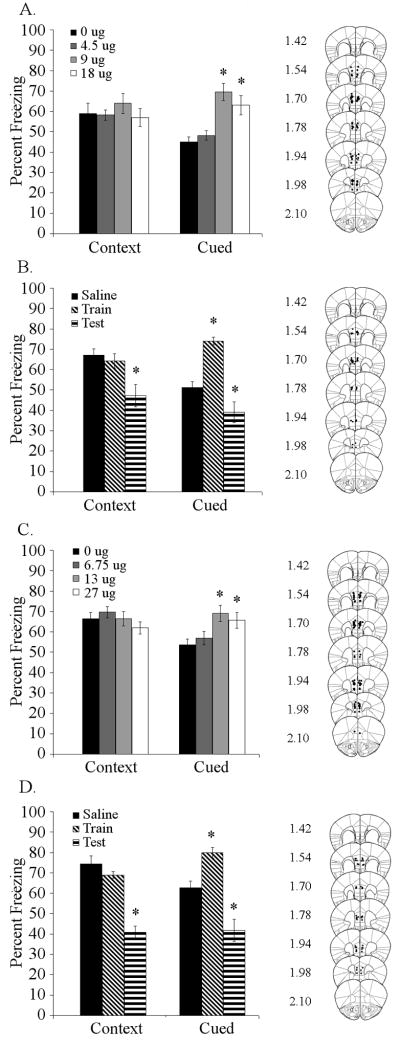
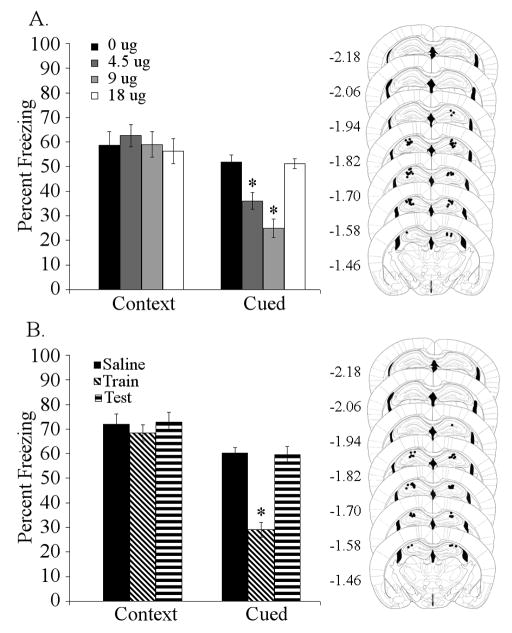
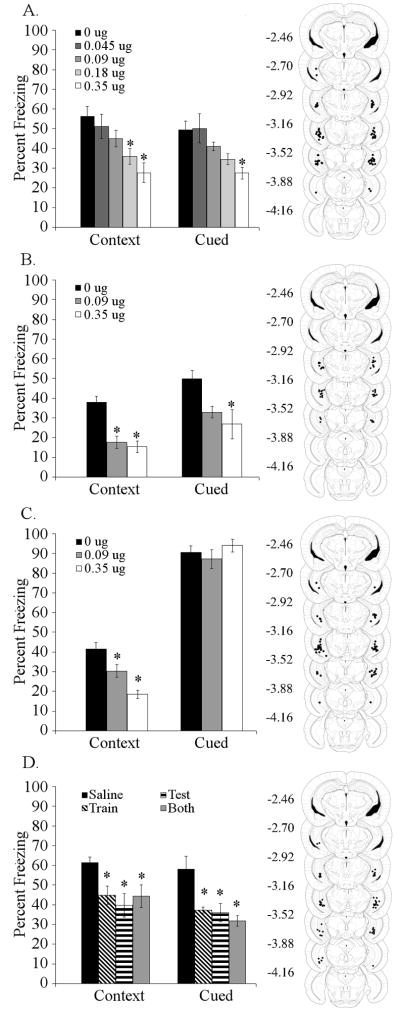
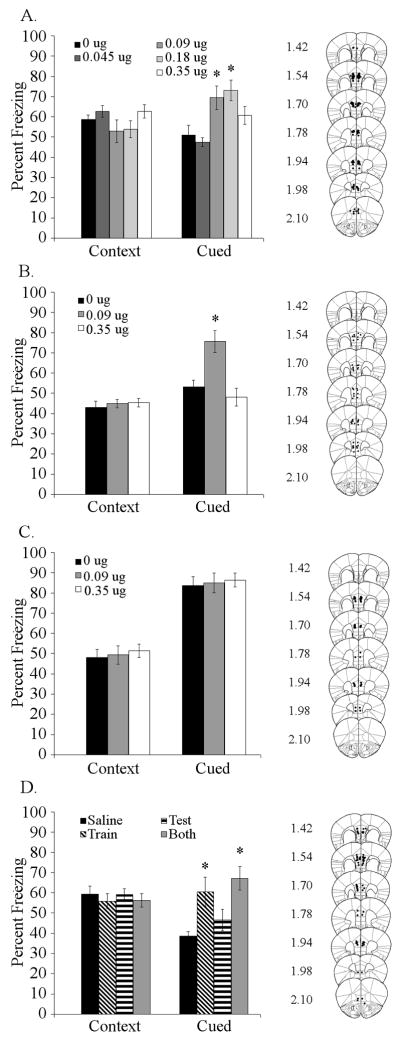
Acute nicotine enhances multiple types of learning including trace fear conditioning but the underlying neural substrates of these effects are not well understood. Trace fear conditioning critically involves the medial prefrontal cortex and hippocampus, which both express nicotinic acetylcholine receptors (nAChRs). Therefore, nicotine could act in either or both areas to enhance trace fear conditioning. To identify the underlying neural areas and nAChR subtypes, we examined the effects of infusion of nicotine, or nicotinic antagonists dihydro-beta-erythroidine (DHβE: high-affinity nAChRs) or methyllycaconitine (MLA: low-affinity nAChRs) into the dorsal hippocampus, ventral hippocampus, and medial prefrontal cortex (mPFC) on trace and contextual fear conditioning. We found that the effects of nicotine on trace and contextual fear conditioning vary by brain region and nAChR subtype. The dorsal hippocampus was involved in the effects of nicotine on both trace and contextual fear conditioning but each task was sensitive to different doses of nicotine. Additionally, dorsal hippocampal infusion of the antagonist DHβE produced deficits in trace but not contextual fear conditioning. Nicotine infusion into the ventral hippocampus produced deficits in both trace and contextual fear conditioning. In the mPFC, nicotine enhanced trace but not contextual fear conditioning. Interestingly, infusion of the antagonists MLA or DHβE in the mPFC also enhanced trace fear conditioning. These findings suggest that nicotine acts on different substrates to enhance trace versus contextual fear conditioning, and that nicotine-induced desensitization of nAChRs in the mPFC may contribute to the effects of nicotine on trace fear conditioning.
急性尼古丁增强多种类型的学习,包括痕迹恐惧条件反射,但这些影响的潜在神经基质尚不清楚。痕迹恐惧条件反射关键涉及内侧前额叶皮层和海马体,两者都表达烟碱型乙酰胆碱受体 (nAChR)。因此,尼古丁可以在一个或两个区域起作用,以增强痕迹恐惧条件反射。为了确定潜在的神经区域和 nAChR 亚型,我们检查了将尼古丁、烟碱拮抗剂二氢-β-erythroidine (DHβE:高亲和力 nAChR) 或甲基lycaconitine (MLA:低亲和力 nAChR) 输注到背侧海马体、腹侧海马体和内侧前额叶皮层 (mPFC) 对痕迹和情境恐惧条件反射的影响。我们发现,尼古丁对痕迹和情境恐惧条件反射的影响因脑区和 nAChR 亚型而异。背侧海马体参与了尼古丁对痕迹和情境恐惧条件反射的影响,但每种任务都对不同剂量的尼古丁敏感。此外,背侧海马体输注拮抗剂 DHβE 导致痕迹恐惧条件反射但不导致情境恐惧条件反射缺陷。尼古丁输注到腹侧海马体导致痕迹和情境恐惧条件反射都出现缺陷。在 mPFC 中,尼古丁增强了痕迹恐惧条件反射,但不增强情境恐惧条件反射。有趣的是,mPFC 中拮抗剂 MLA 或 DHβE 的输注也增强了痕迹恐惧条件反射。这些发现表明,尼古丁作用于不同的底物来增强痕迹恐惧条件反射与情境恐惧条件反射,并且 mPFC 中 nAChR 的尼古丁诱导脱敏可能有助于尼古丁对痕迹恐惧条件反射的影响。