Department of Pharmacology, Institute of Biomedical Sciences, University of São Paulo, São Paulo, Brazil.
Respir Res. 2010 Aug 24;11(1):115. doi: 10.1186/1465-9921-11-115.
Fluctuations of estradiol and progesterone levels caused by the menstrual cycle worsen asthma symptoms. Conflicting data are reported in literature regarding pro and anti-inflammatory properties of estradiol and progesterone.
Female Wistar rats were ovalbumin (OVA) sensitized 1 day after resection of the ovaries (OVx). Control group consisted of sensitized-rats with intact ovaries (Sham-OVx). Allergic challenge was performed by aerosol (OVA 1%, 15 min) two weeks later. Twenty four hours after challenge, BAL, bone marrow and total blood cells were counted. Lung tissues were used as explants, for expontaneous cytokine secretion in vitro or for immunostaining of E-selectin.
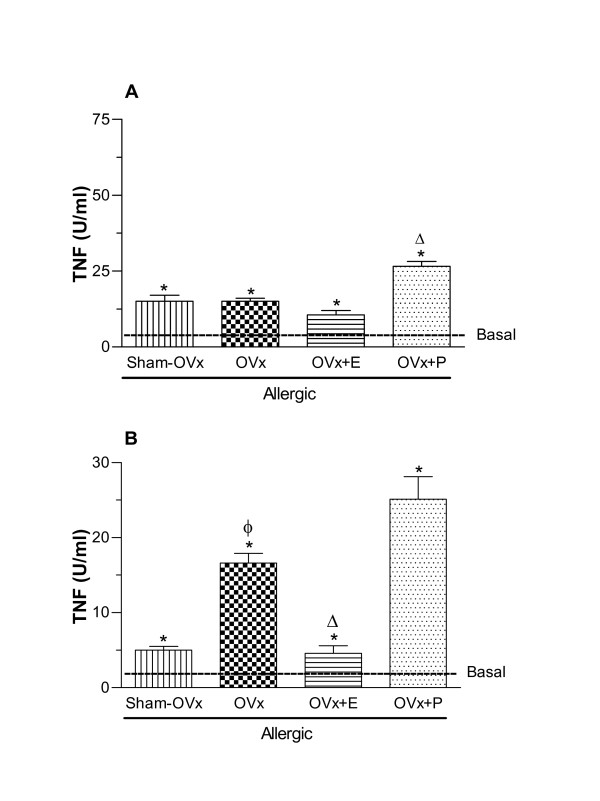
We observed an exacerbated cell recruitment into the lungs of OVx rats, reduced blood leukocytes counting and increased the number of bone marrow cells. Estradiol-treated OVx allergic rats reduced, and those treated with progesterone increased, respectively, the number of cells in the BAL and bone marrow. Lungs of OVx allergic rats significantly increased the E-selectin expression, an effect prevented by estradiol but not by progesterone treatment. Systemically, estradiol treatment increased the number of peripheral blood leukocytes in OVx allergic rats when compared to non treated-OVx allergic rats. Cultured-BAL cells of OVx allergic rats released elevated amounts of LTB4 and nitrites while bone marrow cells increased the release of TNF-alpha and nitrites. Estradiol treatment of OVx allergic rats was associated with a decreased release of TNF-alpha, IL-10, LTB4 and nitrites by bone marrow cells incubates. In contrast, estradiol caused an increase in IL-10 and NO release by cultured-BAL cells. Progesterone significantly increased TNF- alpha by cultured BAL cells and bone marrow cells.
Data presented here suggest that upon hormonal oscillations the immune sensitization might trigger an allergic lung inflammation whose phenotype is under control of estradiol. Our data could contribute to the understanding of the protective role of estradiol in some cases of asthma symptoms in fertile ans post-menopausal women clinically observed.
月经周期引起的雌二醇和孕酮水平波动会加重哮喘症状。文献中关于雌二醇和孕酮的促炎和抗炎特性的报告存在矛盾。
雌性 Wistar 大鼠在卵巢切除后 1 天进行卵清蛋白 (OVA) 致敏(OVx)。对照组由卵巢完整的致敏大鼠组成(Sham-OVx)。两周后,通过气溶胶(OVA1%,15 分钟)进行变应原挑战。挑战后 24 小时,进行 BAL、骨髓和全血细胞计数。肺组织用作离体细胞因子自发分泌的外植体,或用于 E-选择素免疫染色。
我们观察到 OVx 大鼠肺部细胞募集加剧,血液白细胞计数减少,骨髓细胞增多。雌二醇处理的 OVx 变应性大鼠分别减少和孕酮处理的大鼠增加 BAL 和骨髓中的细胞数。OVx 变应性大鼠的肺部 E-选择素表达显著增加,该作用被雌二醇但不是孕酮治疗所阻止。系统地,与未处理的 OVx 变应性大鼠相比,雌二醇处理的 OVx 变应性大鼠外周血白细胞数增加。OVx 变应性大鼠培养的 BAL 细胞释放的 LTB4 和亚硝酸盐增加,而骨髓细胞增加 TNF-α 和亚硝酸盐的释放。雌二醇处理的 OVx 变应性大鼠骨髓细胞孵育时 TNF-α、IL-10、LTB4 和亚硝酸盐的释放减少。相比之下,雌二醇导致培养的 BAL 细胞释放更多的 IL-10 和 NO。孕酮显著增加培养的 BAL 细胞和骨髓细胞的 TNF-α。
本研究结果表明,在激素波动的情况下,免疫致敏可能会引发过敏性肺炎症,其表型受雌二醇的控制。我们的数据可能有助于理解在临床上观察到的生育期和绝经后妇女哮喘症状的某些情况下雌二醇的保护作用。