Department of Pharmaceutical & Biomedical Sciences, Medical University of South Carolina, 280 Calhoun Street, Charleston, SC 29425, USA.
BMC Complement Altern Med. 2010 Aug 24;10:46. doi: 10.1186/1472-6882-10-46.
Reactive oxygen species (ROS) and reactive nitrogen species (RNS) are produced during hemorrhagic shock and resuscitation (H/R), which may contribute to multiple organ failure. The Aim of this study was to test the hypothesis that green tea (Camellia sinenesis) extract containing 85% polyphenols decreases injury after H/R in rats by scavenging ROS and RNS.
Female Sprague Dawley rats were given 100 mg polyphenol extract/kg body weight or vehicle 2 h prior to hemorrhagic shock. H/R was induced by two protocols: 1) withdrawal of blood to a mean arterial pressure of 40 mm Hg followed by further withdrawals to decrease blood pressure progressively to 28 mm Hg over 1 h (severe), and 2) withdrawal of blood to a sustained hypotension of 40 mm Hg for 1 h (moderate). Rats were then resuscitated over 1 h with 60% of the shed blood volume plus twice the shed blood volume of lactated Ringer's solution. Serum samples were collected at 10 min and 2 h after resuscitation. At 2 or 18 h, livers were harvested for cytokine and 3-nitrotyrosine quantification, immunohistochemical detection of 4-hydroxynonenol (4-HNE) and inducible nitric oxide synthase (iNOS) protein expression.
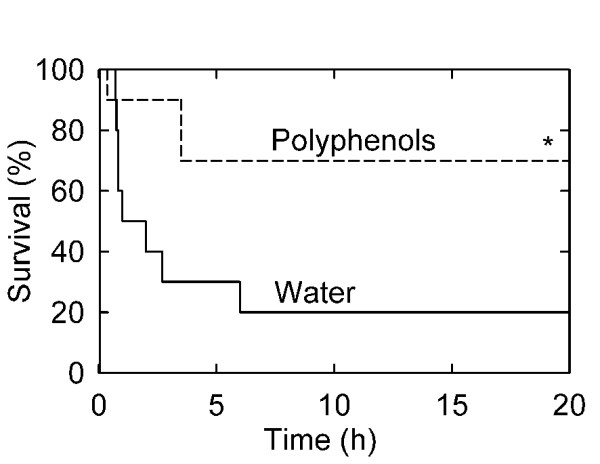
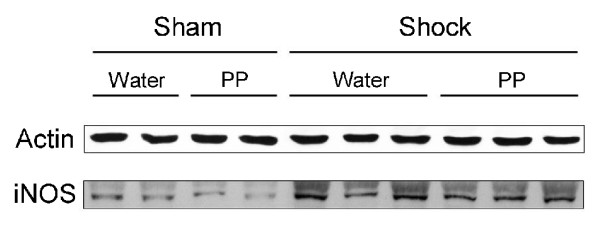
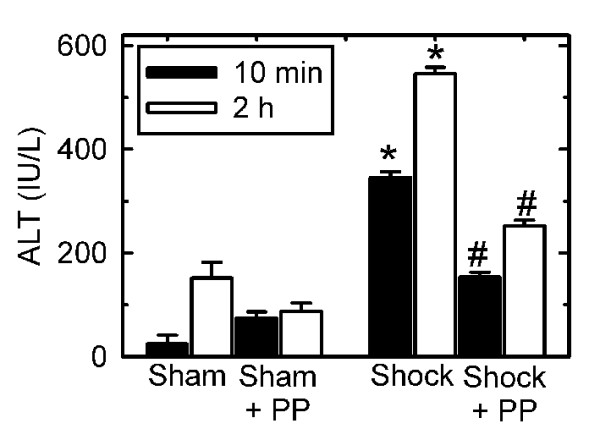
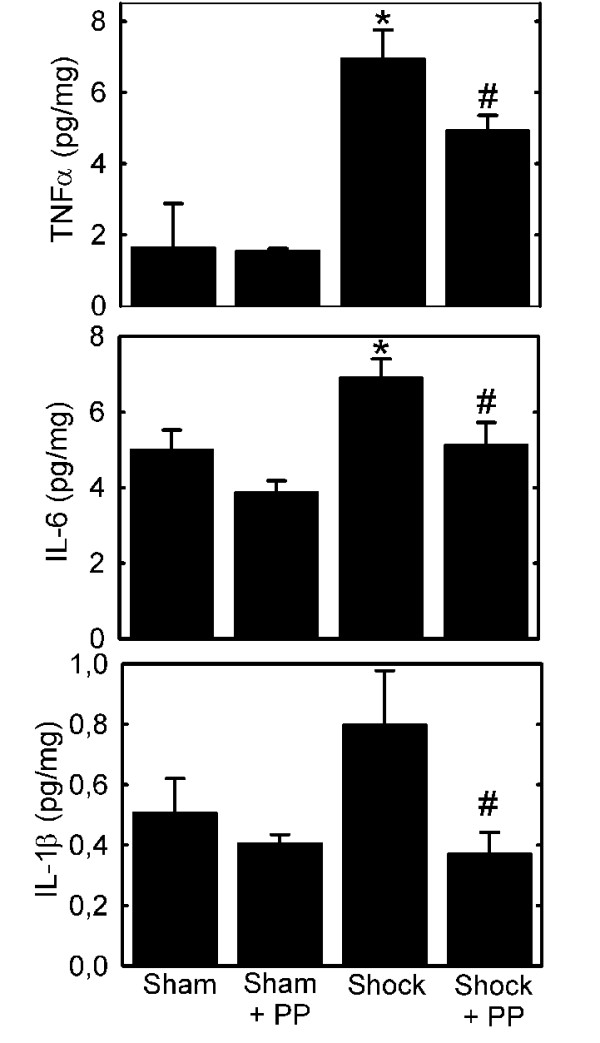
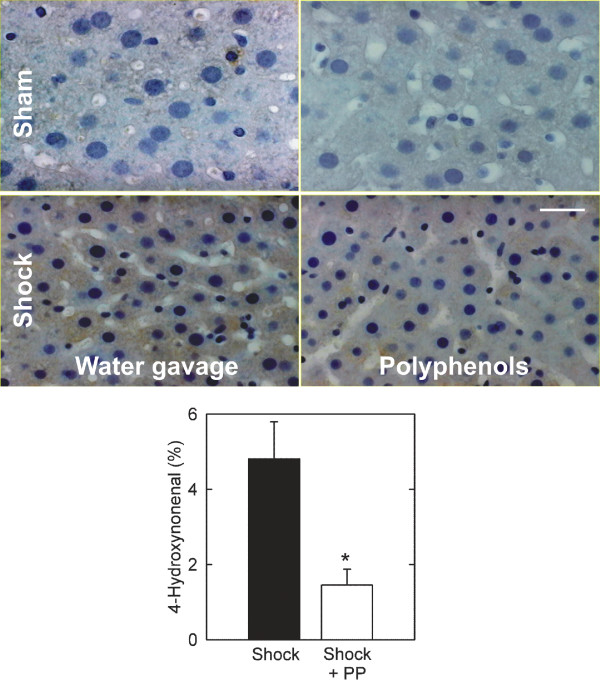
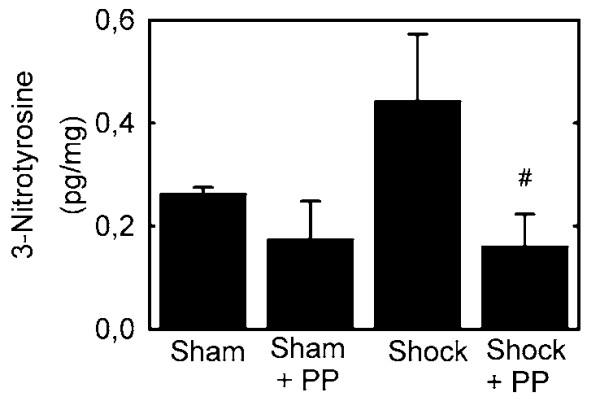
After severe H/R, 18-h survival increased from 20% after vehicle to 70% after polyphenols (p < 0.05). After moderate H/R, survival was greater (80%) and not different between vehicle and polyphenols. In moderate H/R, serum alanine aminotransferase (ALT) increased at 10 min and 2 h postresuscitation to 345 and 545 IU/L, respectively. Polyphenol treatment blunted this increase to 153 and 252 IU/L at 10 min and 2 h (p < 0.01). Polyphenols also blunted increases in liver homogenates of TNFalpha (7.0 pg/mg with vehicle vs. 4.9 pg/mg with polyphenols, p < 0.05), IL-1beta (0.80 vs. 0.37 pg/mg, p < 0.05), IL-6 (6.9 vs. 5.1 pg/mg, p < 0.05) and nitrotyrosine (1.9 pg/mg vs. 0.6 pg/mg, p < 0.05) measured 18 h after H/R. Hepatic 4-HNE immunostaining indicative of lipid peroxidation also decreased from 4.8% after vehicle to 1.5% after polyphenols (p < 0.05). By contrast, polyphenols did not block increased iNOS expression at 2 h after H/R.
Polyphenols decrease ROS/RNS formation and are beneficial after hemorrhagic shock and resuscitation.
在出血性休克和复苏(H/R)期间会产生活性氧(ROS)和活性氮(RNS),这可能导致多器官衰竭。本研究旨在验证以下假设:含有 85%多酚的绿茶(Camellia sinenesis)提取物通过清除 ROS 和 RNS 来减少大鼠 H/R 后的损伤。
雌性 Sprague Dawley 大鼠在出血性休克前 2 小时给予 100mg 多酚提取物/体重。通过两种方案诱导 H/R:1)将平均动脉压降至 40mmHg 后进一步采血,逐渐降至 28mmHg ,持续 1 小时(严重);2)将血压维持在 40mmHg 持续 1 小时(中度)。然后,大鼠在 1 小时内用 60%失血量加两倍失血量的乳酸林格氏液复苏。在复苏后 10 分钟和 2 小时采集血清样本。在 2 或 18 小时时,采集肝脏样本以检测细胞因子和 3-硝基酪氨酸含量,免疫组化检测 4-羟壬烯醇(4-HNE)和诱导型一氧化氮合酶(iNOS)蛋白表达。
在严重的 H/R 后,18 小时生存率从载体组的 20%增加到多酚组的 70%(p < 0.05)。在中度 H/R 后,生存率更高(80%),载体组和多酚组之间无差异。在中度 H/R 中,血清丙氨酸氨基转移酶(ALT)在复苏后 10 分钟和 2 小时分别升高至 345 和 545IU/L。多酚处理使 10 分钟和 2 小时的 ALT 分别降至 153 和 252IU/L(p < 0.01)。多酚还可减轻肝匀浆中 TNFalpha(载体组为 7.0pg/mg,多酚组为 4.9pg/mg,p < 0.05)、IL-1beta(0.80 vs. 0.37pg/mg,p < 0.05)、IL-6(6.9 vs. 5.1pg/mg,p < 0.05)和硝基酪氨酸(1.9pg/mg vs. 0.6pg/mg,p < 0.05)的增加,这些变化在 H/R 后 18 小时测量。肝 4-HNE 免疫染色表明脂质过氧化也从载体组的 4.8%降至多酚组的 1.5%(p < 0.05)。相比之下,多酚组在 H/R 后 2 小时并未阻止 iNOS 表达的增加。
多酚可减少 ROS/RNS 的形成,并在出血性休克和复苏后有益。