Cho Y-M, Pu H-F, Huang W J, Ho L-T, Wang S-W, Wang P S
Department of Physiology, School of Medicine, National Yang-Ming University, Taipei, Taiwan.
Int J Androl. 2011 Aug;34(4):379-89. doi: 10.1111/j.1365-2605.2010.01091.x. Epub 2010 Aug 2.
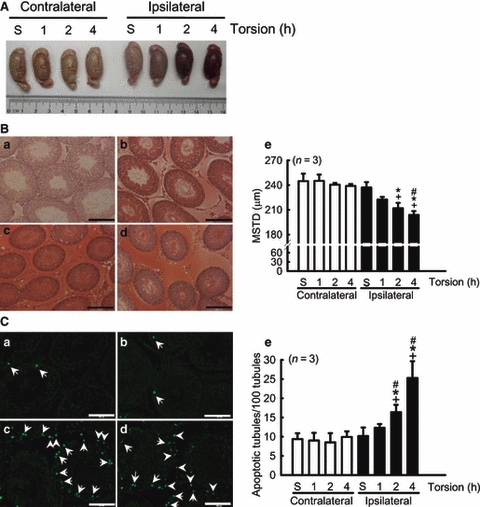
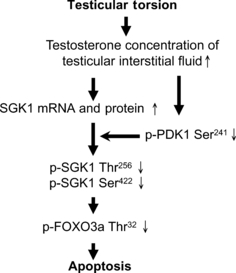
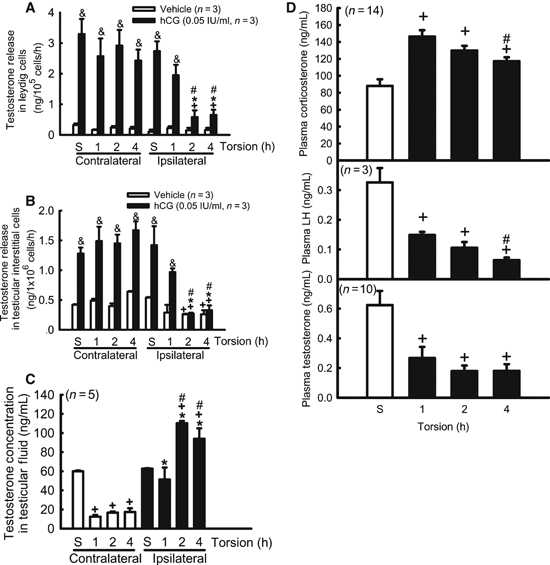
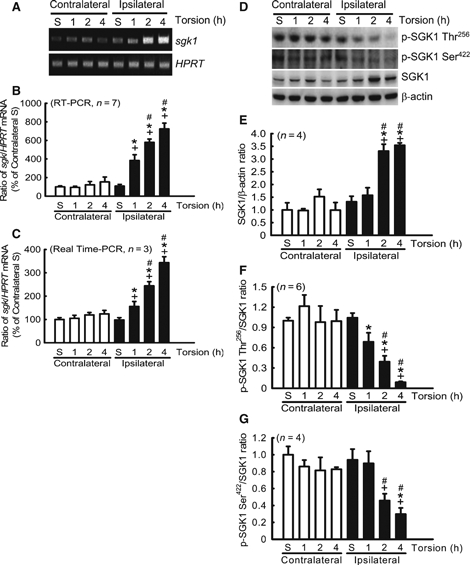
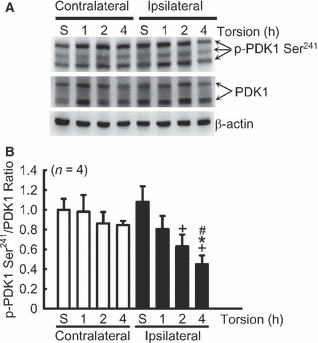
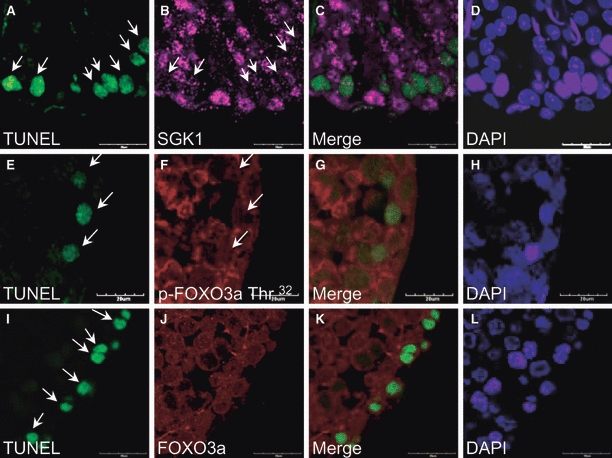
Serum- and glucocorticoid-inducible kinase-1 (SGK1) is a serine/threonine protein kinase that responds to various stimuli and mediates cell survival. Although it is known that testicular torsion leads to testicular damage and male infertility, the role of SGK1 in torsion remains unclear. This study investigated whether torsion-induced apoptosis is associated with changes in phosphoinositide-dependent protein kinase-1 (PDK1), SGK1 and forkhead transcription factor FOXO3a expression and/or phosphorylation in rats. Sprague-Dawley rats were divided into four groups: sham (control), 1, 2 and 4 h of unilateral torsion. Bilateral testes, testicular interstitial fluid (TIF) and blood samples were collected immediately after torsion. Our results revealed that SGK1 protein and mRNA were abundantly present in testes and were induced by 2 h of torsion, but that phosphorylation of SGK1, PDK1 and FOXO3a decreased simultaneously. After 2 h of torsion, the testosterone secretion capacity of the primary Leydig cells and testicular interstitial cells (TICs) was impaired and apoptotic spermatogonia and TICs were observed; in addition, the mean seminiferous tubular diameter was decreased. Torsion increased plasma corticosterone levels, but decreased plasma luteinizing hormone and testosterone levels. However, the testosterone levels of the TIF in the ipsilateral testes were significantly enhanced after 2 h of torsion, but suppressed in the contralateral testes. This animal study suggests that PDK1, SGK1 and FOXO3a are involved in torsion-induced apoptosis and that medical therapy should be performed as early as 2 h after the occurrence of torsion to prevent further damage.
血清和糖皮质激素诱导激酶-1(SGK1)是一种丝氨酸/苏氨酸蛋白激酶,可对多种刺激作出反应并介导细胞存活。尽管已知睾丸扭转会导致睾丸损伤和男性不育,但SGK1在扭转中的作用仍不清楚。本研究调查了扭转诱导的细胞凋亡是否与大鼠中磷酸肌醇依赖性蛋白激酶-1(PDK1)、SGK1和叉头转录因子FOXO3a表达和/或磷酸化的变化有关。将Sprague-Dawley大鼠分为四组:假手术(对照)组、单侧扭转1小时、2小时和4小时组。扭转后立即采集双侧睾丸、睾丸间质液(TIF)和血样。我们的结果显示,SGK1蛋白和mRNA大量存在于睾丸中,并在扭转2小时后被诱导,但SGK1、PDK1和FOXO3a的磷酸化同时降低。扭转2小时后,原代睾丸间质细胞和睾丸间质细胞(TICs)的睾酮分泌能力受损,观察到凋亡的精原细胞和TICs;此外,生精小管平均直径减小。扭转使血浆皮质酮水平升高,但使血浆黄体生成素和睾酮水平降低。然而,扭转2小时后,同侧睾丸TIF中的睾酮水平显著升高,但对侧睾丸中的睾酮水平受到抑制。这项动物研究表明,PDK1、SGK1和FOXO3a参与了扭转诱导的细胞凋亡,并且应在扭转发生后2小时内尽早进行药物治疗以防止进一步损伤。