Naydenov E, Bussarsky V, Nachev S, Hadjidekova S, Toncheva D
Department of Neurosurgery, University Hospital St. Ivan Rilski, Sofia, Bulgaria.
Case Rep Oncol. 2009 Jul 17;2(2):103-110. doi: 10.1159/000228545.
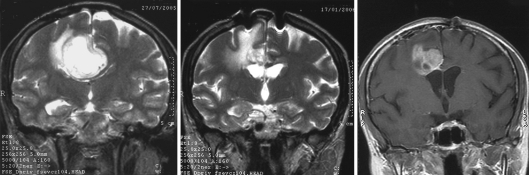
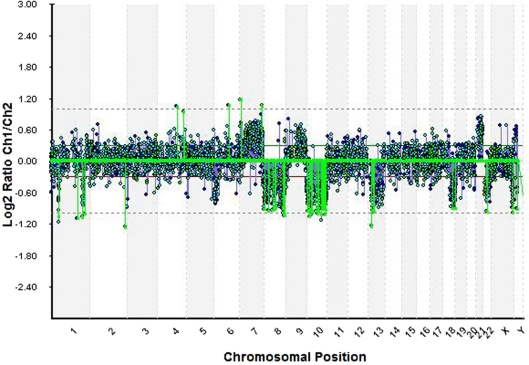
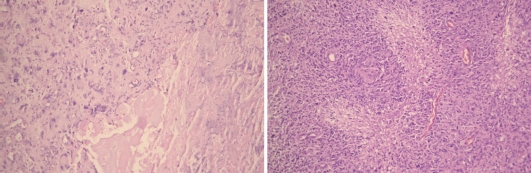
Glioblastoma multiforme (GBM) is the most common glial tumor of the central nervous system. Overall survival is less than a year in most of the cases in spite of multimodal treatment approaches. A 45-year-old female with histologically confirmed giant cell GBM was treated at our institution. Subtotal excision of the lesion situated in the right precentral area was performed during the initial stay in August 2005. The patient improved after the procedure with no hypertension and additional neurological deficit. Radiotherapy plus concomitant and adjuvant temozolomide was performed. The patient was symptom-free for 35 months after initial surgery. From July 2008 the patient developed partial motor seizures in the left side of the body and progressive hemiparesis. Local tumor progression was demonstrated on the neuroimaging studies. In December 2008, a second operative intervention was performed with subtotal excision of the tumor. Forty-five months after the initial diagnosis the patient is still alive with moderate neurological deficit. Microarray analysis of the tumor found the following numeric chromosomal aberrations: monosomy 8, 10, 13, 22, and trisomy 21, as well as amplifications in 4q34.1, 4q28.2, 6q16.3, 7q36.1, 7p21.3, and deletions in 1q42.12, 1q32.2, 1q25.2, 1p33, 2q37.2, 18q22.3, 19p13.2, Xq28, and Xq27.3. GBMs seem to be a heterogeneous group of glial tumors with different clinical course and therapeutic response. Microarray analysis is a useful method to establish a number of possible molecular predictors.
多形性胶质母细胞瘤(GBM)是中枢神经系统最常见的胶质肿瘤。尽管采用了多模式治疗方法,但大多数病例的总生存期仍不足一年。我院收治了一名45岁经组织学确诊为巨细胞型GBM的女性患者。2005年8月患者首次住院期间,对位于右侧中央前区的病灶进行了次全切除。术后患者病情改善,未出现高血压及其他神经功能缺损。进行了放疗加同步和辅助替莫唑胺治疗。初次手术后患者无症状达35个月。从2008年7月起,患者身体左侧出现部分运动性癫痫发作,并逐渐出现偏瘫。神经影像学检查显示局部肿瘤进展。2008年12月,进行了第二次手术干预,次全切除肿瘤。初始诊断45个月后,患者仍存活,但有中度神经功能缺损。对肿瘤进行的微阵列分析发现了以下染色体数目异常:8号、10号、13号、22号染色体单体,以及21号染色体三体,同时还发现了4q34.1、4q28.2、6q16.3、7q36.1、7p21.3区域的扩增,以及1q42.12、1q32.2、1q25.2、1p33、2q37.2、18q22.3、19p13.2、Xq28和Xq27.3区域的缺失。GBM似乎是一组具有不同临床病程和治疗反应的异质性胶质肿瘤。微阵列分析是确定多种可能分子预测指标的有用方法。