Department of Functional Morphology, Institute of Physiology, Academy of Sciences of the Czech Republic, Prague, Czech Republic.
J Neuroinflammation. 2010 Aug 26;7:49. doi: 10.1186/1742-2094-7-49.
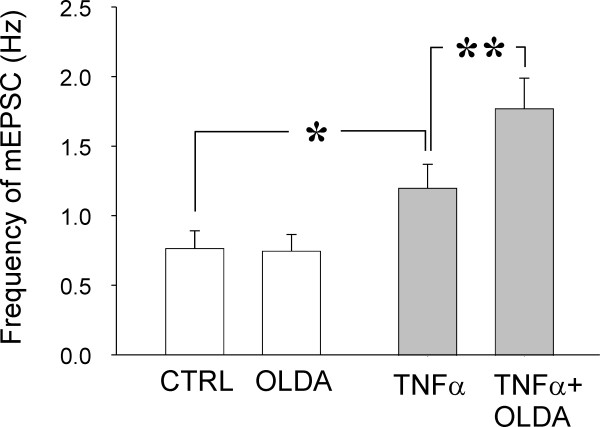
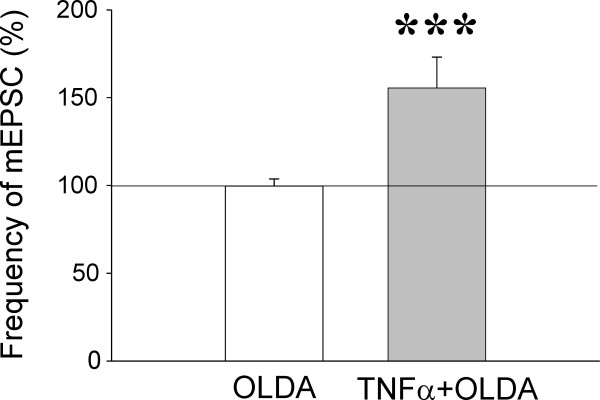
Modulation of synaptic transmission in the spinal cord dorsal horn is thought to be involved in the development and maintenance of different pathological pain states. The proinflamatory cytokine, tumor necrosis factor alpha (TNFalpha), is an established pain modulator in both the peripheral and the central nervous system. Up-regulation of TNFalpha and its receptors (TNFR) in dorsal root ganglion (DRG) cells and in the spinal cord has been shown to play an important role in neuropathic and inflammatory pain conditions. Transient receptor potential vanilloid 1 (TRPV1) receptors are known as molecular integrators of nociceptive stimuli in the periphery, but their role on the spinal endings of nociceptive DRG neurons is unclear. The endogenous TRPV1 receptor agonist N-oleoyldopamine (OLDA) was shown previously to activate spinal TRPV1 receptors. In our experiments the possible influence of TNFalpha on presynaptic spinal cord TRPV1 receptor function was investigated. Using the patch-clamp technique, miniature excitatory postsynaptic currents (mEPSCs) were recorded in superficial dorsal horn neurons in acute slices after incubation with 60 nM TNFalpha. A population of dorsal horn neurons with capsaicin sensitive primary afferent input recorded after the TNFalpha pretreatment had a basal mEPSC frequency of 1.35 +/- 0.20 Hz (n = 13), which was significantly higher when compared to a similar population of neurons in control slices (0.76 +/- 0.08 Hz; n = 53; P < 0.01). In control slices application of a low concentration of OLDA (0.2 uM) did not evoke any change in mEPSC frequency. After incubation with TNFalpha, OLDA (0.2 uM) application to slices induced a significant increase in mEPSC frequency (155.5 +/- 17.5%; P < 0.001; n = 10). Our results indicate that TNFalpha may have a significant impact on nociceptive signaling at the spinal cord level that could be mediated by increased responsiveness of presynaptic TRPV1 receptors to endogenous agonists. This could be of major importance, especially during pathological conditions, when increased levels of TNFalpha and TNFR are present in the spinal cord.
脊髓背角的突触传递调制被认为参与了不同病理疼痛状态的发展和维持。促炎细胞因子肿瘤坏死因子-α(TNFα)是外周和中枢神经系统中已确立的疼痛调节剂。已经表明,背根神经节(DRG)细胞和脊髓中 TNFα及其受体(TNFR)的上调在神经性和炎性疼痛情况下起着重要作用。瞬时受体电位香草酸 1(TRPV1)受体被认为是外周伤害性刺激的分子整合器,但其在伤害性 DRG 神经元的脊髓末端的作用尚不清楚。内源性 TRPV1 受体激动剂 N-油酰多巴胺(OLDA)先前已被证明可激活脊髓 TRPV1 受体。在我们的实验中,研究了 TNFα对脊髓 TRPV1 受体功能的可能影响。使用膜片钳技术,在 TNFα孵育后,在急性切片中记录浅层背角神经元中的微小兴奋性突触后电流(mEPSC)。一组具有辣椒素敏感的初级传入输入的背角神经元在 TNFα预处理后具有基础 mEPSC 频率 1.35 +/- 0.20 Hz(n = 13),与对照切片中类似神经元的频率相比显著升高(0.76 +/- 0.08 Hz;n = 53;P < 0.01)。在对照切片中,应用低浓度 OLDA(0.2 μM)不会引起 mEPSC 频率的任何变化。在用 TNFα孵育后,将 OLDA(0.2 μM)应用于切片会导致 mEPSC 频率显着增加(155.5 +/- 17.5%;P < 0.001;n = 10)。我们的结果表明,TNFα可能对脊髓水平的伤害性信号产生重大影响,这种影响可能是通过增加内源性激动剂对突触前 TRPV1 受体的反应性介导的。这可能非常重要,特别是在病理条件下,脊髓中存在 TNFα 和 TNFR 水平升高时。