Department of Functional Morphology, Institute of Physiology, Academy of Sciences of the Czech Republic, Prague, Czech Republic.
J Neuroinflammation. 2011 Dec 21;8:177. doi: 10.1186/1742-2094-8-177.
The cytokine tumor necrosis factor α (TNFα) is an established pain modulator in both the peripheral and central nervous systems. Modulation of nociceptive synaptic transmission in the spinal cord dorsal horn (DH) is thought to be involved in the development and maintenance of several pathological pain states. Increased levels of TNFα and its receptors (TNFR) in dorsal root ganglion (DRG) cells and in the spinal cord DH have been shown to play an essential role in neuropathic pain processing. In the present experiments the effect of TNFα incubation on modulation of primary afferent synaptic activity was investigated in a model of peripheral neuropathy.
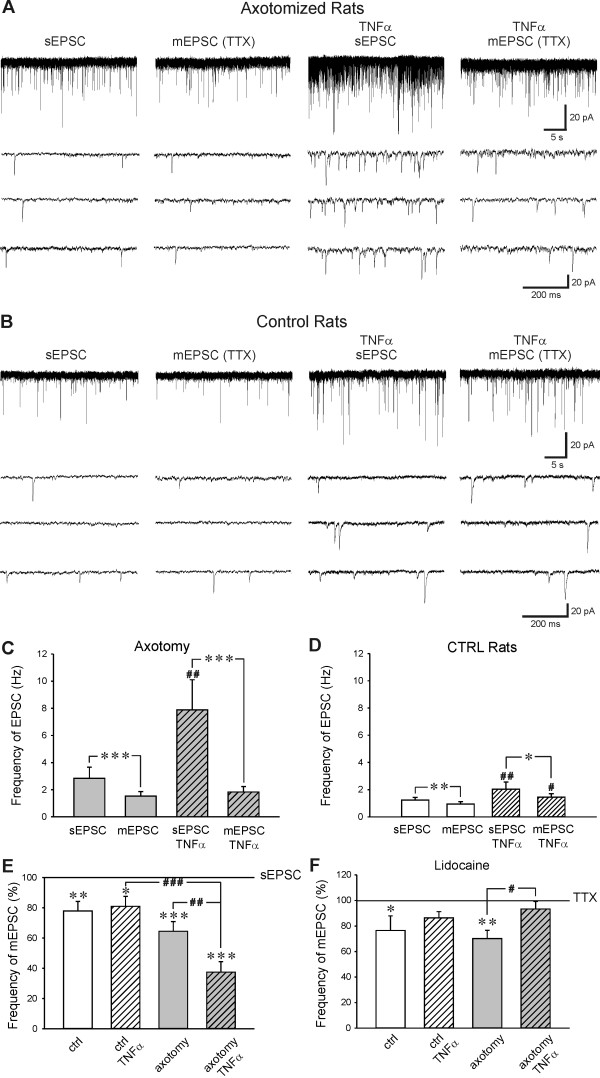
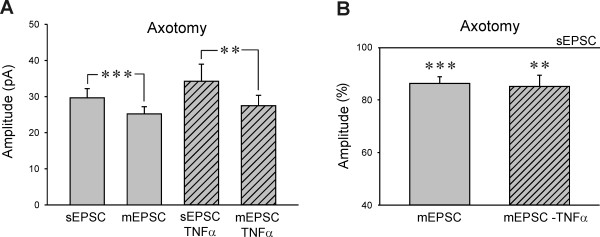
Spontaneous and miniature excitatory postsynaptic currents (sEPSC and mEPSCs) were recorded in superficial DH neurons in acute spinal cord slices prepared from animals 5 days after sciatic nerve transection and in controls.
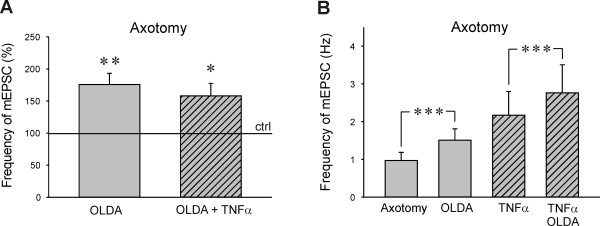
In slices after axotomy the sEPSC frequency was 2.8 ± 0.8 Hz, while neurons recorded from slices after TNFα incubation had significantly higher sEPSC frequency (7.9 ± 2.2 Hz). The effect of TNFα treatment was smaller in the slices from the control animals, where sEPSC frequency was 1.2 ± 0.2 Hz in slices without and 2.0 ± 0.5 Hz with TNFα incubation. Tetrodotoxin (TTX) application in slices from axotomized animals and after TNFα incubation decreased the mEPSC frequency to only 37.4 ± 6.9% of the sEPSC frequency. This decrease was significantly higher than in the slices without the TNFα treatment (64.4 ± 6.4%). TTX application in the control slices reduced the sEPSC frequency to about 80% in both TNFα untreated and treated slices. Application of low concentration TRPV1 receptors endogenous agonist N-oleoyldopamine (OLDA, 0.2 μM) in slices after axotomy induced a significant increase in mEPSC frequency (175.9 ± 17.3%), similar to the group with TNFα pretreatment (158.1 ± 19.5%).
Our results indicate that TNFα may enhance spontaneous transmitter release from primary afferent fibres in the spinal cord DH by modulation of TTX-sensitive sodium channels following sciatic nerve transection. This nerve injury also leads to enhanced sensitivity of presynaptic TRPV1 receptors to endogenous agonist. Modulation of presynaptic receptor activity on primary sensory terminals by TNFα may play an important role in neuropathic pain development.
细胞因子肿瘤坏死因子-α(TNFα)是外周和中枢神经系统中一种既定的疼痛调节剂。脊髓背角(DH)中伤害性突触传递的调制被认为与几种病理性疼痛状态的发展和维持有关。已经表明,背根神经节(DRG)细胞和脊髓 DH 中 TNFα 和其受体(TNFR)水平的升高在神经病理性疼痛处理中起重要作用。在本实验中,研究了 TNFα 孵育对周围神经病变模型中初级传入突触活性调制的影响。
在从坐骨神经横切后 5 天制备的急性脊髓切片中,记录浅层 DH 神经元中的自发性和微小兴奋性突触后电流(sEPSC 和 mEPSC)。
在轴突切断后的切片中,sEPSC 频率为 2.8±0.8Hz,而 TNFα 孵育后的神经元记录到的 sEPSC 频率明显更高(7.9±2.2Hz)。在没有 TNFα 处理的情况下,对照组切片中的 sEPSC 频率为 1.2±0.2Hz,而 TNFα 孵育后的 sEPSC 频率为 2.0±0.5Hz,TNFα 处理的效果较小。在轴突切断后的切片中应用河豚毒素(TTX)和 TNFα 孵育后,mEPSC 频率降低至 sEPSC 频率的 37.4±6.9%。与没有 TNFα 处理的切片(64.4±6.4%)相比,这种降低显著更高。在对照组切片中,TTX 应用将 sEPSC 频率降低至 TNFα 未处理和处理切片的约 80%。在轴突切断后的切片中应用低浓度 TRPV1 受体内源性激动剂 N-油酰多巴胺(OLDA,0.2μM)诱导 mEPSC 频率显著增加(175.9±17.3%),与 TNFα 预处理组相似(158.1±19.5%)。
我们的结果表明,TNFα 可能通过调节坐骨神经横切后的 TTX 敏感钠通道来增强脊髓 DH 中初级传入纤维的自发性递质释放。这种神经损伤还导致 TRPV1 受体对内源性激动剂的敏感性增强。TNFα 对初级感觉末梢突触前受体活性的调节可能在神经病理性疼痛的发展中起重要作用。