Department of Otolaryngology/Head & Neck Surgery, Haukeland University Hospital, 5021 Bergen, Norway.
Eur Arch Otorhinolaryngol. 2011 Mar;268(3):449-56. doi: 10.1007/s00405-010-1344-6. Epub 2010 Aug 28.
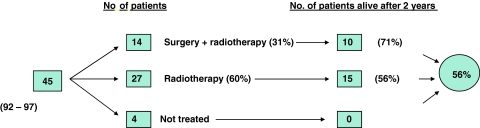
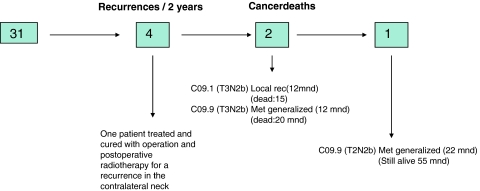
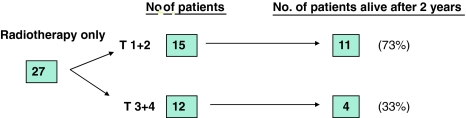
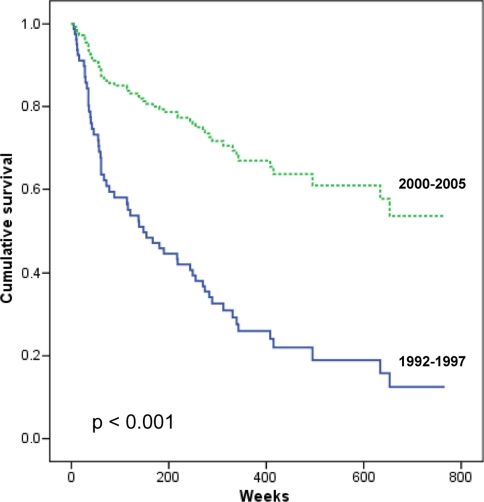
Since 1992 we have prospectively included all head and neck cancer patients in our health region in a departmental based register. Our hospital takes care of all head and neck cancer patients in our health region consisting of approximately 1 million people. In 1997, we evaluated the results of the treatment of oropharyngeal cancer in the 1992-1997 period. On the basis of this evaluation, we changed our treatment policy for tonsillar and base of tongue carcinoma. We first changed the treatment for the lesions with worst prognosis, i.e., those with T3-T4 carcinomas, from radiotherapy only, to radical surgery and postoperative radiotherapy. We have since that time increasingly also operated the smaller oropharyngeal carcinomas. The 2 years' overall survival and disease-specific survival for all patients diagnosed in the 1992-1997 period was 56 and 63%, respectively. The results from a similar group of patients in the 6 years' period from 2000 to 2005, after the change in treatment, have increased to 83 and 88%. When we looked at the subgroup of patients in the 2000-2005 period treated with surgery and postoperative radiotherapy, 45 out of 69 patients (65%) presenting with an oropharyngeal cancer were fit for operation. With radical surgery and postoperative radiation therapy, the 2 years overall survival is now 91%. The 2-year disease-specific survival is 96% and the locoregional control is 98%. This is a marked improvement as compared to radiotherapy alone and definitely competitive with modern radiochemotherapy.
自 1992 年以来,我们前瞻性地将我们健康区域内的所有头颈部癌症患者纳入了一个部门登记处。我们的医院负责照顾我们健康区域内的所有头颈部癌症患者,约有 100 万人。1997 年,我们评估了 1992-1997 年期间口咽癌治疗的结果。在此评估的基础上,我们改变了扁桃体和舌根癌的治疗策略。我们首先改变了预后最差的病变(即 T3-T4 癌)的治疗方法,从单纯放疗改为根治性手术和术后放疗。从那时起,我们越来越多地对较小的口咽癌进行手术。1992-1997 年期间诊断的所有患者的 2 年总生存率和疾病特异性生存率分别为 56%和 63%。在治疗方法改变后的 6 年期间(2000-2005 年),类似患者组的结果分别增加到 83%和 88%。当我们观察 2000-2005 年期间接受手术和术后放疗的患者亚组时,69 名口咽癌患者中有 45 名(65%)适合手术。采用根治性手术和术后放疗,2 年总生存率现在为 91%。2 年疾病特异性生存率为 96%,局部区域控制率为 98%。与单纯放疗相比,这是显著的改善,并且肯定具有现代放化疗的竞争力。