College of Life Sciences, Zhejiang University, Hangzhou, China.
PLoS One. 2010 Aug 24;5(8):e12380. doi: 10.1371/journal.pone.0012380.
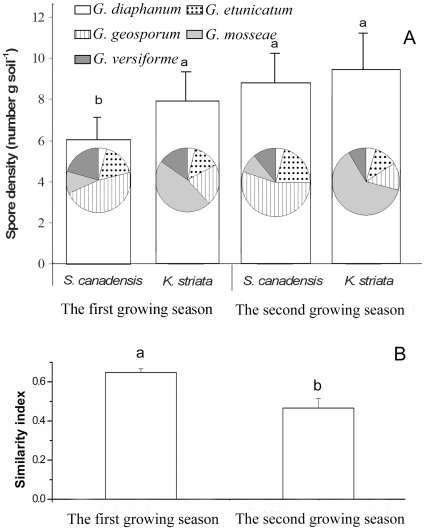
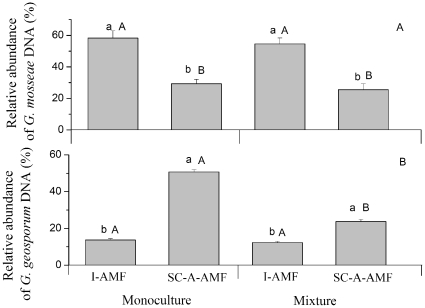
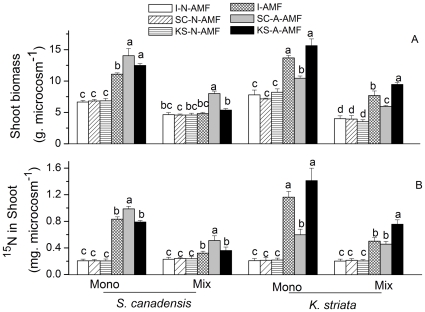
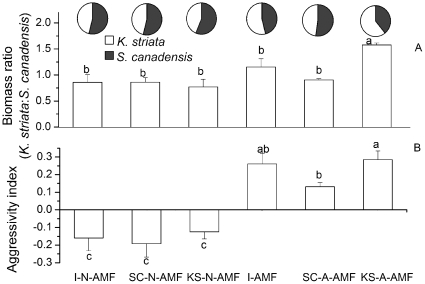
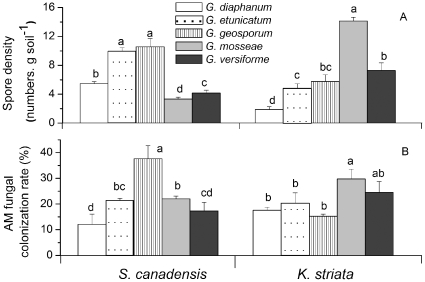
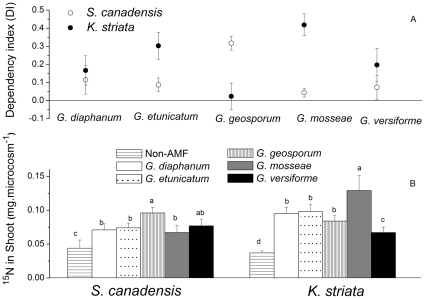
Negative or positive feedback between arbuscular mycorrhizal fungi (AMF) and host plants can contribute to plant species interactions, but how this feedback affects plant invasion or resistance to invasion is not well known. Here we tested how alterations in AMF community induced by an invasive plant species generate feedback to the invasive plant itself and affect subsequent interactions between the invasive species and its native neighbors. We first examined the effects of the invasive forb Solidago canadensis L. on AMF communities comprising five different AMF species. We then examined the effects of the altered AMF community on mutualisms formed with the native legume forb species Kummerowia striata (Thunb.) Schindl. and on the interaction between the invasive and native plants. The host preferences of the five AMF were also assessed to test whether the AMF form preferred mutualistic relations with the invasive and/or the native species. We found that S. canadensis altered AMF spore composition by increasing one AMF species (Glomus geosporum) while reducing Glomus mosseae, which is the dominant species in the field. The host preference test showed that S. canadensis had promoted the abundance of AMF species (G. geosporum) that most promoted its own growth. As a consequence, the altered AMF community enhanced the competitiveness of invasive S. canadensis at the expense of K. striata. Our results demonstrate that the invasive S. canadensis alters soil AMF community composition because of fungal-host preference. This change in the composition of the AMF community generates positive feedback to the invasive S. canadensis itself and decreases AM associations with native K. striata, thereby making the native K. striata less dominant.
丛枝菌根真菌 (AMF) 与宿主植物之间的负反馈或正反馈可以促进植物种间相互作用,但这种反馈如何影响植物的入侵或对入侵的抵抗力还不清楚。在这里,我们测试了由入侵植物物种引起的 AMF 群落的变化如何产生反馈给入侵植物本身,并影响入侵物种与其本地邻居之间的后续相互作用。我们首先研究了入侵植物加拿大一枝黄花 (Solidago canadensis L.) 对包含五种不同 AMF 物种的 AMF 群落的影响。然后,我们研究了改变的 AMF 群落对与本地豆科植物种鸡眼草 (Kummerowia striata (Thunb.) Schindl.) 形成的共生关系的影响,以及对入侵和本地植物之间相互作用的影响。还评估了五种 AMF 的宿主偏好,以测试 AMF 是否与入侵和/或本地物种形成互利关系。我们发现,加拿大一枝黄花通过增加一种 AMF 物种 (Glomus geosporum) 而减少优势种 Glomus mosseae 来改变 AMF 孢子组成。宿主偏好测试表明,加拿大一枝黄花促进了最能促进其自身生长的 AMF 物种 (G. geosporum) 的丰度。因此,改变的 AMF 群落增强了入侵的加拿大一枝黄花的竞争力,而牺牲了鸡眼草。我们的结果表明,入侵的加拿大一枝黄花由于真菌-宿主偏好而改变了土壤 AMF 群落组成。AMF 群落组成的这种变化为入侵的加拿大一枝黄花本身产生了正反馈,并减少了与本地鸡眼草的 AM 关联,从而使本地鸡眼草的优势度降低。