Department of Medicine, University of Florida, Gainesville, FL 32610, USA.
Int J Oncol. 2010 Oct;37(4):963-71. doi: 10.3892/ijo_00000747.
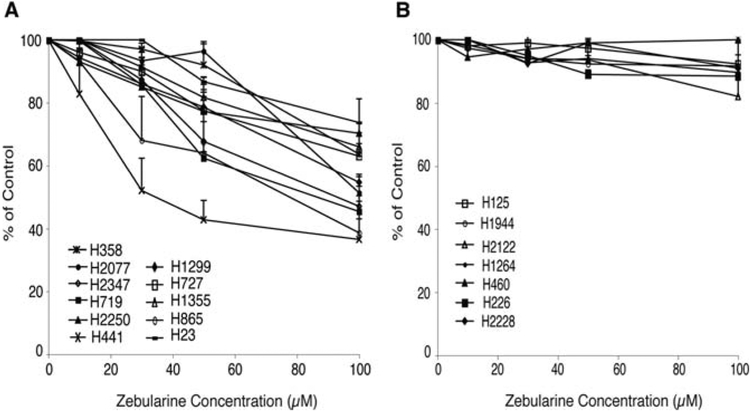
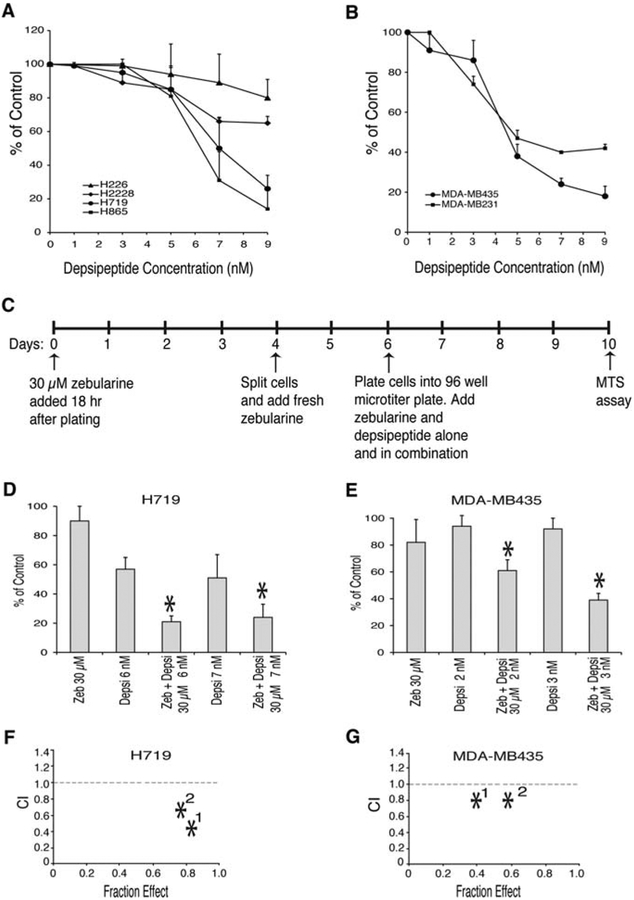
Aberrant hypermethylation at CpG sites within the CDKN2A gene is associated with silencing and has been proposed as a target for reactivation using both DNA methylation and histone deacetylation inhibitors. This study investigates the role of selecting tumor samples with a silenced as compared to deleted CDKN2A locus when assessing the efficacy of DNA methyltransferase inhibitor, zebularine, combined with the HDAC inhibitor, depsipeptide. Non-small cell lung cancer cell lines with defined CDKN2A status were analyzed by MTS assay to determine the effect of zebularine or zebularine combined with depsipeptide on tumor cell growth. We observed that zebularine treatment resulted in inhibition of cell growth in 11 out of 12 lung cancer cell lines with silenced CDKN2A, but no cell growth inhibition was detected in the 7 lung cancer cell lines tested with deleted CDKN2A (p>0.001). In addition, we found that the combination of 30 microM zebularine and 6 or 7 nM depsipeptide resulted in a synergistic inhibition of cell growth in tumor cells with silenced CDKN2A (p<0.001, CI=0.70 and 0.57, respectively) but not in tumor cells with deleted CDKN2A. In conclusion, tumor cells with methylated CDKN2A are more sensitive to zebularine than cell lines with deleted CDKN2A and the combination of zebularine/depsipeptide results in a synergistic effect on cell growth inhibition that is also linked with the presence of silenced CDKN2A. Thus, combination of DNA methyltransferase and HDAC inhibitors may be a potential treatment for lung cancer patients, but careful selection of patients will be needed to optimize the benefit of this regimen.
CDKN2A 基因内 CpG 位点的异常高甲基化与沉默有关,并已被提议作为使用 DNA 甲基化和组蛋白去乙酰化抑制剂进行重新激活的靶标。本研究调查了在评估 DNA 甲基转移酶抑制剂 zebularine 与 HDAC 抑制剂 depsipeptide 的疗效时,选择具有沉默而不是缺失 CDKN2A 基因座的肿瘤样本的作用。通过 MTS 测定法分析具有明确 CDKN2A 状态的非小细胞肺癌细胞系,以确定 zebularine 或 zebularine 与 depsipeptide 联合对肿瘤细胞生长的影响。我们观察到,在 12 个具有沉默 CDKN2A 的肺癌细胞系中的 11 个中,zebularine 处理导致细胞生长受到抑制,但在 7 个具有缺失 CDKN2A 的肺癌细胞系中未检测到细胞生长抑制(p>0.001)。此外,我们发现 30μM zebularine 与 6 或 7 nM depsipeptide 的组合导致沉默 CDKN2A 的肿瘤细胞生长协同抑制(p<0.001,CI=0.70 和 0.57),但对缺失 CDKN2A 的肿瘤细胞没有抑制作用。总之,与缺失 CDKN2A 的细胞系相比,具有甲基化 CDKN2A 的肿瘤细胞对 zebularine 更敏感,并且 zebularine/depsipeptide 的组合对细胞生长抑制具有协同作用,这也与沉默的 CDKN2A 的存在有关。因此,DNA 甲基转移酶和 HDAC 抑制剂的联合可能是治疗肺癌患者的一种潜在方法,但需要仔细选择患者,以优化该方案的益处。