School for Public Health and Primary Care (Caphri), Department of Health Promotion, Maastricht University, the Netherlands.
Int J Behav Nutr Phys Act. 2010 Sep 3;7:64. doi: 10.1186/1479-5868-7-64.
The aim of the present study was to evaluate the cost-effectiveness of tailored print communication (TPC), telephone motivational interviewing (TMI), a combination of the two, and no intervention on two outcomes in adults aged 45 to 70, half of them having hypertension: increasing the number of public health guidelines met for three behaviors (physical activity and fruit and vegetable consumption), and impact on quality adjusted life years (QALYs).
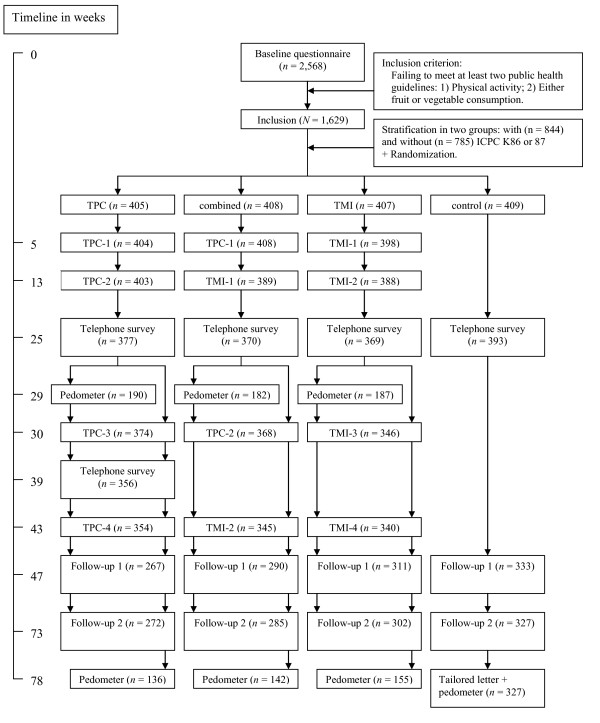
Participants (n = 1,629) from 23 Dutch general practices were randomized into one of four groups, which received 4 TPCs, 4 TMIs, 2 of each (combined), or no intervention (control), respectively. The self-reported outcomes, measured at baseline and 73 weeks follow-up (7 months after the last intervention component), were difference in total number of guidelines met at follow-up compared to baseline, and number of QALYs experienced over 73 weeks. The costs of implementing the intervention were estimated using a bottom-up approach.
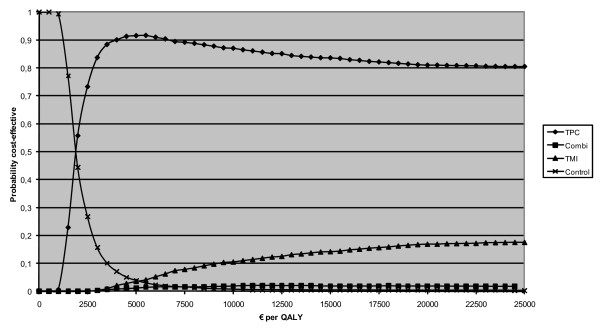
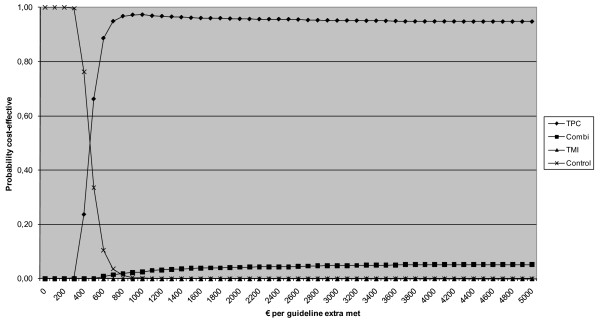
At 73 weeks follow-up participants showed increased adherence with 0.62 (TPC), 0.40 (TMI), 0.50 (combined), and 0.26 (control) guidelines compared to baseline, and experienced 1.09, 1.08, 1.08, and 1.07 QALYs, respectively. The costs for the control group were considered to be zero. TMI was more expensive (€107 per person) than both the combined intervention (€80) and TPC (€57). The control condition was most cost-effective for lower ceiling ratios, while TPC had the highest probability of being most cost-effective for higher ceiling ratios (more than €160 per additional guideline met, and €2,851 for each individual QALY).
For low society's willingness to pay, the control group was most cost-effective for the number of QALYs experienced over 73 weeks. This also applied to the increase in the number of guidelines met at lower ceiling ratios, whereas at higher ceiling ratios, TPC had a higher probability of being more cost-effective than the TMI, combined or control conditions. This also seemed to apply for QALYs experienced over 73 weeks. More research is needed on the long-term efficacy of both TPC and TMI, as well as on how to increase their cost-effectiveness.
Dutch Trial Register NTR1068.
本研究旨在评估针对特定人群的印刷交流材料(TPC)、电话动机性访谈(TMI)、二者结合以及无干预这四种措施在 45 至 70 岁的成年人(其中一半患有高血压)中的成本效益,评估指标为三个行为(体力活动、水果和蔬菜摄入)的公共卫生指南达标数量变化,以及对质量调整生命年(QALYs)的影响。
23 家荷兰综合诊所的参与者(n = 1629)被随机分为四组,分别接受 4 份 TPC、4 份 TMI、2 份 TPC 和 2 份 TMI(联合组)或无干预(对照组)。在基线和 73 周(末次干预后 7 个月)随访时采用自我报告的结果进行评估,主要指标为随访时与基线相比,指南达标总数的差异,以及 73 周期间 QALYs 的数量。采用自下而上的方法估算实施干预的成本。
在 73 周随访时,与基线相比,参与者的依从性分别增加了 0.62 条(TPC)、0.40 条(TMI)、0.50 条(联合组)和 0.26 条(对照组)指南,且分别经历了 1.09、1.08、1.08 和 1.07 个 QALYs。对照组的成本被认为是零。TMI 比联合干预(€80)和 TPC(€57)更昂贵。对于较低的上限比率,对照组是最具成本效益的,而对于较高的上限比率,TPC 最有可能具有成本效益(每增加一条指南多花费€160 以上,每增加一个 QALY 花费€2851)。
对于较低的社会意愿支付水平,对照组在 73 周期间经历的 QALYs 数量方面是最具成本效益的。这也适用于较低上限比率下指南达标数量的增加,而对于较高的上限比率,TPC 比 TMI、联合或对照组更有可能具有成本效益。这似乎也适用于 73 周期间经历的 QALYs。需要进一步研究 TPC 和 TMI 的长期疗效,以及如何提高其成本效益。
荷兰试验注册 NTR1068。