Division of Immunology, Beth Israel Deaconess Medical Center, Harvard Medical School, Boston, Massachusetts, USA.
Nat Immunol. 2010 Oct;11(10):920-7. doi: 10.1038/ni.1931. Epub 2010 Sep 5.
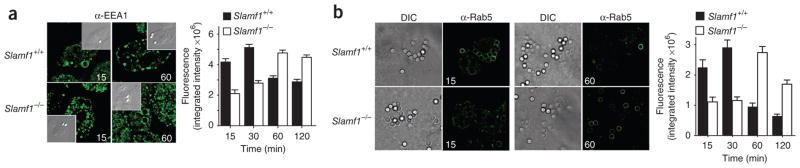
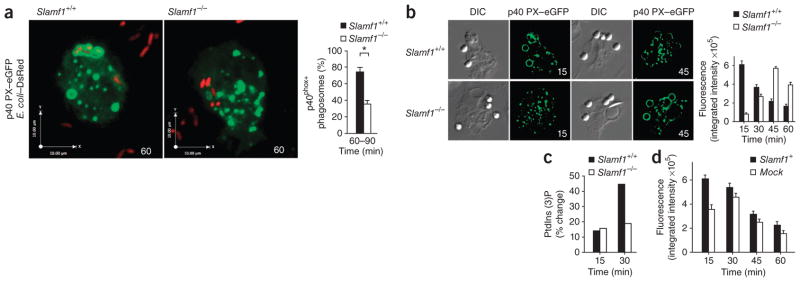
Phagocytosis is a pivotal process by which macrophages eliminate microorganisms after recognition by pathogen sensors. Here we unexpectedly found that the self ligand and cell surface receptor SLAM functioned not only as a costimulatory molecule but also as a microbial sensor that controlled the killing of gram-negative bacteria by macrophages. SLAM regulated activity of the NADPH oxidase NOX2 complex and phagolysosomal maturation after entering the phagosome, following interaction with the bacterial outer membrane proteins OmpC and OmpF. SLAM recruited a complex containing the intracellular class III phosphatidylinositol kinase Vps34, its regulatory protein kinase Vps15 and the autophagy-associated molecule beclin-1 to the phagosome, which was responsible for inducing the accumulation of phosphatidylinositol-3-phosphate, a regulator of both NOX2 function and phagosomal or endosomal fusion. Thus, SLAM connects the gram-negative bacterial phagosome to ubiquitous cellular machinery responsible for the control of bacterial killing.
吞噬作用是巨噬细胞在识别病原体传感器后消除微生物的关键过程。在这里,我们出人意料地发现,自我配体和细胞表面受体 SLAM 不仅作为共刺激分子起作用,而且还作为微生物传感器,控制巨噬细胞对革兰氏阴性菌的杀伤。SLAM 在进入吞噬体后与细菌外膜蛋白 OmpC 和 OmpF 相互作用,调节 NADPH 氧化酶 NOX2 复合物和吞噬溶酶体成熟的活性。SLAM 将包含细胞内 III 类磷酸肌醇激酶 Vps34、其调节蛋白激酶 Vps15 和自噬相关分子 beclin-1 的复合物募集到吞噬体,这负责诱导磷脂酰肌醇-3-磷酸的积累,该磷酸是调节 NOX2 功能和吞噬体或内体融合的调节剂。因此,SLAM 将革兰氏阴性菌的吞噬体与负责控制细菌杀伤的普遍存在的细胞机制联系起来。