Division of Infectious Diseases, Wadsworth Center, New York State Department of Health, Albany, New York, United States of America.
PLoS One. 2010 Sep 2;5(9):e12499. doi: 10.1371/journal.pone.0012499.
The development of an HIV/AIDS vaccine has proven to be elusive. Because human vaccine trials have not yet demonstrated efficacy, new vaccine strategies are needed for the HIV vaccine pipeline. We have been developing a new HIV vaccine platform using a live enterovirus, coxsackievirus B4 (CVB4) vector. Enteroviruses are ideal candidates for development as a vaccine vector for oral delivery, because these viruses normally enter the body via the oral route and survive the acidic environment of the stomach.
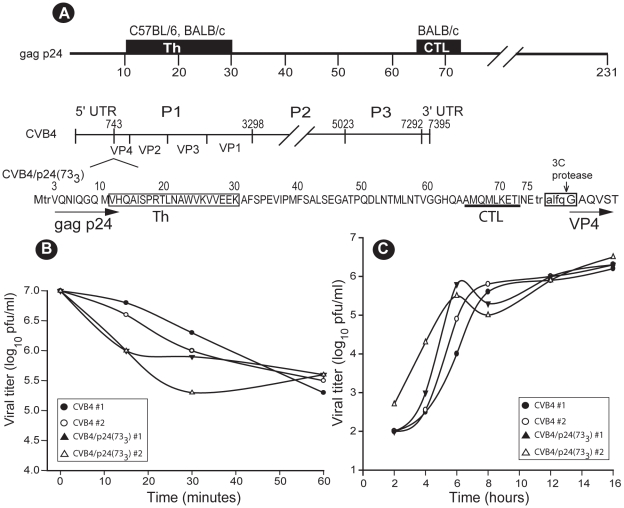
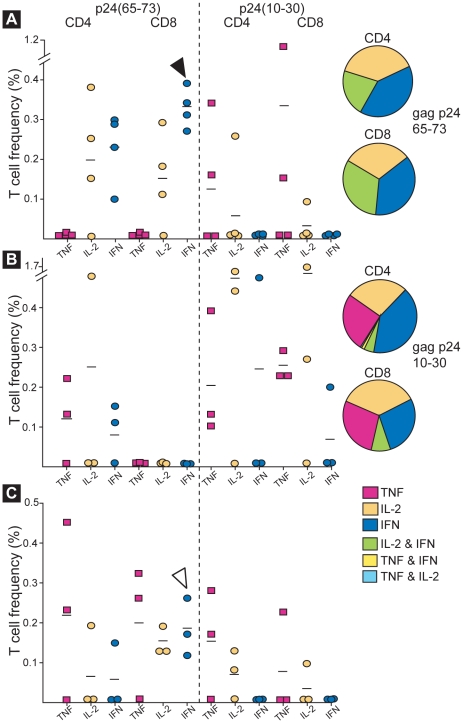
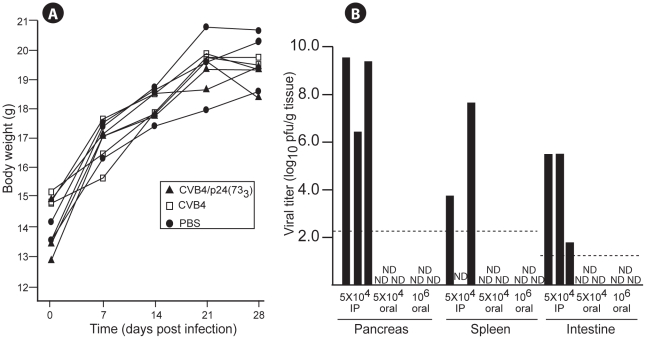
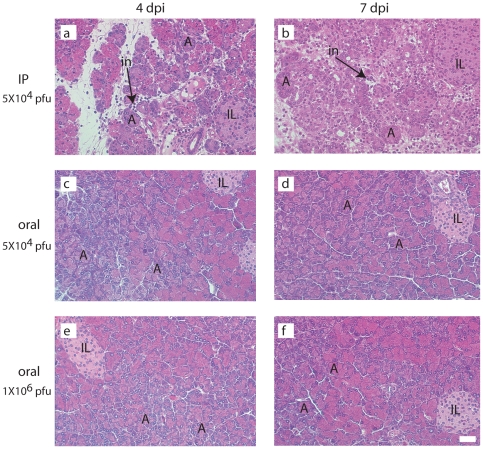
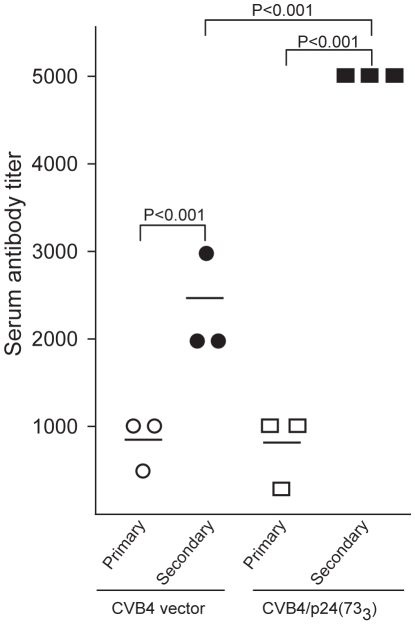
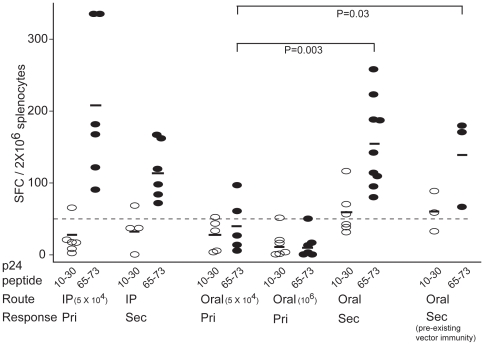
METHODOLOGY/PRINCIPAL FINDINGS: We constructed a live coxsackievirus B4 recombinant, CVB4/p24(73(3)), that expresses seventy-three amino acids of the gag p24 sequence (HXB2) and assessed T cell responses after immunization of mice. The CVB4 recombinant was physically stable, replication-competent, and genetically stable. Oral or intraperitoneal immunization with the recombinant resulted in strong systemic gag p24-specific T cell responses as determined by the IFN-gamma ELISPOT assay and by multiparameter flow cytometry. Oral immunization with CVB4/p24(73(3)) resulted in a short-lived, localized infection of the gut without systemic spread. Because coxsackieviruses are ubiquitous in the human population, we also evaluated whether the recombinant was able to induce gag p24-specific T cell responses in mice pre-immunized with the CVB4 vector. We showed that oral immunization with CVB4/p24(73(3)) induced gag p24-specific immune responses in vector-immune mice.
CONCLUSIONS/SIGNIFICANCE: The CVB4/p24(73(3)) recombinant retained the physical and biological characteristics of the parental CVB4 vector. Oral immunization with the CVB4 recombinant was safe and resulted in the induction of systemic HIV-specific T cell responses. Furthermore, pre-existing vector immunity did not preclude the development of gag p24-specific T cell responses. As the search continues for new vaccine strategies, the present study suggests that live CVB4/HIV recombinants are potential new vaccine candidates for HIV.
艾滋病病毒/艾滋病疫苗的研发一直难以实现。由于人类疫苗试验尚未显示出疗效,因此需要为艾滋病病毒疫苗库开发新的疫苗策略。我们一直在使用一种活肠病毒,柯萨奇病毒 B4(CVB4)载体来开发一种新的艾滋病病毒疫苗平台。肠病毒是作为口服递送疫苗载体开发的理想候选者,因为这些病毒通常通过口腔途径进入人体,并在胃的酸性环境中存活。
方法/主要发现:我们构建了一种活的柯萨奇病毒 B4 重组体,CVB4/p24(73(3)),它表达了 gag p24 序列(HXB2)的 73 个氨基酸,并评估了免疫小鼠后的 T 细胞反应。CVB4 重组体物理稳定、复制有效且遗传稳定。通过 IFN-γ ELISPOT 测定和多参数流式细胞术,口服或腹腔内免疫重组体导致强烈的全身性 gag p24 特异性 T 细胞反应。CVB4/p24(73(3))的口服免疫导致肠道的短暂、局部感染,而没有系统传播。由于柯萨奇病毒在人群中普遍存在,我们还评估了重组体是否能够在预先用 CVB4 载体免疫的小鼠中诱导 gag p24 特异性 T 细胞反应。我们表明,CVB4/p24(73(3))的口服免疫在载体免疫的小鼠中诱导了 gag p24 特异性免疫反应。
结论/意义:CVB4/p24(73(3))重组体保留了亲本 CVB4 载体的物理和生物学特征。CVB4 重组体的口服免疫是安全的,并导致诱导全身性 HIV 特异性 T 细胞反应。此外,预先存在的载体免疫并不排除 gag p24 特异性 T 细胞反应的发展。随着对新疫苗策略的探索不断深入,本研究表明,活 CVB4/HIV 重组体可能是艾滋病病毒的潜在新疫苗候选物。