
髓样分化因子 88(MyD88)缺陷增加小鼠患糖尿病的风险。
Myeloid differentiation factor 88 (MyD88)-deficiency increases risk of diabetes in mice.
机构信息
Department of Pharmacotherapy, Graduate School of Biomedical Sciences, Hiroshima University, Hiroshima, Japan.
出版信息
PLoS One. 2010 Sep 2;5(9):e12537. doi: 10.1371/journal.pone.0012537.
BACKGROUND
Multiple lines of evidence suggest innate immune response pathways to be involved in the development of obesity-associated diabetes although the molecular mechanism underling the disease is unknown. Recent observations suggest that saturated fatty acids can act as a ligand for toll-like receptor (TLR) 4, which is thought to mediate obesity-associated insulin resistance. Myeloid differentiation factor 88 (MyD88) is an adapter protein for TLR/IL-1 receptor signaling, which is involved in the activation of inflammatory pathways. To evaluate molecular mechanisms linking obesity-associated diabetes down-stream of TLR4, we investigated physiological role of MyD88 in high-fat diet (HFD)-induced obesity.
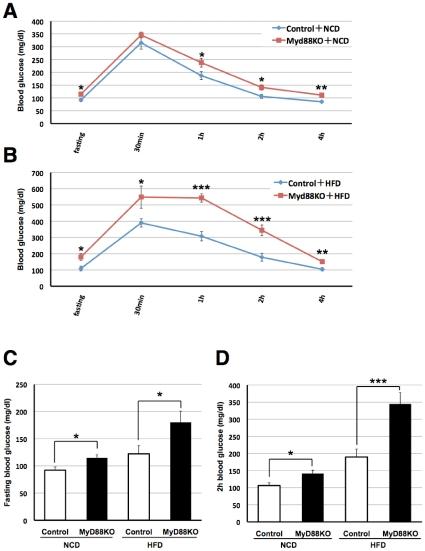
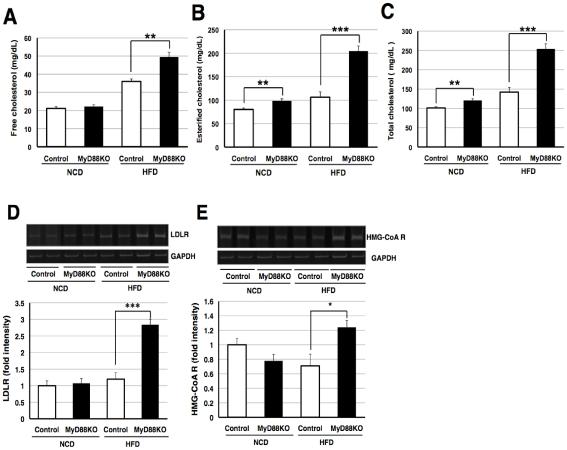
METHODOLOGY/PRINCIPAL FINDINGS: In the present study, we found MyD88-deficient mice fed a HFD had increased circulating levels of insulin, leptin and cholesterol, as well as liver dysfunction (increased induction of ALT levels, increased activation of JNK and cleavage of PARP), which were linked to the onset of severe diabetes. On the other hand, TNF-alpha would not be involved in HFD-induced diabetes in MyD88-deficient mice, because TNF-alpha level was attenuated in MyD88-deficient mice fed with HFD.
CONCLUSIONS/SIGNIFICANCE: The present finding of an unexpected role for MyD88 in preventing diabetes may provide a potential novel target/strategy for treating metabolic syndrome.
背景
多项证据表明,先天免疫反应途径可能与肥胖相关的糖尿病的发生有关,尽管这种疾病的分子机制尚不清楚。最近的观察表明,饱和脂肪酸可以作为 Toll 样受体 (TLR) 4 的配体,TLR 4 被认为介导肥胖相关的胰岛素抵抗。髓样分化因子 88 (MyD88) 是 TLR/IL-1 受体信号转导的衔接蛋白,它参与炎症途径的激活。为了评估肥胖相关糖尿病下游 TLR4 相关的分子机制,我们研究了 MyD88 在高脂肪饮食 (HFD) 诱导肥胖中的生理作用。
方法/主要发现:在本研究中,我们发现高脂饮食喂养的 MyD88 缺陷型小鼠循环胰岛素、瘦素和胆固醇水平升高,肝功能障碍(ALT 水平升高、JNK 激活增加和 PARP 切割增加),这与严重糖尿病的发生有关。另一方面,TNF-α可能不会参与 MyD88 缺陷型小鼠的 HFD 诱导型糖尿病,因为 HFD 喂养的 MyD88 缺陷型小鼠的 TNF-α水平降低。
结论/意义:本研究发现 MyD88 在预防糖尿病方面的意外作用,这可能为治疗代谢综合征提供一个新的潜在靶点/策略。



 Zotero 插件