Kim Jieun, Lee Jongsoon
Soonchunhyang Institute of MediBio Science (SIMS), Department of Integrated Biomedical Science, Soonchunhyang University, Cheonan, Korea.
Ann Pediatr Endocrinol Metab. 2021 Mar;26(1):1-13. doi: 10.6065/apem.2040188.094. Epub 2021 Mar 31.
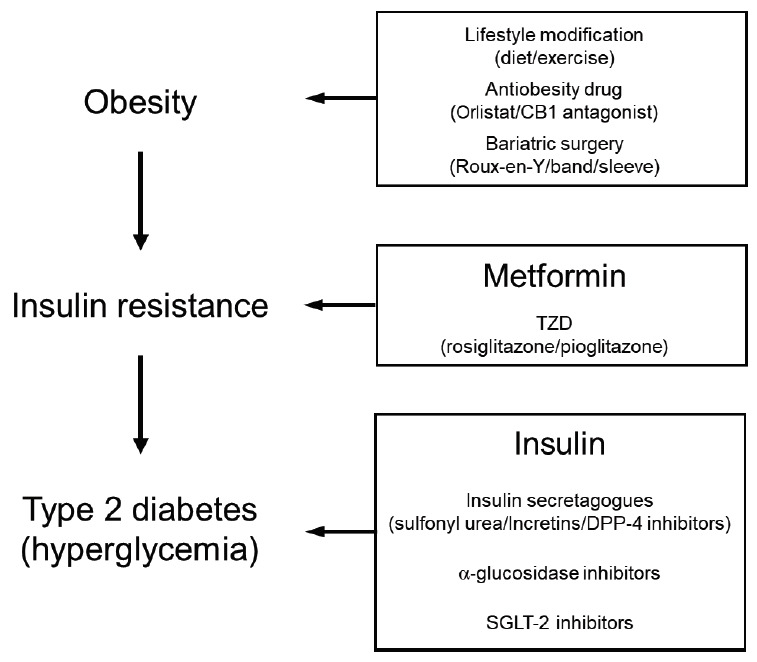
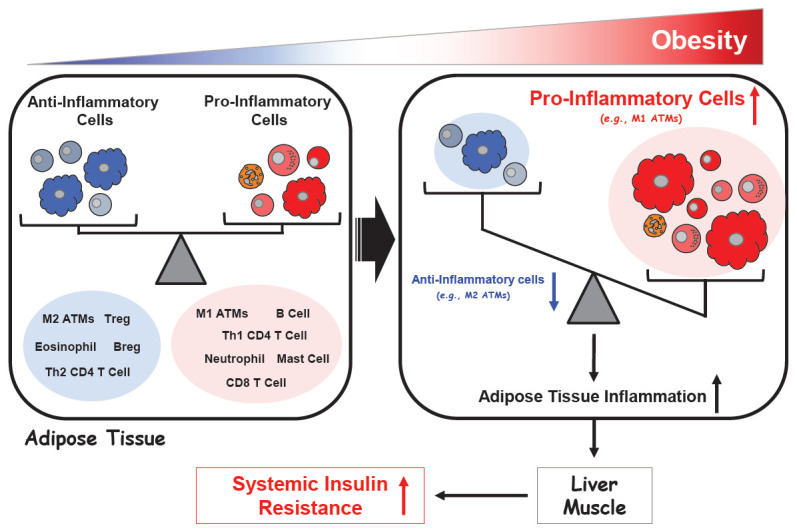
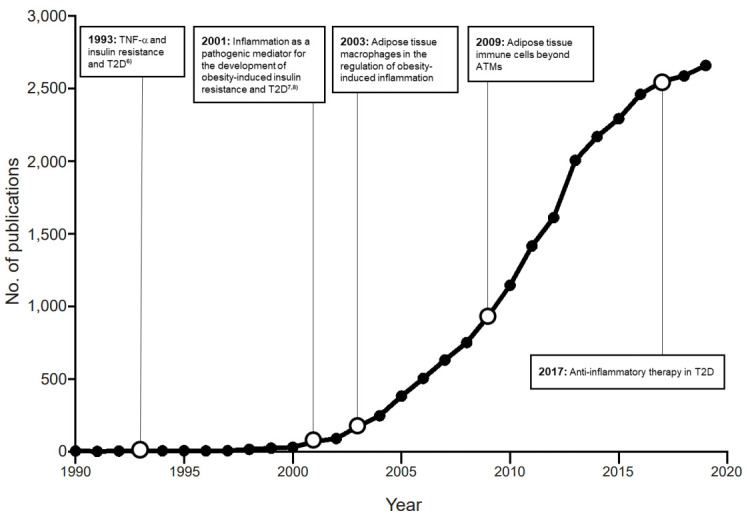
The prevalence of obesity has increased alarmingly both worldwide and in Korea. This has also dramatically increased the prevalence of chronic obesity-associated diseases, including type 2 diabetes (T2D). Extensive studies on the molecular etiology of T2D have revealed several potential mechanisms by which obesity induces the development of insulin resistance and T2D. One of these is low-grade chronic inflammation. Studies hinting at the existence of this phenomenon were first published about 30 years ago. Ten years later, several seminal papers confirmed its existence, which then led to a rapid and massive escalation of research in this field. Today, the notion that obesity-induced inflammation mediates T2D is now well-accepted. This paper will review the key developments in this field, including the discovery that obesity-induced inflammation and insulin resistance is mainly regulated by adipose tissue-resident immune cells, particularly those in visceral adipose tissue. This review further details the research areas, including (1) the obesity-related factors that induce adipose tissue macrophage (ATM) inflammation, (2) the precise effector functions by which adipose tissue immune cells promote insulin resistance, (3) whether there are early immunological events that have an outsize effect on later events and could be targeted to arrest the development of insulin resistance, (4) the roles played by nonimmunological functions of ATMs and other immune cells, and (5) whether there are noncanonical immune responses to obesity (i.e., immune responses that are unique to obesity and cannot be detected by following the discoveries in the classical immunity field).
肥胖症在全球和韩国的患病率都惊人地上升。这也显著增加了与慢性肥胖相关疾病的患病率,包括2型糖尿病(T2D)。对T2D分子病因的广泛研究揭示了肥胖诱导胰岛素抵抗和T2D发展的几种潜在机制。其中之一是低度慢性炎症。暗示这种现象存在的研究最早发表于约30年前。十年后,几篇具有开创性的论文证实了其存在,这随后导致该领域的研究迅速大量增加。如今,肥胖诱导的炎症介导T2D这一观点已被广泛接受。本文将回顾该领域的关键进展,包括发现肥胖诱导的炎症和胰岛素抵抗主要由驻留在脂肪组织中的免疫细胞调节,尤其是那些在内脏脂肪组织中的免疫细胞。本综述进一步详细阐述了研究领域,包括(1)诱导脂肪组织巨噬细胞(ATM)炎症的肥胖相关因素,(2)脂肪组织免疫细胞促进胰岛素抵抗的精确效应功能,(3)是否存在对后期事件有巨大影响且可作为靶点来阻止胰岛素抵抗发展的早期免疫事件,(4)ATM和其他免疫细胞的非免疫功能所起的作用,以及(5)是否存在对肥胖的非经典免疫反应(即肥胖特有的、无法通过遵循经典免疫领域的发现来检测的免疫反应)。