Magee-Womens Research Institute, 204 Craft Avenue, Pittsburgh, PA 15213, USA.
Curr Opin Cell Biol. 2010 Dec;22(6):744-51. doi: 10.1016/j.ceb.2010.08.016. Epub 2010 Sep 9.
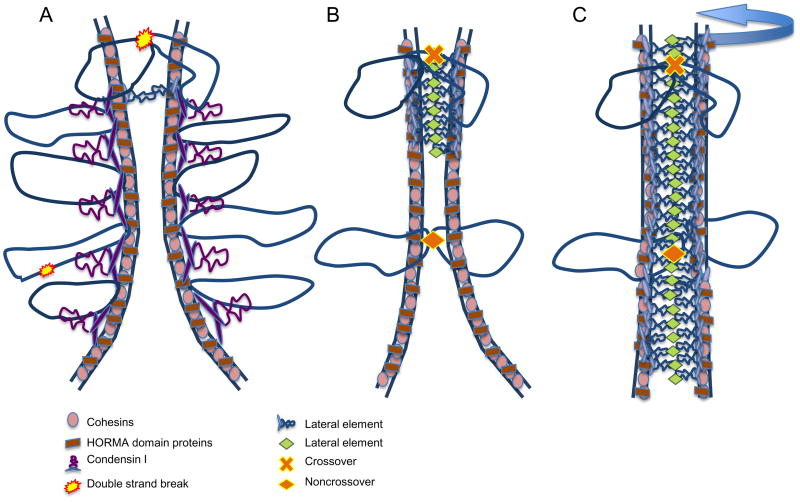
The perpetuation of most eukaryotic species requires differentiation of pluripotent progenitors into egg and sperm and subsequent fusion of these gametes to form a new zygote. Meiosis is a distinguishing feature of gamete formation as it leads to the twofold reduction in chromosome number thereby maintaining ploidy across generations. This process increases offspring diversity through the random segregation of chromosomes and the exchange of genetic material between homologous parental chromosomes, known as meiotic crossover recombination. These exchanges require the establishment of unique and dynamic chromatin configurations that facilitate cohesion, homolog pairing, synapsis, double strand break formation and repair. The precise orchestration of these events is critical for gamete survival as demonstrated by the majority of human aneuploidies that can be traced to defects in the first meiotic division (Hassold T, Hall H, Hunt P: The origin of human aneuploidy: where we have been, where we are going. Hum Mol Genet 2007, 16 Spec No. 2:R203-R208.). This review will focus on recent advances in our understanding of key meiotic events and how coordination of these events is occurring.
大多数真核生物物种的延续需要多能祖细胞分化为卵子和精子,然后这些配子融合形成新的受精卵。减数分裂是配子形成的一个显著特征,因为它导致染色体数目的两倍减少,从而维持了世代间的ploidy。这个过程通过染色体的随机分离和同源亲本染色体之间的遗传物质交换,即减数交叉重组,增加了后代的多样性。这些交换需要建立独特和动态的染色质构型,以促进凝聚、同源配对、联会、双链断裂的形成和修复。这些事件的精确协调对于配子的存活至关重要,这可以从大多数可追溯到第一次减数分裂缺陷的人类非整倍体中得到证明(Hassold T、Hall H、Hunt P:人类非整倍体的起源:我们去过哪里,我们要去哪里。Hum Mol Genet 2007, 16 Spec No. 2:R203-R208.)。这篇综述将重点介绍我们对关键减数分裂事件的理解的最新进展,以及这些事件的协调是如何发生的。