Department of Biology, University of South Dakota, Vermillion, South Dakota, USA.
PLoS One. 2010 Sep 7;5(9):e12565. doi: 10.1371/journal.pone.0012565.
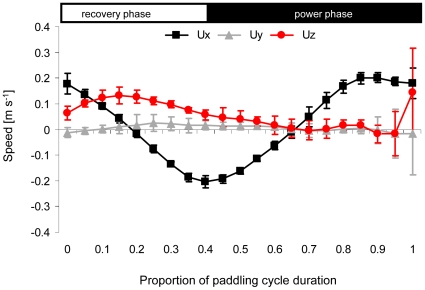
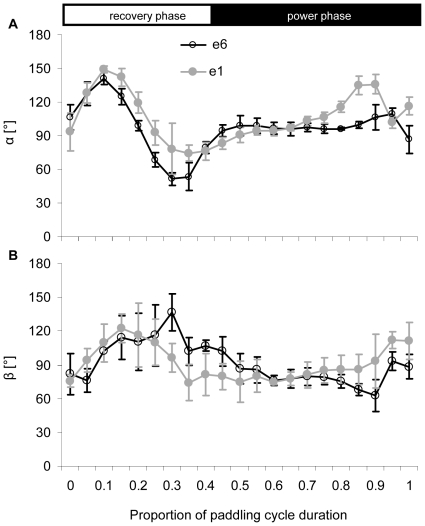
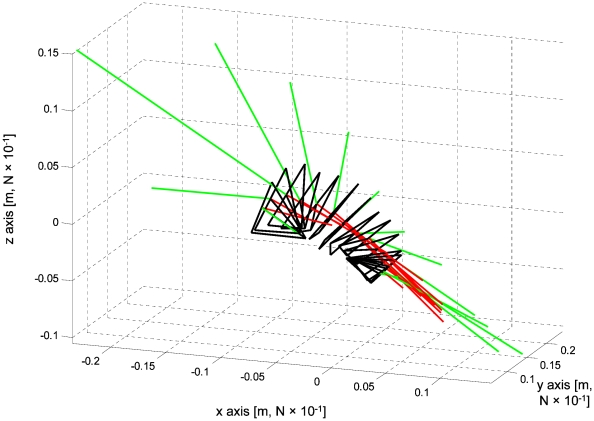
Diving ducks use their webbed feet to provide the propulsive force that moves them underwater. To hold position near the bottom while feeding, ducks paddle constantly to resist the buoyant force of the body. Using video sequences from two orthogonal cameras we reconstructed the 3-dimensional motion of the feet through water and estimated the forces involved with a quasi-steady blade-element model. We found that during station holding, near the bottom, ducks use drag based propulsion with the webbed area of the foot moving perpendicular to the trajectory of the foot. The body was pitched at 76+/-3.47 degrees below the horizon and the propulsive force was directed 26+/-1.9 degrees ventral to the body so that 98% of the propulsive force in the sagittal plane of the duck worked to oppose buoyancy. The mechanical work done by moving both feet through a paddling cycle was 1.1+/-0.2 J which was equivalent to an energy expenditure of 3.7+/-0.5 W to hold position while feeding at 1.5 m depth. We conclude that in shallow water the high energetic cost of feeding in ducks is due to the need to paddle constantly against buoyancy even after reaching the bottom. The mechanical energy spent on holding position near the bottom, while feeding, is approximately 2 fold higher than previous estimates that were made for similar bottom depths but based on the presumed motion of the body instead of motion of the feet.
潜水鸭用它们的蹼足提供推进力,使它们在水下移动。为了在底部附近保持位置而进食,鸭子会不断划桨以抵抗身体的浮力。我们使用来自两个正交摄像机的视频序列,通过水重建了脚部的三维运动,并使用准稳态叶片元素模型估计了涉及的力。我们发现,在底部附近的静止位置,鸭子使用基于阻力的推进方式,蹼足的面积垂直于脚部的轨迹移动。身体的俯仰角为 76+/-3.47 度低于地平线,推进力的方向指向身体的 26+/-1.9 度腹侧,因此在鸭的矢状面中,98%的推进力用于对抗浮力。通过一个划桨周期移动两只脚所做的机械功为 1.1+/-0.2 J,这相当于在 1.5 米深度进食时保持位置的能量消耗为 3.7+/-0.5 W。我们得出结论,在浅水中,鸭子进食的高能量成本是由于即使到达底部后仍需要不断划桨以对抗浮力。在底部附近保持位置时所花费的机械能,大约是之前对类似底部深度进行的估计的两倍,之前的估计是基于对身体运动的假设,而不是对脚部运动的假设。