University of Arizona, United States.
J Affect Disord. 2011 Jan;128(1-2):178-83. doi: 10.1016/j.jad.2010.07.017. Epub 2010 Sep 15.
Pre-menstrual dysphoric disorder (PMDD), a dysphoric form of pre-menstrual syndrome, is included as a diagnosis for further study in the DSM-IV-TR (APA, 2000). The present study investigated whether a marker of risk for major depressive disorder (MDD), prefrontal brain asymmetry, also characterizes women with PMDD.
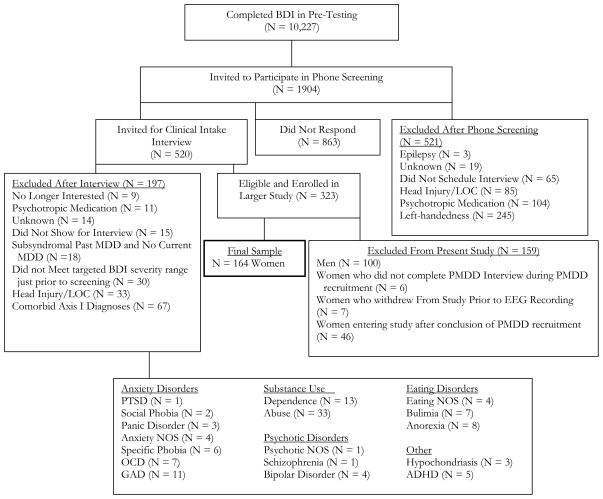
In a sample of 25 college women with PMDD symptomatology and 25 matched controls, resting frontal electroencephalographic (EEG) activity was assessed on four occasions within a two-week span.
Across several frontal sites women with PMDD had relatively less left than right prefrontal brain activity, consistent with a diathesis-stress model for menstrual-related dysphoria.
The findings suggest an overlap in the risk profile for MDD and PMDD.
经前烦躁障碍(PMDD)是经前综合征的一种烦躁形式,被纳入 DSM-IV-TR(APA,2000)中进一步研究的诊断标准。本研究调查了一种与重度抑郁症(MDD)风险相关的标志物,即前额叶大脑不对称,是否也能描述 PMDD 女性的特征。
在 25 名有 PMDD 症状的女大学生和 25 名匹配的对照组中,在两周内的四个时间点评估了静息额部脑电图(EEG)活动。
在几个额部部位,PMDD 女性的左侧前额叶大脑活动明显少于右侧,与月经相关烦躁的素质-应激模型一致。
这些发现表明 MDD 和 PMDD 的风险特征存在重叠。