GGD Gelre-IJssel (Community Health Service), PO Box 51, 7300 AB Apeldoor, Academic Collaborative Centre AGORA, The Netherlands.
BMC Public Health. 2010 Sep 13;10:552. doi: 10.1186/1471-2458-10-552.
The aim of this paper is to provide the rationale for an evaluation design for a complex intervention program targeting loneliness among non-institutionalized elderly people in a Dutch community. Complex public health interventions characteristically use the combined approach of intervening on the individual and on the environmental level. It is assumed that the components of a complex intervention interact with and reinforce each other. Furthermore, implementation is highly context-specific and its impact is influenced by external factors. Although the entire community is exposed to the intervention components, each individual is exposed to different components with a different intensity.
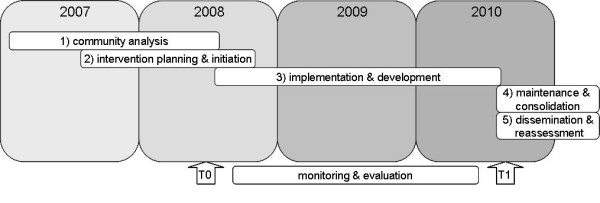
METHODS/DESIGN: A logic model of change is used to develop the evaluation design. The model describes what outcomes may logically be expected at different points in time at the individual level. In order to address the complexity of a real-life setting, the evaluation design of the loneliness intervention comprises two types of evaluation studies. The first uses a quasi-experimental pre-test post-test design to evaluate the effectiveness of the overall intervention. A control community comparable to the intervention community was selected, with baseline measurements in 2008 and follow-up measurements scheduled for 2010. This study focuses on changes in the prevalence of loneliness and in the determinants of loneliness within individuals in the general elderly population. Complementarily, the second study is designed to evaluate the individual intervention components and focuses on delivery, reach, acceptance, and short-term outcomes. Different means of project records and surveys among participants are used to collect these data.
Combining these two evaluation strategies has the potential to assess the effectiveness of the overall complex intervention and the contribution of the individual intervention components thereto.
本文旨在为一项针对荷兰社区非机构化老年人孤独问题的复杂干预计划的评估设计提供依据。复杂的公共卫生干预措施通常采用干预个体和环境层面的综合方法。人们认为,复杂干预的组成部分相互作用并相互加强。此外,实施具有高度的情境特异性,其影响受到外部因素的影响。尽管整个社区都受到干预措施的影响,但每个个体都受到不同强度的不同组成部分的影响。
方法/设计:变化逻辑模型用于开发评估设计。该模型描述了在个体层面上不同时间点可能逻辑上预期的结果。为了应对现实环境的复杂性,孤独干预的评估设计包括两种类型的评估研究。第一种使用准实验前测后测设计来评估整体干预的效果。选择了一个与干预社区可比的对照社区,并于 2008 年进行基线测量,计划于 2010 年进行随访测量。这项研究侧重于一般老年人群体中孤独的普遍性和孤独决定因素的个体内变化。此外,第二项研究旨在评估个体干预措施,并侧重于交付、覆盖范围、接受度和短期结果。通过参与者的项目记录和调查的不同手段收集这些数据。
结合这两种评估策略,有可能评估整体复杂干预的效果以及个别干预措施的贡献。