Laboratoire HIFIH, UPRES EA 3859, IFR 132, Université d'Angers, Rue Haute de Reculée, Angers, F-49035 France.
Crit Care. 2010;14(5):R165. doi: 10.1186/cc9257. Epub 2010 Sep 13.
Hydrogen sulfide (H2S) has been shown to improve survival in rodent models of lethal hemorrhage. Conversely, other authors have reported that inhibition of endogenous H2S production improves hemodynamics and reduces organ injury after hemorrhagic shock. Since all of these data originate from unresuscitated models and/or the use of a pre-treatment design, we therefore tested the hypothesis that the H2S donor, sodium hydrosulfide (NaHS), may improve hemodynamics in resuscitated hemorrhagic shock and attenuate oxidative and nitrosative stresses.
Thirty-two rats were mechanically ventilated and instrumented to measure mean arterial pressure (MAP) and carotid blood flow (CBF). Animals were bled during 60 minutes in order to maintain MAP at 40 ± 2 mm Hg. Ten minutes prior to retransfusion of shed blood, rats randomly received either an intravenous bolus of NaHS (0.2 mg/kg) or vehicle (0.9% NaCl). At the end of the experiment (T = 300 minutes), blood, aorta and heart were harvested for Western blot (inductible Nitric Oxyde Synthase (iNOS), Nuclear factor-κB (NF-κB), phosphorylated Inhibitor κB (P-IκB), Inter-Cellular Adhesion Molecule (I-CAM), Heme oxygenase 1(HO-1), Heme oxygenase 2(HO-2), as well as nuclear respiratory factor 2 (Nrf2)). Nitric oxide (NO) and superoxide anion (O2(-)) were also measured by electron paramagnetic resonance.
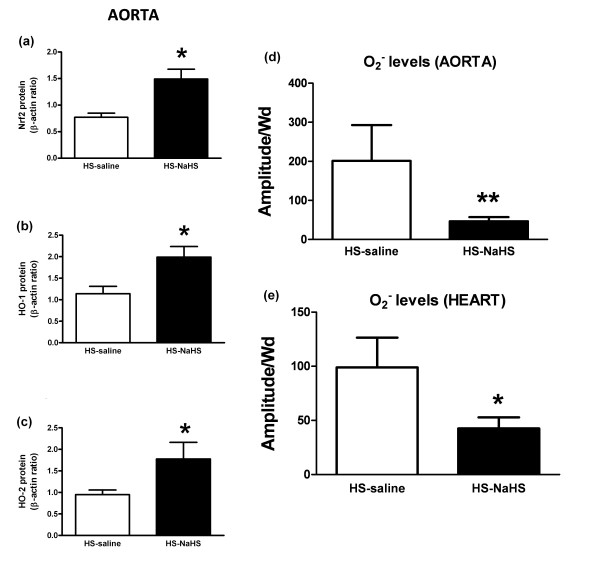
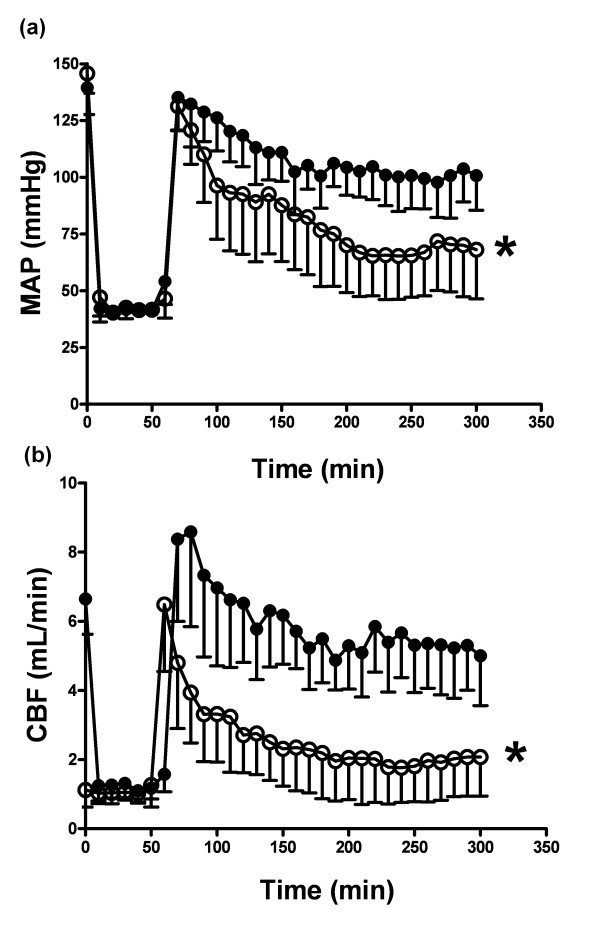
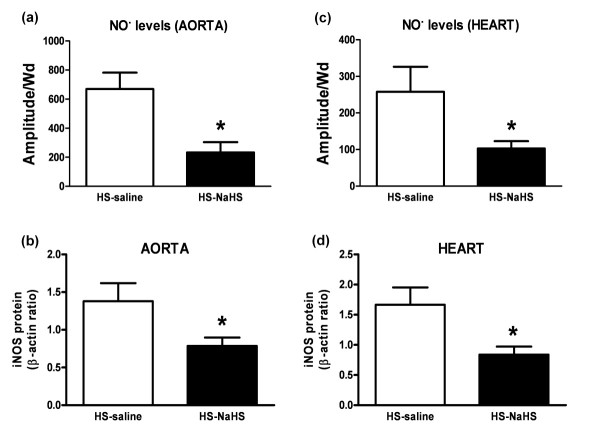
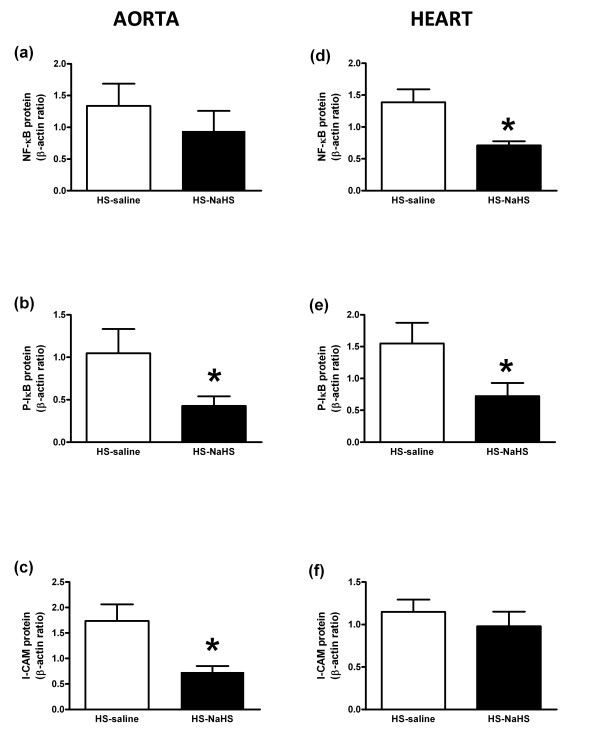
At the end of the experiment, control rats exhibited a decrease in MAP which was attenuated by NaHS (65 ± 32 versus 101 ± 17 mmHg, P < 0.05). CBF was better maintained in NaHS-treated rats (1.9 ± 1.6 versus 4.4 ± 1.9 ml/minute P < 0.05). NaHS significantly limited shock-induced metabolic acidosis. NaHS also prevented iNOS expression and NO production in the heart and aorta while significantly reducing NF-kB, P-IκB and I-CAM in the aorta. Compared to the control group, NaHS significantly increased Nrf2, HO-1 and HO-2 and limited O2(-) release in both aorta and heart (P < 0.05).
NaHS is protective against the effects of ischemia reperfusion induced by controlled hemorrhage in rats. NaHS also improves hemodynamics in the early resuscitation phase after hemorrhagic shock, most likely as a result of attenuated oxidative stress. The use of NaHS hence appears promising in limiting the consequences of ischemia reperfusion (IR).
硫化氢(H2S)已被证明可提高致命性出血的啮齿动物模型的存活率。相反,其他作者报告说,内源性 H2S 产生的抑制可改善出血性休克后的血液动力学并减少器官损伤。由于所有这些数据均源自未复苏的模型和/或预处理设计,因此我们检验了这样一个假设,即 H2S 供体硫氢化钠(NaHS)可改善复苏后出血性休克的血液动力学,并减轻氧化和硝化应激。
32 只大鼠接受机械通气并进行颈动脉血流(CBF)测量。动物在 60 分钟内出血以维持 MAP 为 40±2mmHg。在回输失血前 10 分钟,大鼠随机接受静脉内推注 NaHS(0.2mg/kg)或载体(0.9%NaCl)。在实验结束时(T=300 分钟),采集血液、主动脉和心脏进行 Western blot(诱导型一氧化氮合酶(iNOS)、核因子-κB(NF-κB)、磷酸化抑制κB(P-IκB)、细胞间黏附分子(I-CAM)、血红素加氧酶 1(HO-1)、血红素加氧酶 2(HO-2)以及核呼吸因子 2(Nrf2))。通过电子顺磁共振还测量了一氧化氮(NO)和超氧阴离子(O2(-))。
在实验结束时,对照组大鼠的 MAP 下降,而 NaHS 减轻了这种下降(65±32 对 101±17mmHg,P<0.05)。NaHS 处理的大鼠更好地维持 CBF(1.9±1.6 对 4.4±1.9ml/minute,P<0.05)。NaHS 显著限制了休克引起的代谢性酸中毒。NaHS 还抑制了心脏和主动脉中的 iNOS 表达和 NO 生成,同时显著降低了主动脉中的 NF-κB、P-IκB 和 I-CAM。与对照组相比,NaHS 显著增加了 Nrf2、HO-1 和 HO-2,并限制了主动脉和心脏中的 O2(-)释放(P<0.05)。
NaHS 可防止大鼠控制性出血引起的缺血再灌注损伤。NaHS 还可改善出血性休克后早期复苏阶段的血液动力学,这很可能是由于氧化应激减轻所致。因此,使用 NaHS 有望限制缺血再灌注(IR)的后果。