Department of Pharmacology and Clinical Pharmacology, School of Medical Sciences, Faculty of Medical and Health Sciences, The University of Auckland, Auckland, New Zealand.
Mol Pain. 2010 Sep 13;6:53. doi: 10.1186/1744-8069-6-53.
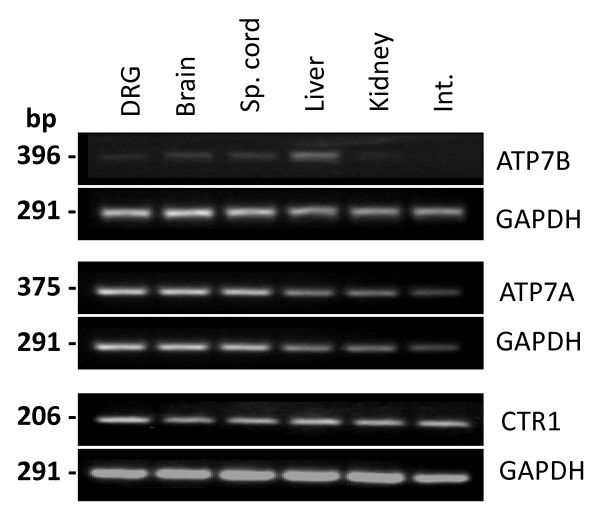
ATP7A, ATP7B and CTR1 are metal transporting proteins that control the cellular disposition of copper and platinum drugs, but their expression in dorsal root ganglion (DRG) tissue and their role in platinum-induced neurotoxicity are unknown. To investigate the DRG expression of ATP7A, ATP7B and CTR1, lumbar DRG and reference tissues were collected for real time quantitative PCR, RT-PCR, immunohistochemistry and Western blot analysis from healthy control adult rats or from animals treated with intraperitoneal oxaliplatin (1.85 mg/kg) or drug vehicle twice weekly for 8 weeks.
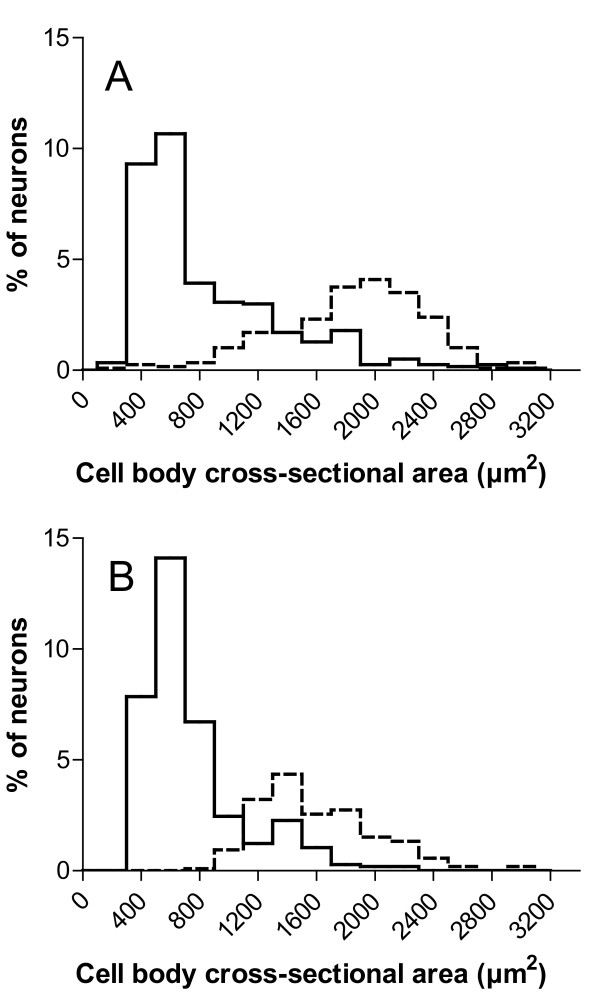
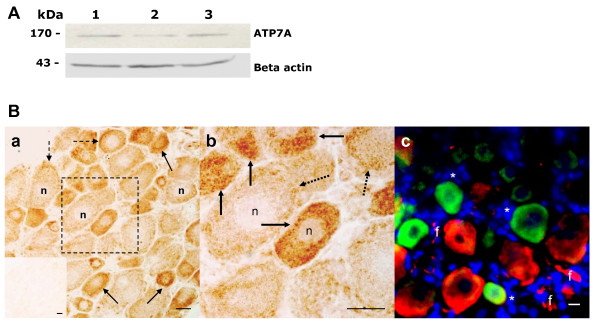
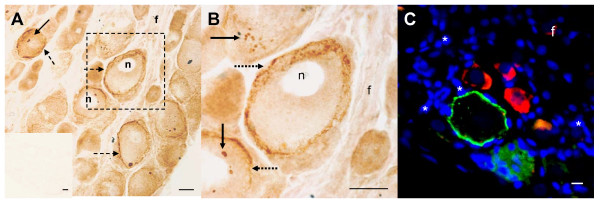
In DRG tissue from healthy control animals, ATP7A mRNA was clearly detectable at levels similar to those found in the brain and spinal cord, and intense ATP7A immunoreactivity was localised to the cytoplasm of cell bodies of smaller DRG neurons without staining of satellite cells, nerve fibres or co-localisation with phosphorylated heavy neurofilament subunit (pNF-H). High levels of CTR1 mRNA were detected in all tissues from healthy control animals, and strong CTR1 immunoreactivity was associated with plasma membranes and vesicular cytoplasmic structures of the cell bodies of larger-sized DRG neurons without co-localization with ATP7A. DRG neurons with strong expression of ATP7A or CTR1 had distinct cell body size profiles with minimal overlap between them. Oxaliplatin treatment did not alter the size profile of strongly ATP7A-immunoreactive neurons but significantly reduced the size profile of strongly CTR1-immunoreactive neurons. ATP7B mRNA was barely detectable, and no specific immunoreactivity for ATP7B was found, in DRG tissue from healthy control animals.
In conclusion, adult rat DRG tissue exhibits a specific pattern of expression of copper transporters with distinct subsets of peripheral sensory neurons intensely expressing either ATP7A or CTR1, but not both or ATP7B. The neuron subtype-specific and largely non-overlapping distribution of ATP7A and CTR1 within rat DRG tissue may be required to support the potentially differing cuproenzyme requirements of distinct subsets of sensory neurons, and could influence the transport and neurotoxicity of oxaliplatin.
ATP7A、ATP7B 和 CTR1 是金属转运蛋白,可控制细胞内铜和铂类药物的分布,但它们在背根神经节 (DRG) 组织中的表达及其在铂类诱导的神经毒性中的作用尚不清楚。为了研究 ATP7A、ATP7B 和 CTR1 在 DRG 中的表达,从健康对照成年大鼠或每周两次腹腔注射奥沙利铂 (1.85mg/kg) 或药物载体处理 8 周的动物中收集腰椎 DRG 和参考组织,进行实时定量 PCR、RT-PCR、免疫组织化学和 Western blot 分析。
在健康对照动物的 DRG 组织中,ATP7A mRNA 的检测水平明显与大脑和脊髓相似,并且强烈的 ATP7A 免疫反应定位于较小 DRG 神经元的细胞体细胞质中,卫星细胞、神经纤维或与磷酸化重神经丝亚单位 (pNF-H) 无共定位。所有健康对照动物的组织中均检测到高水平的 CTR1 mRNA,强烈的 CTR1 免疫反应与较大 DRG 神经元的细胞体的质膜和囊泡细胞质结构相关,与 ATP7A 无共定位。具有强烈 ATP7A 或 CTR1 表达的 DRG 神经元具有明显不同的细胞体大小分布,彼此之间很少重叠。奥沙利铂处理不会改变强烈 ATP7A 免疫反应性神经元的大小分布,但显著降低强烈 CTR1 免疫反应性神经元的大小分布。健康对照动物的 DRG 组织中几乎检测不到 ATP7B mRNA,也未发现 ATP7B 的特异性免疫反应。
总之,成年大鼠 DRG 组织表现出特定的铜转运体表达模式,具有明显的外周感觉神经元亚群强烈表达 ATP7A 或 CTR1,但不是两者或 ATP7B。ATP7A 和 CTR1 在大鼠 DRG 组织中的神经元亚型特异性和基本不重叠分布可能是支持不同感觉神经元亚群潜在不同铜酶需求所必需的,并且可能影响奥沙利铂的转运和神经毒性。