Centre for Environmental Stress and Adaptation Research, Department of Genetics, Bio21 Institute, The University of Melbourne, Parkville, Melbourne 3010, Australia.
BMC Evol Biol. 2010 Sep 16;10:284. doi: 10.1186/1471-2148-10-284.
Progression of development has to be insulated from the damaging impacts of environmental and genetic perturbations to produce highly predictable phenotypes. Molecular chaperones, such as the heat shock proteins (HSPs), are known to buffer various environmental stresses, and are deeply involved in protein homeostasis. These characteristics of HSPs imply that they might affect developmental buffering and canalization.
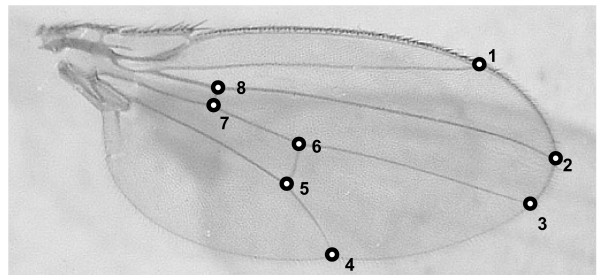
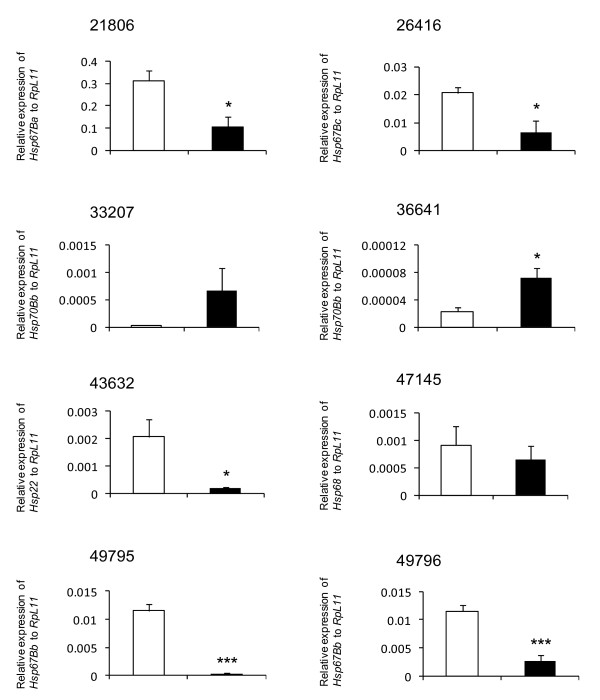
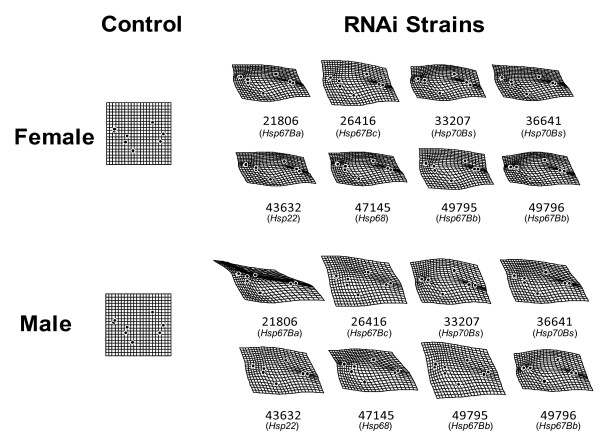
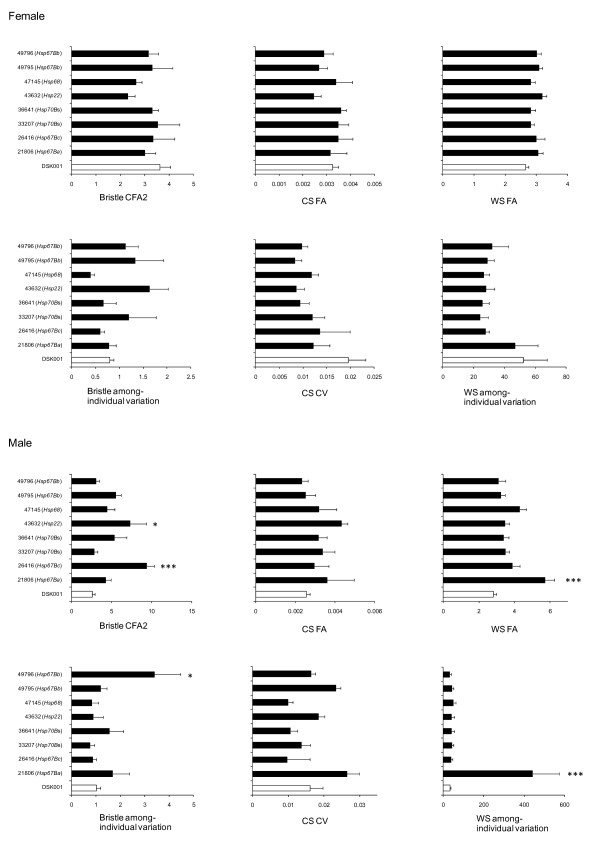
We examined the role of nine Hsp genes using the GAL4/UAS-RNAi system on phenotypic variation of various morphological traits in Drosophila melanogaster. The stability of bristle number, wing size and wing shape was characterized through fluctuating asymmetry (FA) and the coefficient of variation (CV), or among-individual variation. Progeny of the GAL4/Hsp-RNAi crosses tended to have reduced trait means for both wing size and wing shape. Transcriptional knockdown of Hsp67Bc and Hsp22 significantly increased FA of bristle number, while knockdown of Hsp67Ba significantly increased FA and among-individual variation of wing shape but only in males. Suppression of Hsp67Bb expression significantly increased among-individual variation of bristle number. The knockdown of gene expression was confirmed for Hsp67Ba, Hsp67Bc, Hsp22, and Hsp67Bb. Correlation between FA and CV or among-individual variation of each trait is weak and not significant except for the case of male wing shape.
Four small Hsp genes (Hsp22, Hsp67Ba, Hsp67Bb and Hsp67Bc) showed involvement in the processes of morphogenesis and developmental stability. Due to possible different functions in terms of developmental buffering of these small Hsps, phenotypic stability of an organism is probably maintained by multiple mechanisms triggered by different environmental and genetic stresses on different traits. This novel finding may lead to a better understanding of non-Hsp90 molecular mechanisms controlling variability in morphological traits.
为了产生高度可预测的表型,发展的进程必须与环境和遗传扰动的破坏性影响隔离开来。热休克蛋白(HSPs)等分子伴侣已知可以缓冲各种环境压力,并深入参与蛋白质的动态平衡。HSP 的这些特性意味着它们可能会影响发育缓冲和渠道化。
我们使用 GAL4/UAS-RNAi 系统在黑腹果蝇的各种形态特征的表型变异中研究了九个 Hsp 基因的作用。通过波动不对称(FA)和变异系数(CV)或个体间变异来描述刚毛数量、翅膀大小和翅膀形状的稳定性。GAL4/Hsp-RNAi 杂交后代的翅膀大小和翅膀形状的特征均值均有所降低。Hsp67Bc 和 Hsp22 的转录敲低显著增加了刚毛数量的 FA,而 Hsp67Ba 的敲低则显著增加了雄性翅膀形状的 FA 和个体间变异,但仅在雄性中。抑制 Hsp67Bb 表达显著增加了刚毛数量的个体间变异。Hsp67Ba、Hsp67Bc、Hsp22 和 Hsp67Bb 的基因表达敲低得到了证实。除了雄性翅膀形状外,每个性状的 FA 与 CV 或个体间变异之间的相关性都很弱且不显著。
四个小 HSP 基因(Hsp22、Hsp67Ba、Hsp67Bb 和 Hsp67Bc)参与了形态发生和发育稳定性的过程。由于这些小 HSP 在发育缓冲方面可能具有不同的功能,因此生物体的表型稳定性可能是由不同的环境和遗传压力对不同性状触发的多种机制维持的。这一新发现可能有助于更好地理解控制形态特征变异性的非 HSP90 分子机制。