Muséum National d'Histoire Naturelle Département Systématique et Evolution UMR 7205, Centre National de la Recherche Scientifique, Paris, France.
PLoS Genet. 2011 Oct;7(10):e1002314. doi: 10.1371/journal.pgen.1002314. Epub 2011 Oct 6.
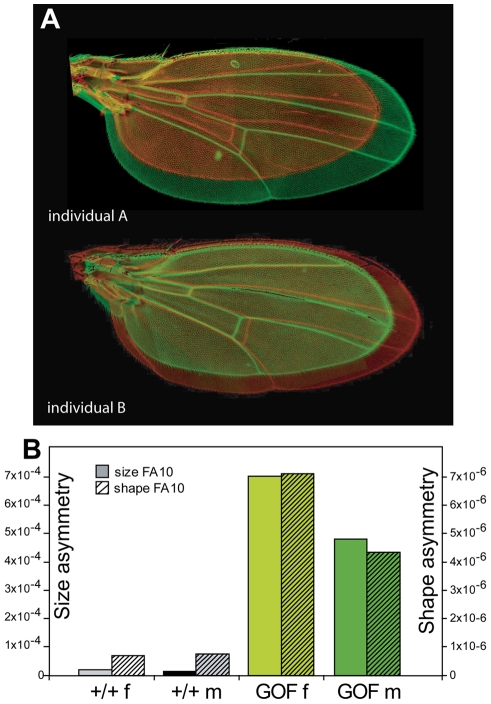
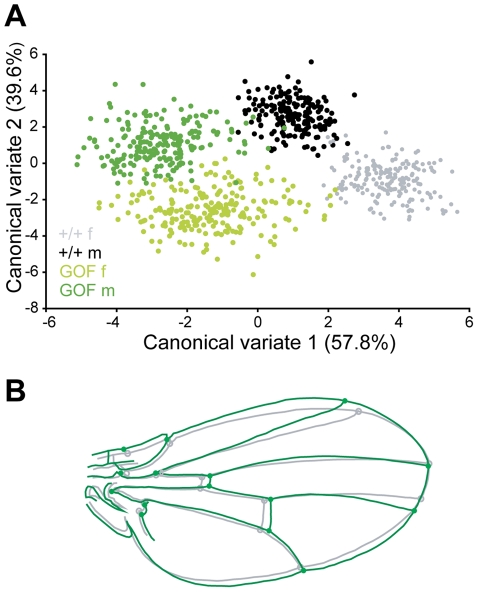
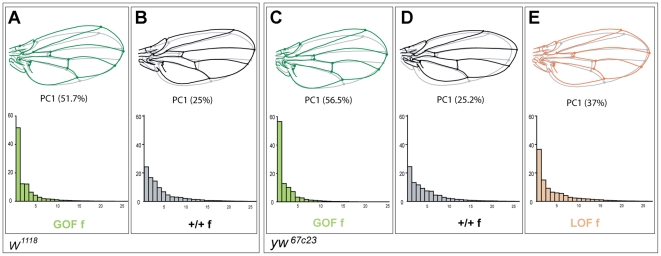
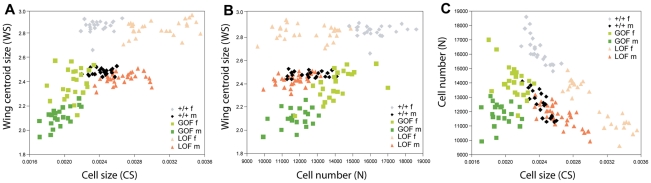
Morphological consistency in metazoans is remarkable given the pervasive occurrence of genetic variation, environmental effects, and developmental noise. Developmental stability, the ability to reduce developmental noise, is a fundamental property of multicellular organisms, yet its genetic bases remains elusive. Imperfect bilateral symmetry, or fluctuating asymmetry, is commonly used to estimate developmental stability. We observed that Drosophila melanogaster overexpressing Cyclin G (CycG) exhibit wing asymmetry clearly detectable by sight. Quantification of wing size and shape using geometric morphometrics reveals that this asymmetry is a genuine-but extreme-fluctuating asymmetry. Overexpression of CycG indeed leads to a 40-fold increase of wing fluctuating asymmetry, which is an unprecedented effect, for any organ and in any animal model, either in wild populations or mutants. This asymmetry effect is not restricted to wings, since femur length is affected as well. Inactivating CycG by RNAi also induces fluctuating asymmetry but to a lesser extent. Investigating the cellular bases of the phenotypic effects of CycG deregulation, we found that misregulation of cell size is predominant in asymmetric flies. In particular, the tight negative correlation between cell size and cell number observed in wild-type flies is impaired when CycG is upregulated. Our results highlight the role of CycG in the control of developmental stability in D. melanogaster. Furthermore, they show that wing developmental stability is normally ensured via compensatory processes between cell growth and cell proliferation. We discuss the possible role of CycG as a hub in a genetic network that controls developmental stability.
后生动物形态的一致性是显著的,因为遗传变异、环境影响和发育噪声普遍存在。发育稳定性,即减少发育噪声的能力,是多细胞生物的基本特性,但它的遗传基础仍然难以捉摸。不完全的双侧对称或波动不对称,通常用于估计发育稳定性。我们观察到,过度表达细胞周期蛋白 G(CycG)的果蝇表现出明显可察觉的翅膀不对称。使用几何形态测量学对翅膀大小和形状进行定量分析表明,这种不对称性是一种真正的——但极端的波动不对称性。CycG 的过度表达确实导致翅膀波动不对称性增加了 40 倍,这是任何器官和任何动物模型在野生种群或突变体中都前所未有的效果。这种不对称效应不仅限于翅膀,因为股骨长度也受到影响。通过 RNAi 使 CycG 失活也会引起波动不对称性,但程度较小。研究 CycG 失调对表型影响的细胞基础时,我们发现细胞大小的失调在不对称的果蝇中占主导地位。特别是,当 CycG 上调时,在野生型果蝇中观察到的细胞大小和细胞数量之间的紧密负相关被破坏。我们的研究结果强调了 CycG 在控制 D. melanogaster 发育稳定性方面的作用。此外,它们表明翅膀发育稳定性通常是通过细胞生长和细胞增殖之间的补偿过程来保证的。我们讨论了 CycG 作为控制发育稳定性的遗传网络中的枢纽的可能作用。