Department of Anatomy and Neuroscience, Hyogo College of Medicine, Nishinomiya, Hyogo, Japan.
Mol Pain. 2010 Sep 17;6:57. doi: 10.1186/1744-8069-6-57.
Leukotrienes (LTs) belong to the large family of lipid mediators implicated in various inflammatory conditions such as asthma and rheumatoid arthritis. Four distinct types (BLT1, BLT2, CysLT1 and CysLT2) of G-protein-coupled receptors for LTs have been identified. Several studies have reported that LTs are involved in inflammatory pain, but the mechanism and the expression of LT receptors in the nociceptive pathway are unknown.
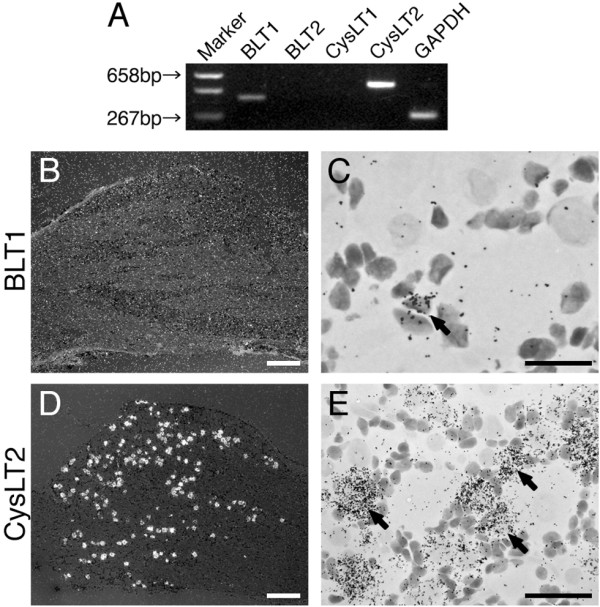
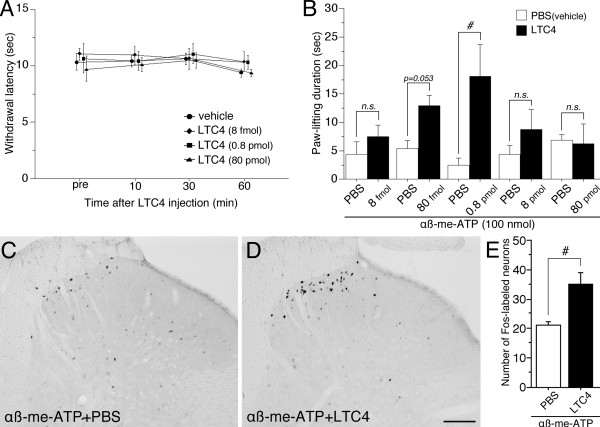
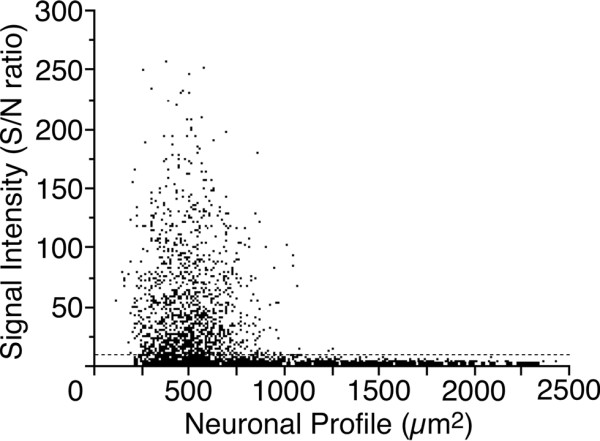
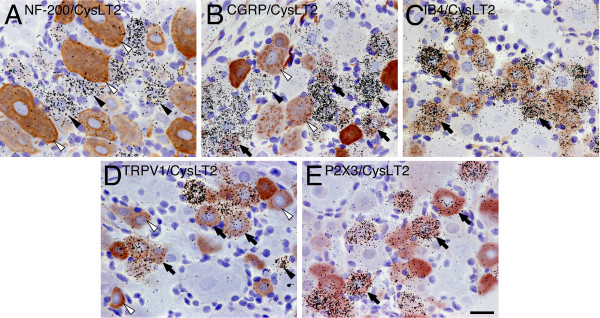
We investigated the precise expression of these four types of LT receptors in the adult rat dorsal root ganglion (DRG) using reverse transcription-polymerase reaction (RT-PCR) and radioisotope-labeled in situ hybridization histochemistry (ISHH). We detected mRNAs for BLT1 and CysLT2 in the DRG, but not for BLT2 and CysLT1. CysLT2 mRNA was preferentially expressed by small sized DRG neurons (about 36% of total neurons), whereas BLT1 mRNA was expressed by non-neuronal cells. Double labeling analysis of CysLT2 with NF-200, calcitonin gene-related peptide (CGRP), isolectin B4 (IB4), transient receptor potential vanilloid subfamily 1 (TRPV1) and P2X3 receptor revealed that many CysLT2-labeled neurons were localized with unmyelinated and non-peptidergic neurons, and interestingly, CysLT2 mRNA heavily co-localized with TRPV1 and P2X3-positive neurons. Intraplantar injection of LTC4, a CysLT2 receptor agonist, itself did not induce the thermal hyperalgesia, spontaneous pain behaviors or swelling of hind paw. However, pretreatment of LTC4 remarkably enhanced the painful behaviors produced by alpha, beta-methylene adenosine 5'-triphosphate (αβ-me-ATP), a P2X3 receptor agonist.
These data suggests that CysLT2 expressed in DRG neurons may play a role as a modulator of P2X3, and contribute to a potentiation of the neuronal activity following peripheral inflammation.
白三烯(LTs)属于脂质介质大家族,与哮喘和类风湿性关节炎等各种炎症状态有关。已经鉴定出四种不同类型(BLT1、BLT2、CysLT1 和 CysLT2)的 LT G 蛋白偶联受体。多项研究报告称 LTs 参与炎症性疼痛,但疼痛通路中 LT 受体的机制和表达尚不清楚。
我们使用逆转录-聚合酶链反应(RT-PCR)和放射性同位素标记原位杂交组织化学(ISHH)研究了这四种 LT 受体在成年大鼠背根神经节(DRG)中的精确表达。我们在 DRG 中检测到 BLT1 和 CysLT2 的 mRNA,但未检测到 BLT2 和 CysLT1。CysLT2 mRNA 优先表达于小尺寸 DRG 神经元(约占总神经元的 36%),而 BLT1 mRNA 则由非神经元细胞表达。CysLT2 与 NF-200、降钙素基因相关肽 (CGRP)、同工凝集素 B4 (IB4)、瞬时受体电位香草酸亚家族 1 (TRPV1) 和 P2X3 受体的双重标记分析表明,许多 CysLT2 标记的神经元定位于无髓和非肽能神经元,有趣的是,CysLT2 mRNA 与 TRPV1 和 P2X3 阳性神经元大量共定位。LTC4,一种 CysLT2 受体激动剂,本身不会引起足底注射后的热痛觉过敏、自发性疼痛行为或后爪肿胀。然而,LTC4 的预处理显着增强了 P2X3 受体激动剂 αβ-亚甲基腺苷 5'-三磷酸 (αβ-me-ATP) 产生的疼痛行为。
这些数据表明,DRG 神经元中表达的 CysLT2 可能作为 P2X3 的调节剂发挥作用,并有助于外周炎症后神经元活动的增强。