Obstetrics and Gynecology, Brigham and Women's Hospital, Boston, MA, USA.
Gynecol Oncol. 2010 Dec;119(3):462-8. doi: 10.1016/j.ygyno.2010.08.028. Epub 2010 Sep 17.
CA125 at presentation of ovarian cancer carries important prognostic significance; but, other than tumor characteristics, little is known about factors that influence CA125 levels. We examined the effect of epidemiologic variables and tumor features on CA125 at diagnosis and their effects on survival.
CA125 levels before treatment, tumor features, and questionnaire data from 805 women with ovarian cancer receiving care at Partners Hospitals were recorded. CA125 values were log-normalized and generalized linear, logistic, or Cox proportional hazards models used to identify predictors of CA125 and influence on survival in the subset of women with invasive, nonmucinous tumors.
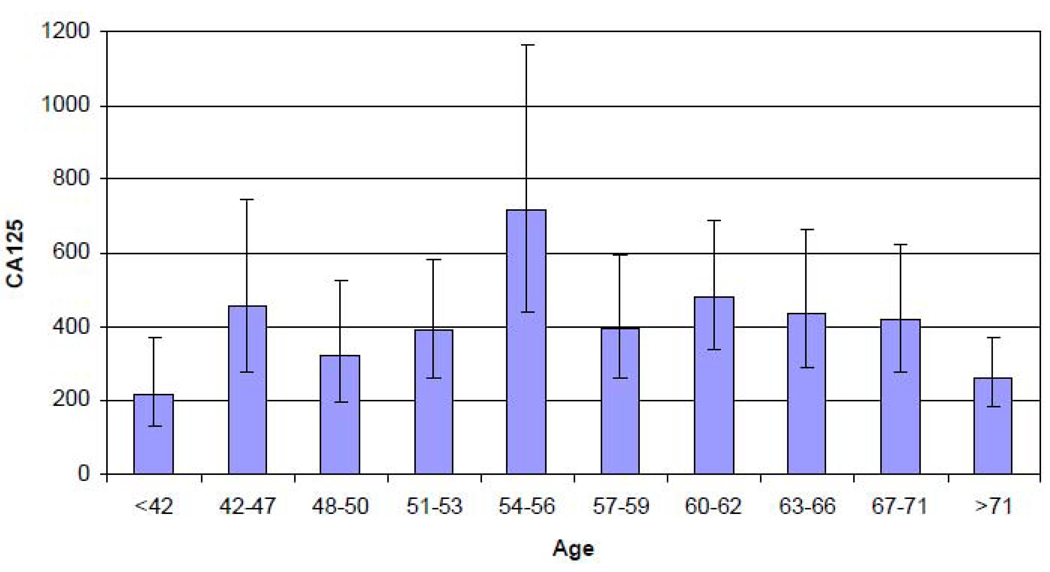
The importance of histology, grade, stage, laterality, and presence of ascites on CA125 level was confirmed. For nonmucinous invasive cancers, Jewish ethnicity, parity, prior breast cancer, and family history of breast or ovarian cancer predicted higher CA125, and greater body mass index (BMI), recurrent yeast infections, colitis, and appendectomy predicted lower CA125. A quadratic model best described the relationship between CA125 and age with lower levels in youngest and oldest women. In multivariate modeling, stage, ascites, and prior breast cancer were the strongest predictors of high CA125 and appendectomy and yeast infections strongest predictors of low CA125. A model with these variables plus CA125 revealed high CA125 remains a predictor of poorer survival.
Ovarian tumor features and presence of ascites are key determinants of CA125 at diagnosis, but epidemiologic features such as BMI, parity, prior breast cancer, and history of inflammatory conditions of the genitourinary or gastrointestinal tracts may also play a role.
卵巢癌患者就诊时的 CA125 具有重要的预后意义;但除了肿瘤特征外,人们对影响 CA125 水平的因素知之甚少。我们研究了流行病学变量和肿瘤特征对诊断时 CA125 水平的影响及其对生存的影响。
记录了在 Partners 医院接受治疗的 805 名卵巢癌女性的 CA125 水平、肿瘤特征和问卷调查数据。CA125 值进行对数正态化,然后使用广义线性、逻辑或 Cox 比例风险模型来确定影响非黏液性浸润性肿瘤患者 CA125 水平的预测因子及其对生存的影响。
证实了组织学、分级、分期、侧别和腹水对 CA125 水平的重要性。对于非黏液性浸润性癌,犹太种族、产次、既往乳腺癌以及乳腺癌或卵巢癌家族史预测 CA125 水平更高,而较高的体重指数(BMI)、复发性酵母感染、结肠炎和阑尾切除术预测 CA125 水平更低。二次模型最好地描述了 CA125 与年龄之间的关系,最年轻和最年长的女性 CA125 水平较低。在多变量建模中,分期、腹水和既往乳腺癌是 CA125 水平升高的最强预测因子,阑尾切除术和酵母感染是 CA125 水平降低的最强预测因子。包含这些变量和 CA125 的模型表明,CA125 水平升高仍然是生存较差的预测因子。
卵巢肿瘤特征和腹水的存在是诊断时 CA125 的关键决定因素,但 BMI、产次、既往乳腺癌以及生殖泌尿系统或胃肠道炎症性疾病的病史等流行病学特征也可能发挥作用。