Mohr O, Velasco E, Fell G, Burckhardt F, Poggensee G, Eckmanns T
Abteilung für Infektionsepidemiologie, Fachgebiet Surveillance, Robert Koch-Institut, DGZ-Ring 1, 13086 Berlin.
Bundesgesundheitsblatt Gesundheitsforschung Gesundheitsschutz. 2010 Sep;53(9):903-9. doi: 10.1007/s00103-010-1122-z.
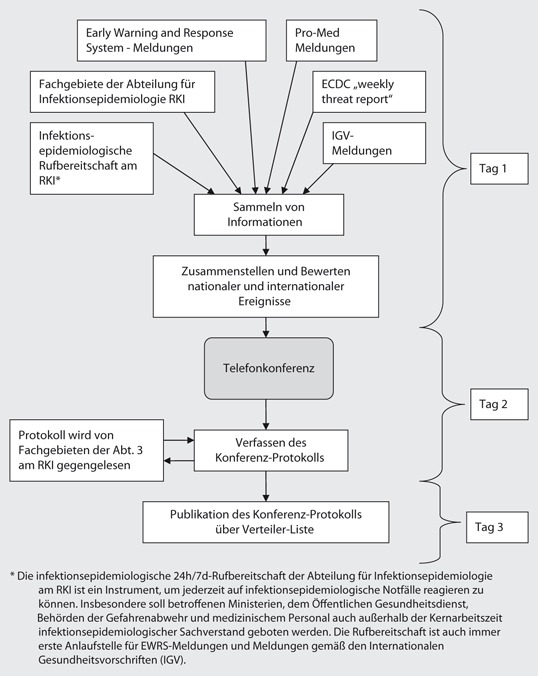
Public health threats are increasingly triggered by events which span across international, national and state level jurisdictions. Innovative surveillance methods are needed to ensure adequate and timely response to such threats. In January 2009 the Department of Infectious Disease Epidemiology at the Robert Koch Institute (RKI) established a system of weekly telephone conferences with all competent authorities of the German federal states to identify, discuss and respond to infectious disease events in real-time. A regular and structured platform was developed for use between participants from state level public health authorities, the military and the RKI. During the first three quarters, 46 infectious diseases were covered, including mandatory reports of measles and meningococcal meningitis and outbreaks of cowpox, which does not have to be notified in Germany. Results of a targeted evaluation and a consistently high attendance rate both indicate that the teleconference has met additional needs for supplemental information exchange among participants. The telephone conference has proven to be a useful resource for rapid and direct communication, coordination and evaluation of signals for public health events in Germany.
公共卫生威胁越来越多地由跨越国际、国家和州级司法管辖区的事件引发。需要创新的监测方法,以确保对这类威胁做出充分及时的应对。2009年1月,罗伯特·科赫研究所(RKI)传染病流行病学部与德国联邦各州的所有主管当局建立了每周电话会议系统,以便实时识别、讨论和应对传染病事件。为州级公共卫生当局、军方和RKI的参与者开发了一个定期且结构化的平台。在前三个季度,涵盖了46种传染病,包括麻疹和脑膜炎球菌性脑膜炎的法定报告以及牛痘疫情,牛痘在德国无需通报。有针对性的评估结果和始终很高的出席率均表明,电话会议满足了参与者之间补充信息交流的额外需求。电话会议已被证明是德国公共卫生事件信号快速直接沟通、协调和评估的有用资源。