Department of Clinical Health and Neuropsychology, Leiden University, Leiden, The Netherlands.
Mol Psychiatry. 2011 Nov;16(11):1088-95. doi: 10.1038/mp.2010.98. Epub 2010 Sep 21.
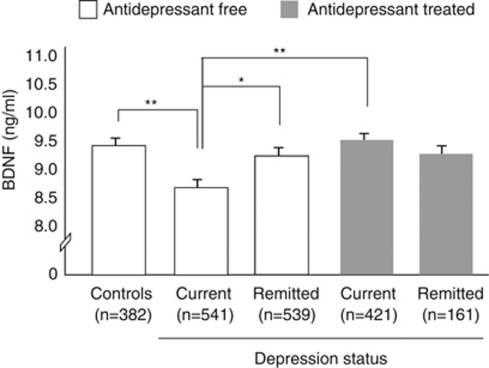
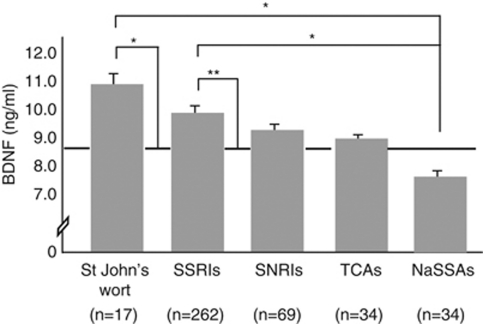
Recent evidence supports 'the neurotrophin hypothesis of depression' in its prediction that brain-derived neurotrophic factor (BDNF) is involved in depression. However, some key questions remain unanswered, including whether abnormalities in BDNF persist beyond the clinical state of depression, whether BDNF levels are related to the clinical features of depression and whether distinct antidepressants affect BDNF levels equally. We addressed these questions and investigated serum BDNF levels in 962 depressed patients, 700 fully remitted persons (≥6 months) and 382 healthy controls. We found serum BDNF levels to be low in antidepressant-free depressed patients relative to controls (P=0.007) and to depressed patients who were treated with an antidepressant (P=0.001). BDNF levels of fully remitted persons (whether unmedicated or treated with an antidepressant) were comparable to those of controls. Analyzing the sample of antidepressant-free depressed patients showed that BDNF levels were unrelated to the core clinical features of depression such as its severity or first versus a recurrent episode. The antidepressant associated upregulation of serum BDNF in depressed patients was confined to selective serotonin reuptake inhibitors (SSRIs) (P=0.003) and St John's wort (P=0.03). Our results suggest that low serum levels of BDNF are a state abnormality that is evident during depression and normalizes during remission. Increases in serum levels of BDNF during antidepressant treatment appear to be confined to some antidepressants and do not parallel clinical characteristics, such as the severity of depressive symptoms.
最近的证据支持“抑郁症的神经营养因子假说”,该假说预测脑源性神经营养因子 (BDNF) 与抑郁症有关。然而,一些关键问题仍未得到解答,包括 BDNF 的异常是否持续存在于抑郁症的临床状态之外、BDNF 水平是否与抑郁症的临床特征有关,以及不同的抗抑郁药是否同样影响 BDNF 水平。我们解决了这些问题,并调查了 962 名抑郁症患者、700 名完全缓解者(≥6 个月)和 382 名健康对照者的血清 BDNF 水平。我们发现,与对照组相比,未接受抗抑郁治疗的抑郁症患者的血清 BDNF 水平较低(P=0.007),与接受抗抑郁治疗的抑郁症患者相比(P=0.001)。完全缓解者(无论是否接受药物治疗)的 BDNF 水平与对照组相当。对未接受抗抑郁治疗的抑郁症患者样本进行分析表明,BDNF 水平与抑郁症的核心临床特征(如严重程度或首次发作与复发发作)无关。抗抑郁药引起的血清 BDNF 上调仅见于选择性 5-羟色胺再摄取抑制剂(SSRIs)(P=0.003)和圣约翰草(P=0.03)。我们的研究结果表明,低血清 BDNF 水平是一种状态异常,在抑郁症期间明显,在缓解期正常化。抗抑郁治疗期间血清 BDNF 水平的增加似乎仅限于某些抗抑郁药,而与临床特征(如抑郁症状的严重程度)并不平行。