Department of Pathology, Yokohama City University School of Medicine, Yokohama, Japan.
PLoS One. 2010 Aug 10;5(8):e12105. doi: 10.1371/journal.pone.0012105.
Sandhoff disease is a lysosomal storage disorder characterized by the absence of β-hexosaminidase and storage of GM2 ganglioside and related glycolipids. We have previously found that the progressive neurologic disease induced in Hexb(-/-) mice, an animal model for Sandhoff disease, is associated with the production of pathogenic anti-glycolipid autoantibodies.
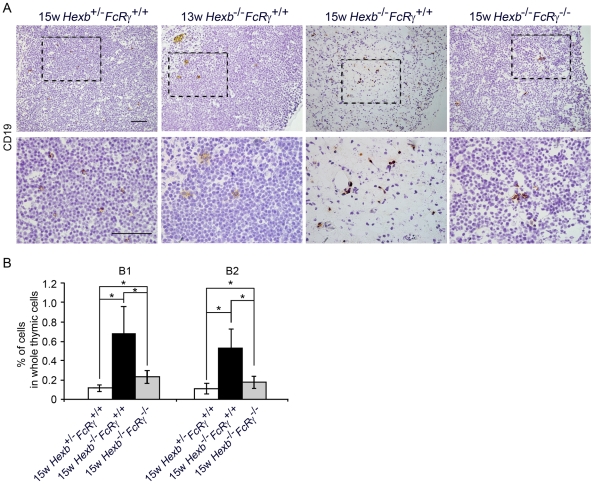
METHODOLOGY/PRINCIPAL FINDINGS: In our current study, we report on the alterations in the thymus during the development of mild to severe progressive neurologic disease. The thymus from Hexb(-/-) mice of greater than 15 weeks of age showed a marked decrease in the percentage of immature CD4(+)/CD8(+) T cells and a significantly increased number of CD4(+)/CD8(-) T cells. During involution, the levels of both apoptotic thymic cells and IgG deposits to T cells were found to have increased, whilst swollen macrophages were prominently observed, particularly in the cortex. We employed cDNA microarray analysis to monitor gene expression during the involution process and found that genes associated with the immune responses were upregulated, particularly those expressed in macrophages. CXCL13 was one of these upregulated genes and is expressed specifically in the thymus. B1 cells were also found to have increased in the thy mus. It is significant that these alterations in the thymus were reduced in FcRγ additionally disrupted Hexb(-/-) mice.
CONCLUSIONS/SIGNIFICANCE: These results suggest that the FcRγ chain may render the usually poorly immunogenic thymus into an organ prone to autoimmune responses, including the chemotaxis of B1 cells toward CXCL13.
桑德霍夫病是一种溶酶体贮积症,其特征是缺乏β-己糖胺酶,以及 GM2 神经节苷脂和相关糖脂的贮积。我们之前发现,Hexb(-/-)小鼠(桑德霍夫病的动物模型)诱导的进行性神经疾病与致病性抗糖脂自身抗体的产生有关。
方法/主要发现:在我们目前的研究中,我们报告了轻度至重度进行性神经疾病发展过程中胸腺的变化。大于 15 周龄的 Hexb(-/-)小鼠的胸腺显示不成熟的 CD4(+)/CD8(+)T 细胞的百分比明显减少,CD4(+)/CD8(-)T 细胞的数量显著增加。在退化过程中,发现凋亡胸腺细胞和 IgG 沉积到 T 细胞的水平都增加了,而肿胀的巨噬细胞则明显观察到,特别是在皮质。我们采用 cDNA 微阵列分析来监测退化过程中的基因表达,发现与免疫反应相关的基因上调,特别是在巨噬细胞中表达的基因上调。CXCL13 是上调的基因之一,它在胸腺中特异性表达。B1 细胞也在胸腺中增加。重要的是,这些胸腺的改变在 FcRγ 进一步破坏 Hexb(-/-)小鼠中减少了。
结论/意义:这些结果表明,FcRγ 链可能使通常免疫原性差的胸腺变成易发生自身免疫反应的器官,包括 B1 细胞向 CXCL13 的趋化作用。