
虾蛄(口足目,软甲纲)在中生代新化石中的演化。
Evolution of mantis shrimps (Stomatopoda, Malacostraca) in the light of new Mesozoic fossils.
机构信息
Biosystematic Documentation, University of Ulm, Helmholtzstr 20, D-89081 Ulm, Germany.
出版信息
BMC Evol Biol. 2010 Sep 21;10:290. doi: 10.1186/1471-2148-10-290.
BACKGROUND
We describe new specimens of Mesozoic mantis shrimps (Stomatopoda, Malacostraca) that exhibit morphological and developmental information previously unknown.
RESULTS
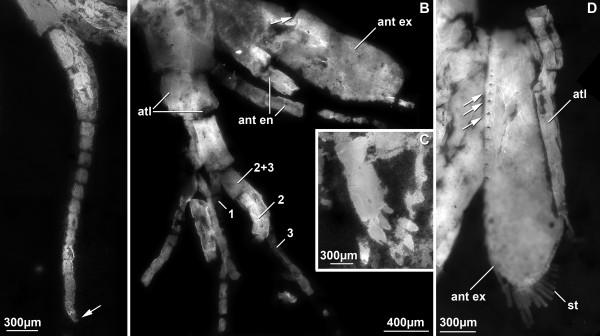
Specimens assigned to the taxon Sculda exhibit preserved pleopods, thoracopods including all four raptorial limbs as well as details of antennae and antennulae. The pleopods and the antennulae resemble those of the modern mantis shrimps, but the raptorial limbs are not as differentiated as in the modern species. In some specimens, the first raptorial limb (second thoracopod) is not significantly larger than the similar-sized posterior three pairs (as in extant species), but instead these appendages become progressively smaller along the series. In this respect they resemble certain Palaeozoic stomatopods. Another specimen, most likely belonging to another species, has one pair of large anterior raptorial thoracopods, a median-sized pair and two more pairs of small-sized raptorial appendages and, thus, shows a new, previously unknown type of morphology. A single specimen of Pseudosculda laevis also exhibits the size of the raptorial limbs; they are differentiated as in modern species, one large pair and three small pairs. Furthermore, we report additional larval specimens and show also post-larval changes, e.g., of the tail fan.
CONCLUSIONS
These new data are used to reconsider the phylogeny of Stomatopoda. We still need a strict taxonomical revision of the Mesozoic mantis shrimps, but this first examination already demonstrates the importance of these fossils for understanding mantis shrimp evolution and the interpretation of evolutionary pathways of particular features.
背景
我们描述了一些中生代螳螂虾(十足目,软甲纲)的新标本,这些标本展示了以前未知的形态和发育信息。
结果
被归为 Sculda 分类群的标本显示出保存完好的胸足、包括所有四个捕食足在内的胸肢,以及触角和触角小枝的细节。胸足和触角小枝类似于现代螳螂虾的胸足和触角小枝,但捕食足没有现代物种那样分化。在一些标本中,第一对捕食足(第二胸肢)并不明显大于后三对相似大小的足(如现存物种),而是沿着系列逐渐变小。在这方面,它们类似于某些古生代的十足目。另一个标本,很可能属于另一个物种,有一对大的前捕食胸肢、一对中等大小的胸肢和两对更小的捕食附肢,因此显示出一种新的、以前未知的形态类型。一个单独的 Pseudosculda laevis 标本也显示了捕食足的大小;它们与现代物种一样分化,有一对大的和三对小的。此外,我们还报告了额外的幼虫标本,并展示了尾扇的后期变化。
结论
这些新数据用于重新考虑十足目动物的系统发育。我们仍然需要对中生代螳螂虾进行严格的分类修订,但这第一次检查已经证明了这些化石对于理解螳螂虾进化以及解释特定特征的进化途径的重要性。




 Zotero 插件