
基于分子数据推断口足目(甲壳纲:软甲亚纲)的进化史。
The evolutionary history of Stomatopoda (Crustacea: Malacostraca) inferred from molecular data.
作者信息
Van Der Wal Cara, Ahyong Shane T, Ho Simon Y W, Lo Nathan
机构信息
School of Life and Environmental Sciences, University of Sydney, Sydney, Australia.
Australian Museum, Sydney, Australia.
出版信息
PeerJ. 2017 Sep 21;5:e3844. doi: 10.7717/peerj.3844. eCollection 2017.
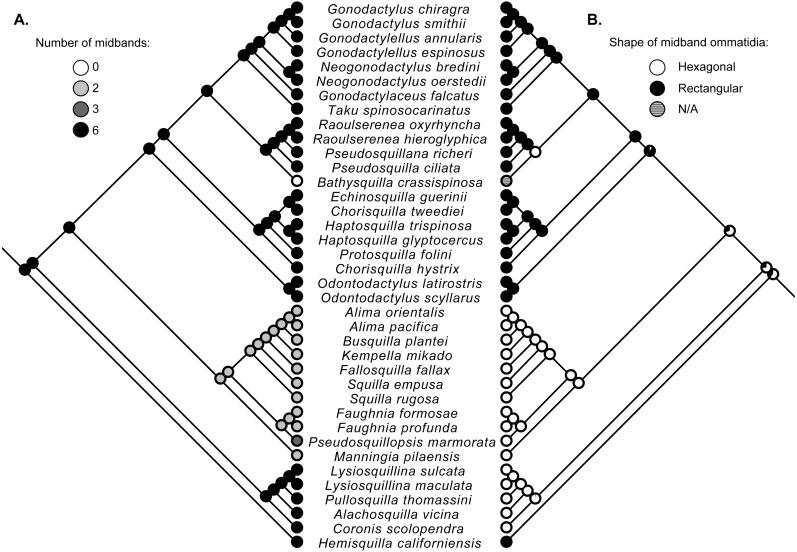
The crustacean order Stomatopoda comprises seven superfamilies of mantis shrimps, found in coastal waters of the tropics and subtropics. These marine carnivores bear notable raptorial appendages for smashing or spearing prey. We investigated the evolutionary relationships among stomatopods using phylogenetic analyses of three mitochondrial and two nuclear markers. Our analyses recovered the superfamily Gonodactyloidea as polyphyletic, with as the sister group to all other extant stomatopods. A relaxed molecular clock, calibrated by seven fossil-based age constraints, was used to date the origin and major diversification events of stomatopods. Our estimates suggest that crown-group stomatopods (Unipeltata) diverged from their closest crustacean relatives about 340 Ma (95% CRI [401-313 Ma]). We found that the specialized smashing appendage arose after the spearing appendage ∼126 Ma (95% CRI [174-87 Ma]). Ancestral state reconstructions revealed that the most recent common ancestor of extant stomatopods had eyes with six midband rows of hexagonal ommatidia. Hexagonal ommatidia are interpreted as plesiomorphic in stomatopods, and this is consistent with the malacostracan ground-plan. Our study provides insight into the evolutionary timescale and systematics of Stomatopoda, although further work is required to resolve with confidence the phylogenetic relationships among its superfamilies.
口足目甲壳动物包括七个螳螂虾超科,分布于热带和亚热带沿海水域。这些海洋食肉动物具有显著的捕食性附肢,用于击碎或刺穿猎物。我们利用三个线粒体标记和两个核标记进行系统发育分析,研究了口足类动物之间的进化关系。我们的分析发现,指虾蛄超科是多系的,其中[具体内容缺失]是所有其他现存口足类动物的姐妹群。利用由七个基于化石的年龄限制校准的宽松分子钟,对口足类动物的起源和主要多样化事件进行了年代测定。我们的估计表明,冠群口足类动物(单盾亚纲)与其最亲近的甲壳类亲属大约在3.4亿年前分化(95%置信区间[4.01-3.13亿年前])。我们发现,专门的击碎附肢在穿刺附肢出现后约1.26亿年前出现(95%置信区间[1.74-0.87亿年前])。祖先状态重建显示,现存口足类动物的最近共同祖先的眼睛有六排位于中带的六边形小眼。六边形小眼在口足类动物中被解释为近祖性状,这与软甲亚纲的基本模式一致。我们的研究为口足目的进化时间尺度和系统学提供了见解,尽管还需要进一步的工作来确定其超科之间的系统发育关系。

 Zotero 插件