Howe Laura D, Tilling Kate, Galobardes Bruna, Smith George Davey, Ness Andy R, Lawlor Debbie A
Department of Social Medicine, University of Bristol, UK.
Int J Pediatr Obes. 2011 Jun;6(2-2):e144-53. doi: 10.3109/17477166.2010.500387. Epub 2010 Sep 22.
Socioeconomic inequalities in obesity are consistently observed in high-income countries. The development of such inequalities across childhood; however, has not been studied using longitudinal data.
Using data from the Avon Longitudinal Study of Parents and Children (participants were born 1991/2 in South-West England), we modelled trajectories of ponderal index (PI) (N=12 246) from birth to 2 years and body mass index (BMI) (N=11 380) from 2 to 10 years. Individual trajectories were estimated using mixed-effects models, and differences in trajectories by socioeconomic position (measured by maternal education) were investigated.
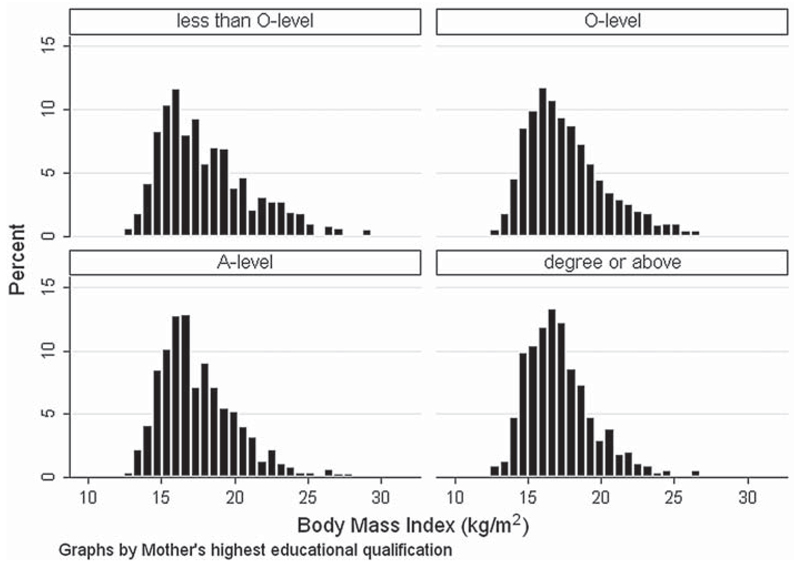
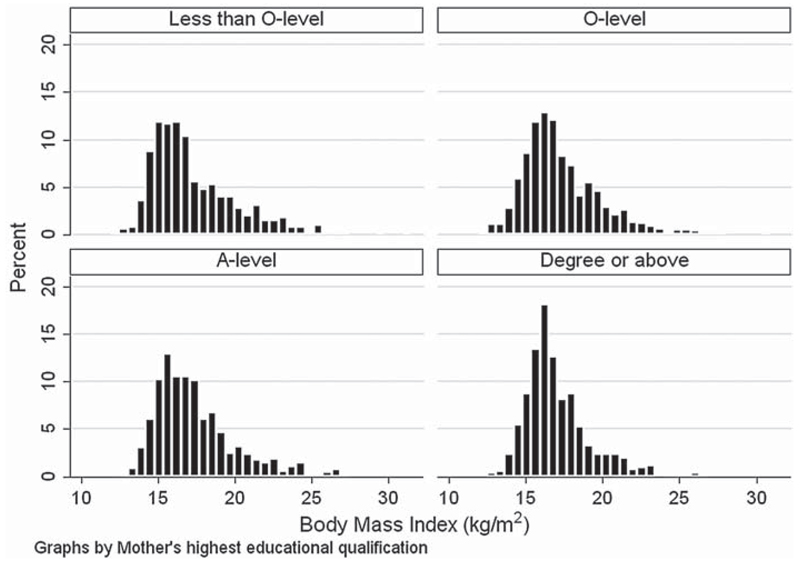
There was little socioeconomic patterning of PI from birth to 2 years. Socioeconomic differences in BMI began to emerge by 4 years old, and widened with increasing age. Amongst girls there was a clear gradient across all categories of maternal education by age 8, with daughters of more educated women being less adipose. Amongst boys, sons of degree-educated women had lower BMI but there was little difference between the lower maternal education categories. By 10 years old the mean BMI difference between the highest and lowest maternal education category was 0.38 kg/m(2) for boys and 0.89 kg/m(2) for girls. The results imply that interventions to prevent inequalities in childhood obesity should begin in pre-school years.
在高收入国家,肥胖方面的社会经济不平等现象一直存在。然而,尚未利用纵向数据对儿童期这种不平等现象的发展情况进行研究。
利用雅芳亲子纵向研究(参与者于1991/1992年出生在英格兰西南部)的数据,我们对出生至2岁的 ponderal 指数(PI)(N = 12246)以及2至10岁的体重指数(BMI)(N = 11380)的轨迹进行了建模。使用混合效应模型估计个体轨迹,并研究社会经济地位(以母亲教育程度衡量)对轨迹的影响。
从出生到2岁,PI几乎没有社会经济模式。BMI的社会经济差异在4岁时开始显现,并随着年龄增长而扩大。在8岁时,所有母亲教育程度类别中,女孩存在明显梯度,受教育程度较高女性的女儿脂肪较少。在男孩中,受过大学教育女性的儿子BMI较低,但母亲教育程度较低的类别之间差异不大。到10岁时,母亲教育程度最高和最低类别之间的平均BMI差异,男孩为0.38kg/m²,女孩为0.89kg/m²。结果表明,预防儿童肥胖不平等现象的干预措施应在学前阶段开始。