Cescon Matteo, Ravaioli Matteo, Grazi Gian Luca, Ercolani Giorgio, Cucchetti Alessandro, Bertuzzo Valentina, Vetrone Gaetano, Del Gaudio Massimo, Vivarelli Marco, D'Errico-Grigioni Antonietta, Dazzi Alessandro, Di Gioia Paolo, Lauro Augusto, Pinna Antonio Daniele
General Surgery and Transplant Unit, Department of General Surgery and Organ Transplantation, University of Bologna, 40138 Bologna, Italy.
J Transplant. 2010;2010. doi: 10.1155/2010/904152. Epub 2010 Aug 25.
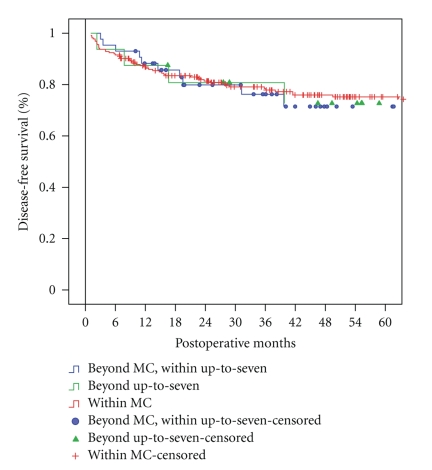
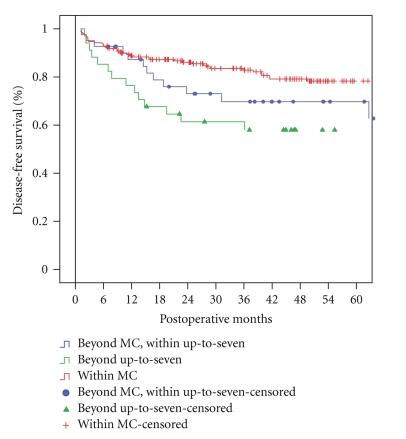
Background. Factors affecting outcomes after orthotopic liver transplantation (OLT) for hepatocellular carcinoma (HCC) have been extensively studied, but some of them have only recently been discovered or reassessed. Methods. We analyzed classical and more recently emerging variables with a hypothetical impact on recurrence-free survival (RFS) in a single-center series of 283 patients transplanted for HCC between 1997 and 2009. Results. Five-year patient survival and RFS were 75% and 86%, respectively. Thirty-four (12%) patients had HCC recurrence. Elevated preoperative alpha-fetoprotein (AFP) levels, preoperative treatments of HCC, unfulfilled Milan and up-to-seven criteria at final histology, poor tumor differentiation, and tumor microvascular invasion negatively affected RFS by univariate analysis. Milan and up-to-seven criteria applied preoperatively, and the use of m-TOR inhibitors did not reach statistical significance. Cox's proportional hazard model showed that only elevated AFP levels (Odds Ratio = 2.88; 95% C.I. = 1.43-5.80; P = .003), preoperative tumor treatments (Odds Ratio = 4.84; 95% C.I. = 1.42-16.42; P = .01), and microvascular invasion (Odds Ratio = 4.82; 95% C.I. = 1.87-12.41; P = .001) were predictors of lower RFS. Conclusions. Biological aggressiveness and preoperative tumor treatment, rather than traditional and expanded dimensional criteria, conditioned the outcomes in patients transplanted for HCC.
背景。影响肝细胞癌(HCC)原位肝移植(OLT)术后预后的因素已得到广泛研究,但其中一些因素直到最近才被发现或重新评估。方法。我们分析了1997年至2009年间在单中心接受HCC移植的283例患者中,对无复发生存期(RFS)可能有影响的经典变量和最近出现的变量。结果。患者的5年生存率和无复发生存率分别为75%和86%。34例(12%)患者出现HCC复发。单因素分析显示,术前甲胎蛋白(AFP)水平升高、HCC的术前治疗、最终组织学检查未达到米兰标准和七标准、肿瘤分化差以及肿瘤微血管侵犯对无复发生存期有负面影响。术前应用米兰标准和七标准以及使用m-TOR抑制剂未达到统计学意义。Cox比例风险模型显示,只有AFP水平升高(比值比=2.88;95%置信区间=1.43 - 5.80;P = 0.003)、术前肿瘤治疗(比值比=4.84;95%置信区间=1.42 - 16.42;P = 0.01)和微血管侵犯(比值比=4.82;95%置信区间=1.87 - 12.41;P = 0.001)是无复发生存期降低的预测因素。结论。生物学侵袭性和术前肿瘤治疗而非传统和扩展的维度标准决定了接受HCC移植患者的预后。