Museum of Zoology and Department of Ecology & Evolutionary Biology, University of Michigan, Ann Arbor, Michigan, USA.
PLoS One. 2010 Sep 16;5(9):e12759. doi: 10.1371/journal.pone.0012759.
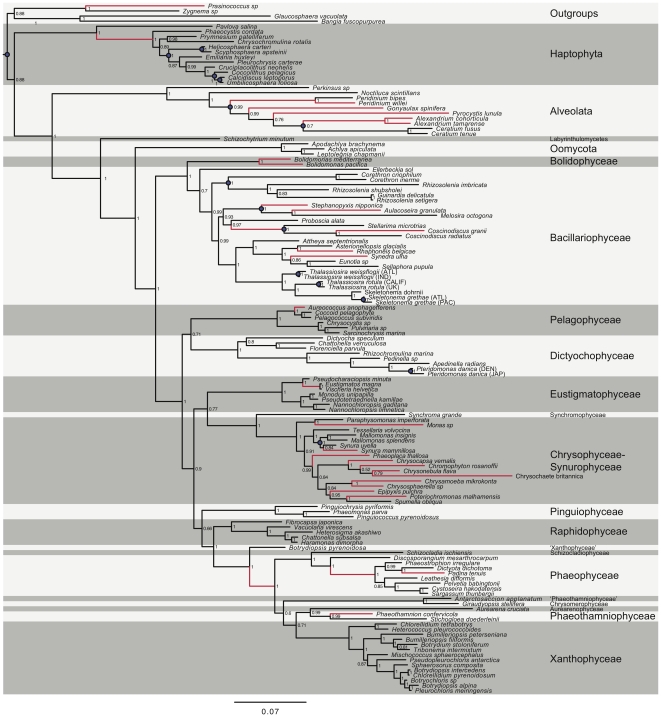
Stramenopiles constitute a large and diverse eukaryotic clade that is currently poorly characterized from both phylogenetic and temporal perspectives at deeper taxonomic levels. To better understand this group, and in particular the photosynthetic stramenopiles (Ochrophyta), we analyzed sequence data from 135 taxa representing most major lineages. Our analytical approach utilized several recently developed methods that more realistically model the temporal evolutionary process.
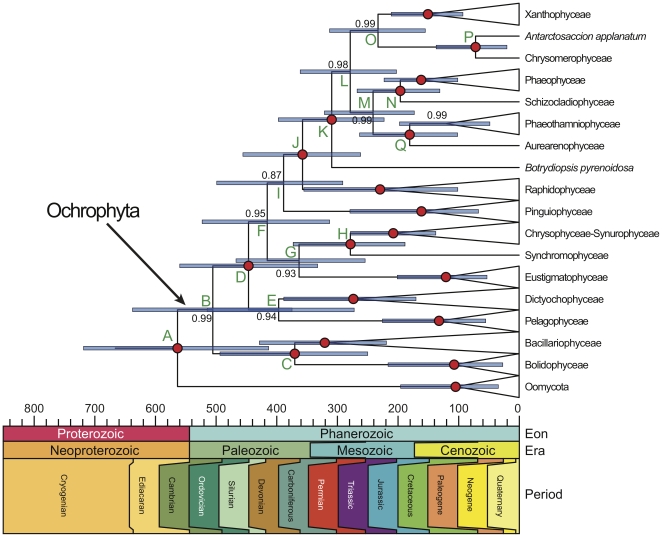
METHODOLOGY/PRINCIPAL FINDINGS: Phylogenetic reconstruction employed a Bayesian joint rate- and pattern-heterogeneity model to reconstruct the evolutionary history of these taxa. Inferred phylogenetic resolution was generally high at all taxonomic levels, sister-class relationships in particular receiving good statistical support. A signal for heterotachy was detected in clustered portions of the tree, although this does not seem to have had a major influence on topological inference. Divergence time estimates, assuming a lognormally-distributed relaxed molecular clock while accommodating topological uncertainty, were broadly congruent over alternative temporal prior distributions. These data suggest that Ochrophyta originated near the Proterozoic-Phanerozoic boundary, diverging from their sister-taxon Oomycota. The evolution of the major ochrophyte lineages appears to have proceeded gradually thereafter, with most lineages coming into existence by ∼200 million years ago.
CONCLUSIONS/SIGNIFICANCE: The evolutionary timescale of the autotrophic stramenopiles reconstructed here is generally older than previously inferred from molecular clocks. However, this more ancient timescale nevertheless casts serious doubt on the taxonomic validity of putative xanthophyte/phaeophyte fossils from the Proterozoic, which predate by as much as a half billion years or more the age suggested by our molecular genetic data. If these fossils truly represent crown stramenopile lineages, then this would imply that molecular rate evolution in this group proceeds in a fashion that is fundamentally incompatible with the relaxed molecular clock model employed here. A more likely scenario is that there is considerable convergent morphological evolution within Heterokonta, and that these fossils have been taxonomically misdiagnosed.
纤毛门是一个庞大而多样的真核生物类群,目前在更深的分类学水平上,从系统发育和时间角度来看,对其了解甚少。为了更好地了解这个群体,特别是光合纤毛门(Ochrophyta),我们分析了代表大多数主要谱系的 135 个分类群的序列数据。我们的分析方法利用了几种最近开发的方法,这些方法更真实地模拟了时间进化过程。
方法/主要发现: 系统发育重建采用贝叶斯联合速率和模式异质性模型来重建这些分类群的进化历史。在所有分类学水平上,推断的系统发育分辨率通常都很高,特别是姐妹类群关系得到了很好的统计支持。在树的聚类部分检测到异速进化的信号,尽管这似乎对拓扑推断没有重大影响。在假设对数正态分布的松弛分子钟的同时,同时考虑拓扑不确定性,进行了替代时间先验分布的分歧时间估计。这些数据表明,Ochrophyta 起源于元古宙-显生宙边界附近,与它们的姐妹分类群 Oomycota 分化。此后,主要的 Ochrophyta 谱系的进化似乎逐渐进行,大多数谱系在大约 2 亿年前就已经存在。
结论/意义: 这里重建的自养纤毛门的进化时间表通常比以前从分子钟推断的要古老。然而,这个更古老的时间表仍然严重怀疑来自元古代的假定黄藻/褐藻化石的分类有效性,这些化石比我们分子遗传数据所暗示的年龄早了多达 5 亿年或更长时间。如果这些化石真的代表冠纤毛门的谱系,那么这将意味着该群体的分子速率进化以与这里使用的松弛分子钟模型根本不兼容的方式进行。更有可能的情况是 Heterokonta 内存在大量趋同的形态进化,而这些化石在分类上被误诊。