Hazani Ron, Whitney Ryan D, Redstone Jeremiah, Chowdhry Saeed, Wilhelmi Bradon J
Division of Plastic and Reconstructive Surgery, University of Louisville School of Medicine, Kentucky.
Eplasty. 2010 Sep 15;10:e57.
Stenosing tenosynovitis of the thumb flexor tendon sheath is also known as trigger thumb. It is an inflammatory process that involves the flexor tendon sheath at the A1 pulley. Successful percutaneous or open treatment of trigger thumb depends on the ability of the clinician to properly predict the location of the A1 pulley. Longitudinal anatomic landmarks can facilitate safe treatment for the trigger thumb while circumventing injury to the neurovascular bundles.
Fourteen fresh cadaveric hands were dissected to identify surface landmarks corresponding to the oblique course of the flexor pollicis longus tendon at the level of the A1 pulley.
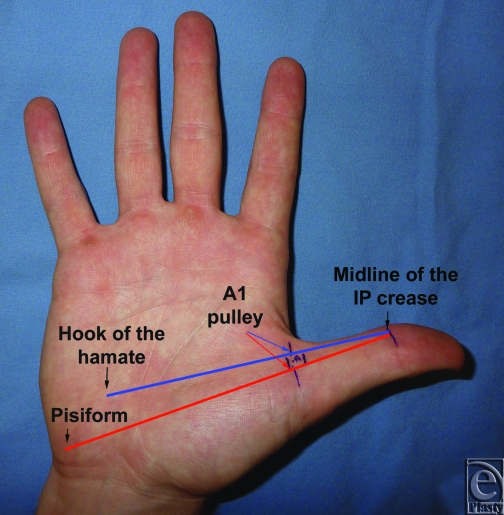
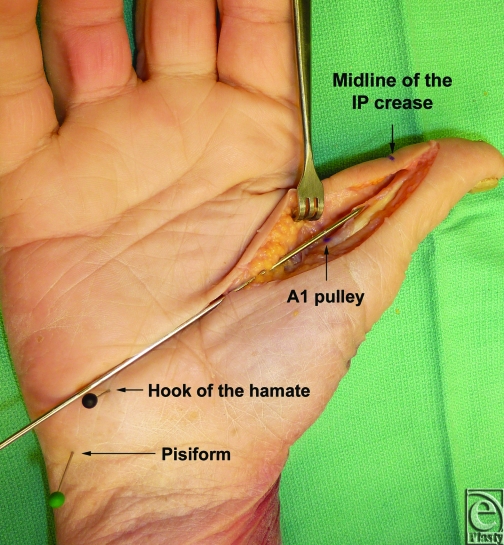
The longitudinal landmarks for the A1 pulley of the thumb are the palpable hook of the hamate and the midline of the thumb interphalangeal (IP) crease. Other bony prominences, such as the pisiform bone did not serve as effective landmarks while the thumb was in an abducted position.
we encourage the use longitudinal anatomic landmarks to predict the location of the thumb A1 pulley. The hook of the hamate and the midline at the palmar interphalangeal crease are reliable landmarks for safe release of the A1 pulley while avoiding inadvertent injury to adjacent structures.
拇指屈肌腱狭窄性腱鞘炎又称扳机指。它是一种累及A1滑车处屈肌腱鞘的炎症过程。扳机指的经皮或开放治疗成功与否取决于临床医生准确预测A1滑车位置的能力。纵向解剖标志有助于扳机指的安全治疗,同时避免损伤神经血管束。
解剖14只新鲜尸体手,以确定与A1滑车水平的拇长屈肌腱斜行路径相对应的表面标志。
拇指A1滑车的纵向标志是可触及的钩骨钩和拇指指间(IP)关节折痕的中线。在拇指外展位时,其他骨性突起,如豌豆骨,不能作为有效的标志。
我们鼓励使用纵向解剖标志来预测拇指A1滑车的位置。钩骨钩和掌指关节折痕处的中线是安全松解A1滑车、避免意外损伤相邻结构的可靠标志。