• 文献检索
  • 文档翻译
  • 深度研究
  • 学术资讯
  • Suppr Zotero 插件Zotero 插件
  • 邀请有礼
  • 套餐&价格
  • 历史记录
应用&插件
Suppr Zotero 插件Zotero 插件浏览器插件Mac 客户端Windows 客户端微信小程序
定价
高级版会员购买积分包购买API积分包
服务
文献检索文档翻译深度研究API 文档MCP 服务
关于我们
关于 Suppr公司介绍联系我们用户协议隐私条款
关注我们

Suppr 超能文献

核心技术专利:CN118964589B侵权必究
粤ICP备2023148730 号-1Suppr @ 2026

文献检索

告别复杂PubMed语法,用中文像聊天一样搜索,搜遍4000万医学文献。AI智能推荐,让科研检索更轻松。

立即免费搜索

文件翻译

保留排版,准确专业,支持PDF/Word/PPT等文件格式,支持 12+语言互译。

免费翻译文档

深度研究

AI帮你快速写综述,25分钟生成高质量综述,智能提取关键信息,辅助科研写作。

立即免费体验

青少年特发性关节炎中代理评估与青少年自身评估的残疾、疼痛和幸福感的一致性。

Agreement between proxy and adolescent assessment of disability, pain, and well-being in juvenile idiopathic arthritis.

机构信息

Arthritis Research UK Epidemiology Unit, University of Manchester, Manchester Academic Health Sciences Centre, Manchester, United Kingdom.

出版信息

J Pediatr. 2011 Feb;158(2):307-12. doi: 10.1016/j.jpeds.2010.08.003.

DOI:10.1016/j.jpeds.2010.08.003
PMID:20869068
原文链接:https://pmc.ncbi.nlm.nih.gov/articles/PMC3202630/
Abstract

OBJECTIVES

Adolescents with juvenile idiopathic arthritis have demonstrated substantial disagreement with their proxy's assessment of their disability, pain, and well-being. Our objective was to describe the clinical and psychological factors associated with discordance.

STUDY DESIGN

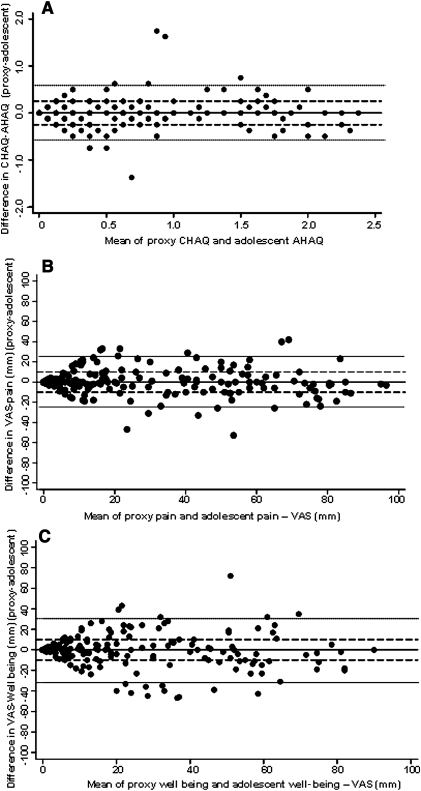
This analysis included 204 proxy-adolescent (median age, 13 years) dyads that completed a Childhood Health Assessment Questionnaire for disability with 100-mm visual analogue scales for pain and well-being. Depressive symptoms in adolescents were measured by the Mood and Feelings Questionnaire and in proxies the General Health Questionnaire. Disagreement was assessed using Bland-Altman plots. Associations with discordance were identified using logistic regression analyses.

RESULTS

There was higher agreement for disability (84%) than for pain (71%) and well-being (66%). Regression analyses found no association between age, sex, or disease duration and disagreement. However, relationships between disease activity and disagreement in outcomes were identified. Independent associations were found between increasing Mood and Feelings Questionnaire scores and disagreement in pain and well-being.

CONCLUSIONS

Proxy and adolescent reports of pain and well-being are more likely to disagree in those with severe disease. Adolescents who report depressive symptoms are also more likely to disagree with their proxy. The reasons for these are multifactorial, and considerations of both reports are important when assessing outcomes in juvenile idiopathic arthritis.

摘要

目的

青少年特发性关节炎患者与其代理人对其残疾、疼痛和幸福感的评估存在显著差异。我们的目的是描述与这种不匹配相关的临床和心理因素。

研究设计

这项分析包括 204 对代理-青少年(中位数年龄 13 岁),他们完成了儿童健康评估问卷以评估残疾程度,并使用 100 毫米视觉模拟量表评估疼痛和幸福感。青少年的抑郁症状通过情绪和感觉问卷测量,而代理人则通过一般健康问卷测量。使用 Bland-Altman 图评估差异。使用逻辑回归分析确定与差异相关的因素。

结果

残疾的一致性(84%)高于疼痛(71%)和幸福感(66%)。回归分析发现年龄、性别或疾病持续时间与差异无关。然而,发现疾病活动与结局的差异之间存在关系。与心境和感觉问卷评分增加相关的是疼痛和幸福感差异的独立关联。

结论

在疾病严重的患者中,代理人和青少年对疼痛和幸福感的报告更有可能存在差异。报告抑郁症状的青少年也更有可能与其代理人意见不一致。这些差异的原因是多因素的,在评估青少年特发性关节炎的结局时,应同时考虑这两种报告。
https://cdn.ncbi.nlm.nih.gov/pmc/blobs/e575/3202630/72117aafa5a6/gr1.jpg

相似文献

1
Agreement between proxy and adolescent assessment of disability, pain, and well-being in juvenile idiopathic arthritis.青少年特发性关节炎中代理评估与青少年自身评估的残疾、疼痛和幸福感的一致性。
J Pediatr. 2011 Feb;158(2):307-12. doi: 10.1016/j.jpeds.2010.08.003.
2
Depressive symptoms, pain and disability for adolescent patients with juvenile idiopathic arthritis: results from the Childhood Arthritis Prospective Study.青少年特发性关节炎患者的抑郁症状、疼痛和残疾:来自儿童关节炎前瞻性研究的结果。
Rheumatology (Oxford). 2018 Aug 1;57(8):1381-1389. doi: 10.1093/rheumatology/key088.
3
Comparing Proxy, Adolescent, and Adult Assessments of Functional Ability in Adolescents With Juvenile Idiopathic Arthritis.比较青少年特发性关节炎青少年的代理、青少年和成人的功能能力评估。
Arthritis Care Res (Hoboken). 2020 Apr;72(4):517-524. doi: 10.1002/acr.23877.
4
Early Self-Reported Pain in Juvenile Idiopathic Arthritis as Related to Long-Term Outcomes: Results From the Nordic Juvenile Idiopathic Arthritis Cohort Study.幼年特发性关节炎患者早期的自我报告疼痛与长期结局的关系:来自北欧幼年特发性关节炎队列研究的结果。
Arthritis Care Res (Hoboken). 2019 Jul;71(7):961-969. doi: 10.1002/acr.23715. Epub 2019 Jun 12.
5
Growing up and moving on in rheumatology: parents as proxies of adolescents with juvenile idiopathic arthritis.在风湿病领域成长与前行:父母作为青少年特发性关节炎患儿的代理人
Arthritis Rheum. 2006 Apr 15;55(2):189-98. doi: 10.1002/art.21834.
6
The correlation between the Childhood Health Assessment Questionnaire and disease activity in juvenile idiopathic arthritis.儿童健康评估问卷与幼年特发性关节炎疾病活动度之间的相关性。
Musculoskeletal Care. 2018 Sep;16(3):339-344. doi: 10.1002/msc.1239. Epub 2018 Mar 24.
7
Determinants of health-related quality of life in children newly diagnosed with juvenile idiopathic arthritis.儿童新诊断为幼年特发性关节炎的健康相关生活质量的决定因素。
Arthritis Care Res (Hoboken). 2014 Feb;66(2):263-9. doi: 10.1002/acr.22117.
8
Validation of the EQ-5D-Y-5L parent-proxy version among children with juvenile idiopathic arthritis.青少年特发性关节炎患儿 EQ-5D-Y-5L 父母代评量表的验证。
Qual Life Res. 2024 Oct;33(10):2677-2691. doi: 10.1007/s11136-024-03682-4. Epub 2024 Aug 14.
9
Determinants of health-related quality of life impairment in Egyptian children and adolescents with juvenile idiopathic arthritis: Sharkia Governorate.埃及沙尔吉亚省青少年特发性关节炎患儿及青少年健康相关生活质量受损的决定因素
Rheumatol Int. 2014 Aug;34(8):1095-101. doi: 10.1007/s00296-014-2950-1. Epub 2014 Jan 28.
10
Relationship of Fatigue, Pain Interference, and Physical Disability in Children Newly Diagnosed With Juvenile Idiopathic Arthritis.儿童幼年特发性关节炎初诊时疲劳、疼痛干扰与身体残疾的关系。
Arthritis Care Res (Hoboken). 2024 Oct;76(10):1409-1418. doi: 10.1002/acr.25377. Epub 2024 Jun 17.

引用本文的文献

1
Predictors of persisting pain in children with Juvenile Idiopathic Arthritis: a case control study nested in the ReACCh-Out cohort.预测儿童青少年特发性关节炎持续疼痛的因素:嵌套在 ReACCh-Out 队列中的病例对照研究。
Pediatr Rheumatol Online J. 2023 Sep 16;21(1):102. doi: 10.1186/s12969-023-00885-w.
2
Significant pain decrease in children with non-systemic Juvenile Idiopathic Arthritis treated to target: results over 24 months of follow up.目标治疗后儿童非系统性幼年特发性关节炎疼痛显著减轻:24 个月随访结果。
Pediatr Rheumatol Online J. 2023 Aug 26;21(1):90. doi: 10.1186/s12969-023-00874-z.
3
The impact of psoriasis on wellbeing and clinical outcomes in juvenile psoriatic arthritis.

本文引用的文献

1
Do mothers and fathers hold similar views about their child's arthritis?母亲和父亲对自己孩子患关节炎的看法相似吗?
Arthritis Rheum. 2009 Dec 15;61(12):1712-8. doi: 10.1002/art.25008.
2
Disease activity and disability in children with juvenile idiopathic arthritis one year following presentation to paediatric rheumatology. Results from the Childhood Arthritis Prospective Study.幼年特发性关节炎患儿发病一年后的疾病活动度和残疾情况。儿童关节炎前瞻性研究结果。
Rheumatology (Oxford). 2010 Jan;49(1):116-22. doi: 10.1093/rheumatology/kep352. Epub 2009 Nov 19.
3
Parent-child agreement across child health-related quality of life instruments: a review of the literature.
银屑病对青少年银屑病关节炎患者的健康相关生活质量和临床结局的影响。
Rheumatology (Oxford). 2024 May 2;63(5):1273-1280. doi: 10.1093/rheumatology/kead370.
4
Prevalence and risk factors of depressive symptoms in children and adolescents with juvenile idiopathic arthritis.儿童和青少年特发性关节炎患者抑郁症状的患病率及相关因素。
Rheumatol Int. 2023 Aug;43(8):1497-1505. doi: 10.1007/s00296-023-05323-4. Epub 2023 Apr 11.
5
Agreement between older adult patient and caregiver proxy symptom reports.老年患者与照顾者代理症状报告之间的一致性。
J Patient Rep Outcomes. 2022 May 14;6(1):50. doi: 10.1186/s41687-022-00457-8.
6
Profiling Behavioral and Psychological Symptoms in Children Undergoing Treatment for Spondyloarthritis and Polyarthritis.对接受脊柱关节炎和多发性关节炎治疗的儿童进行行为和心理症状分析。
J Rheumatol. 2022 May;49(5):489-496. doi: 10.3899/jrheum.210489. Epub 2022 Feb 1.
7
Depression And Anxiety In Patients With Juvenile Idiopathic Arthritis: Current Insights And Impact On Quality Of Life, A Systematic Review.青少年特发性关节炎患者的抑郁和焦虑:当前见解及其对生活质量的影响,一项系统综述
Open Access Rheumatol. 2019 Nov 1;11:237-252. doi: 10.2147/OARRR.S174408. eCollection 2019.
8
Patient-physician discordance in assessment of adherence to inhaled controller medication: a cross-sectional analysis of two cohorts.患者与医生对吸入性控制器药物治疗依从性评估的不一致:两项队列研究的横断面分析。
BMJ Open. 2019 Nov 7;9(11):e031732. doi: 10.1136/bmjopen-2019-031732.
9
Comparing Proxy, Adolescent, and Adult Assessments of Functional Ability in Adolescents With Juvenile Idiopathic Arthritis.比较青少年特发性关节炎青少年的代理、青少年和成人的功能能力评估。
Arthritis Care Res (Hoboken). 2020 Apr;72(4):517-524. doi: 10.1002/acr.23877.
10
Trials with proxy-reported outcomes registered on the Australian New Zealand Clinical Trials Registry (ANZCTR).在澳大利亚新西兰临床试验注册中心(ANZCTR)注册的由代理报告结局的试验。
Qual Life Res. 2019 Apr;28(4):955-962. doi: 10.1007/s11136-018-2080-4. Epub 2018 Dec 15.
儿童健康相关生活质量工具中的亲子协议:文献综述
Qual Life Res. 2008 Aug;17(6):895-913. doi: 10.1007/s11136-008-9350-5. Epub 2008 Jun 3.
4
Determinants of child-parent agreement in quality-of-life reports: a European study of children with cerebral palsy.生活质量报告中儿童与家长意见一致的决定因素:一项针对欧洲脑瘫儿童的研究。
Pediatrics. 2007 Oct;120(4):e804-14. doi: 10.1542/peds.2006-3272.
5
Measuring quality of life.衡量生活质量。
Arch Dis Child. 2007 Apr;92(4):348-50. doi: 10.1136/adc.2005.086405.
6
Criterion validity of the Mood and Feelings Questionnaire for depressive episodes in clinic and non-clinic subjects.《情绪与感受问卷》在临床和非临床受试者中对抑郁发作的效标效度。
J Child Psychol Psychiatry. 2006 Sep;47(9):927-34. doi: 10.1111/j.1469-7610.2006.01646.x.
7
Comparison between Children with Juvenile Idiopathic Arthritis (JIA) and their parents concerning perceived Quality of Life.幼年特发性关节炎(JIA)患儿与其父母在感知生活质量方面的比较。
Qual Life Res. 2006 May;15(4):655-61. doi: 10.1007/s11136-005-3690-1.
8
Growing up and moving on in rheumatology: parents as proxies of adolescents with juvenile idiopathic arthritis.在风湿病领域成长与前行:父母作为青少年特发性关节炎患儿的代理人
Arthritis Rheum. 2006 Apr 15;55(2):189-98. doi: 10.1002/art.21834.
9
Level of agreement between children, parents, and physicians in rating pain intensity in juvenile idiopathic arthritis.儿童、父母和医生在评估幼年特发性关节炎疼痛强度方面的一致性水平。
Arthritis Rheum. 2006 Apr 15;55(2):177-83. doi: 10.1002/art.21840.
10
Growing up and moving on in rheumatology: a multicentre cohort of adolescents with juvenile idiopathic arthritis.在风湿病领域成长与前行:一项针对青少年特发性关节炎青少年的多中心队列研究
Rheumatology (Oxford). 2005 Jun;44(6):806-12. doi: 10.1093/rheumatology/keh603. Epub 2005 Mar 15.