Wildlife Conservation Research Unit, Zoology Department, Recanati-Kaplan Centre, University of Oxford, Oxford, United Kingdom.
PLoS One. 2010 Sep 22;5(9):e12866. doi: 10.1371/journal.pone.0012866.
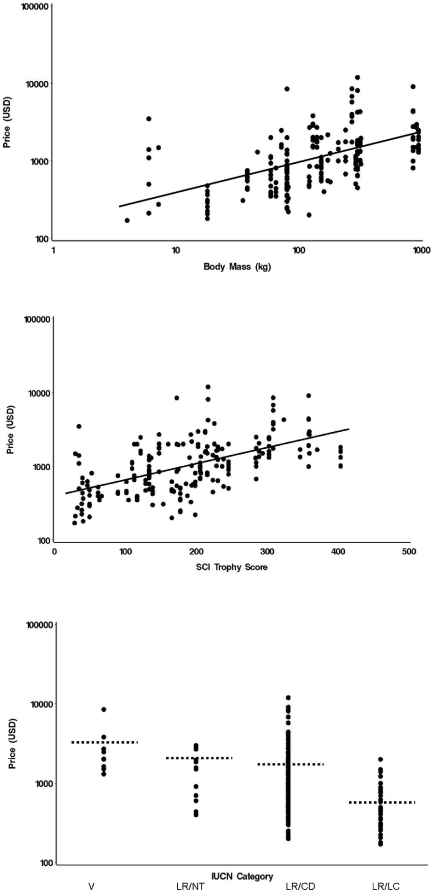
We explore variation in the prices paid by recreational hunters of trophy animals in Africa and its possible causes, including perceived rarity. Previous work has raised the possibility that extinction can result if demand rises fast enough as a species becomes rarer. We attempt to disentangle this from other inter-correlated influences affecting price. Species with larger body sizes and larger trophies were more valuable. Value increased less steeply as a function of size for bovids than for felids and the effect was consistent across countries. Power laws, ubiquitous in physical and social systems, described the trends. The exponent was approximately 0.4 for bovids, compared with approximately 1.0 for felids. Rarity (as indexed by IUCN score) influenced the value of bovid trophies - price was higher for species in categories denoting higher global threat. There was substantial variation in price among and within families not explained by either size or rarity. This may be attributable to a 'charisma' effect, which seems likely to be a general attribute of human perceptions of wildlife. Species where prices were higher than predicted by size or rarity are ranked high in published accounts of desirability by hunters. We conclude that the valuation of these species is explicable to a large extent by body size and perceived rarity, and that differences in valuation between taxonomic groups are related to less easily quantified 'charisma' effects. These findings are relevant for conservationists considering the threat status of species exploited in open access markets, and where license quotas are adjusted in response to changes in perceived rarity.
我们探讨了非洲 Trophy 动物(指猎获的具有象征意义的大型野生动物)的休闲猎人支付价格的变化及其可能的原因,包括感知的稀有性。以前的工作提出了一种可能性,如果一个物种由于变得更加稀有而导致需求快速上升,那么可能会导致灭绝。我们试图将这种情况与影响价格的其他相互关联的因素区分开来。体型较大、战利品较大的物种更有价值。对于牛科动物而言,其价值随体型增加的幅度要小于猫科动物,而且这种影响在各国之间是一致的。在物理和社会系统中普遍存在的幂律描述了这些趋势。对于牛科动物而言,这个指数约为 0.4,而对于猫科动物而言,这个指数约为 1.0。稀有性(以 IUCN 得分指数表示)影响了牛科动物战利品的价值——在全球威胁程度较高的类别中,物种的价格更高。在体型或稀有性都无法解释的情况下,不同家庭之间和内部的价格存在很大差异。这可能归因于“魅力”效应,这似乎是人类对野生动物感知的普遍属性。在猎人的期望排名中,价格高于大小或稀有性预测的物种排名较高。我们的结论是,这些物种的估值在很大程度上可以用体型和感知的稀有性来解释,而分类群之间的估值差异与更难以量化的“魅力”效应有关。这些发现对于考虑在开放获取市场中开发利用的物种的濒危状态以及许可证配额根据感知稀有性的变化进行调整的保护主义者来说是相关的。