Thorax Clinic Institute, Hospital Clínic, Institut d'Investigacions Biomèdiques August Pi i Sunyer, University of Barcelona, Barcelona, Spain.
PLoS Negl Trop Dis. 2010 Sep 21;4(9):e826. doi: 10.1371/journal.pntd.0000826.
Chagas disease remains a major cause of mortality in several countries of Latin America and has become a potential public health problem in non-endemic countries as a result of migration flows. Cardiac involvement represents the main cause of mortality, but its diagnosis is still based on nonspecific criteria with poor sensitivity. Early identification of patients with cardiac involvement is desirable, since early treatment may improve prognosis. This study aimed to assess the role of diastolic dysfunction, abnormal myocardial strain and elevated brain natriuretic peptide (BNP) in the early identification of cardiac involvement in Chagas disease.
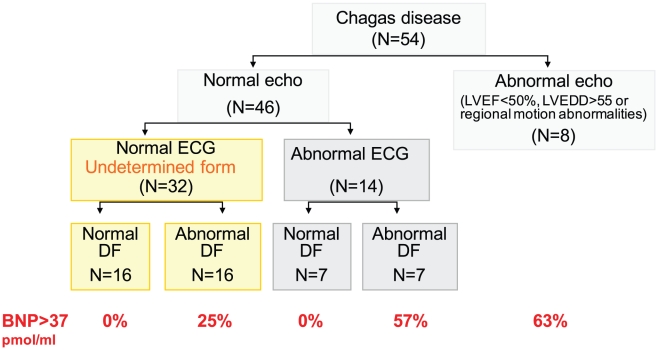
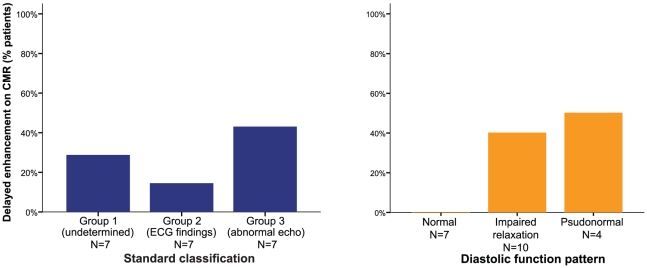
METHODOLOGY/PRINCIPAL FINDINGS: Fifty-four patients divided into 3 groups--group 1 (undetermined form: positive serology without ECG or 2D-echocardiographic abnormalities; N = 32), group 2 (typical ECG abnormalities of Chagas disease but normal 2D-echocardiography; N = 14), and group 3 (regional wall motion abnormalities, left ventricular [LV] end-diastolic diameter >55 mm or LV ejection fraction <50% on echocardiography; N = 8)--and 44 control subjects were studied. Patients with significant non-cardiac diseases, other heart diseases and previous treatment with benznidazol were excluded. The median age was 37 (20-58) years; 40% were men. BNP levels, longitudinal and radial myocardial strain and LV diastolic dysfunction increased progressively from group 1 to 3 (p for trend <0.01). Abnormal BNP levels (>37 pg/ml) were noted in 0%, 13%, 29% and 63% in controls and groups 1 to 3, respectively. Half of patients in the undetermined form had impaired relaxation patterns, whereas half of patients with ECG abnormalities suggestive of Chagas cardiomyopathy had normal diastolic function. In group 1, BNP levels were statistically higher in patients with diastolic dysfunction as compared to those with normal diastolic function (27 ± 26 vs. 11 ± 8 pg/ml, p = 0.03).
CONCLUSION/SIGNIFICANCE: In conclusion, the combination of diastolic function and BNP measurement adds important information that could help to better stratify patients with Chagas disease.
恰加斯病仍然是拉丁美洲几个国家的主要死亡原因,并且由于移民流动,已成为非流行国家的潜在公共卫生问题。心脏受累是主要的死亡原因,但目前的诊断仍然基于敏感性较差的非特异性标准。早期发现心脏受累的患者是可取的,因为早期治疗可能会改善预后。本研究旨在评估舒张功能障碍、异常心肌应变和脑利钠肽(BNP)升高在早期识别恰加斯病心脏受累中的作用。
方法/主要发现:将 54 名患者分为 3 组-第 1 组(未确定型:血清学阳性但心电图或二维超声心动图无异常;N = 32)、第 2 组(恰加斯病的典型心电图异常但二维超声心动图正常;N = 14)和第 3 组(节段性室壁运动异常,左心室舒张末期直径> 55mm 或超声心动图显示左心室射血分数<50%;N = 8)-和 44 名对照组进行了研究。排除了有重大非心脏疾病、其他心脏病和以前使用苯并咪唑治疗的患者。中位年龄为 37(20-58)岁,40%为男性。BNP 水平、纵向和径向心肌应变以及左心室舒张功能从第 1 组到第 3 组逐渐增加(趋势 P < 0.01)。对照组和第 1 到 3 组中分别有 0%、13%、29%和 63%的患者 BNP 水平异常(> 37pg/ml)。未确定型组有一半患者舒张松弛模式异常,而心电图异常提示恰加斯心肌病的患者有一半舒张功能正常。在第 1 组中,与舒张功能正常的患者相比,舒张功能障碍患者的 BNP 水平更高(27 ± 26 与 11 ± 8pg/ml,P = 0.03)。
总之,舒张功能和 BNP 测量的结合提供了重要信息,可以帮助更好地对恰加斯病患者进行分层。