In-vivo-NMR Laboratory, Max Planck Institute for Neurological Research, Cologne, Germany.
PLoS One. 2010 Sep 22;5(9):e12779. doi: 10.1371/journal.pone.0012779.
Regenerative strategies of stem cell grafting have been demonstrated to be effective in animal models of stroke. In those studies, the effectiveness of stem cells promoting functional recovery was assessed by behavioral testing. These behavioral studies do, however, not provide access to the understanding of the mechanisms underlying the observed functional outcome improvement.
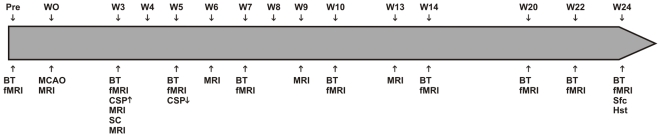
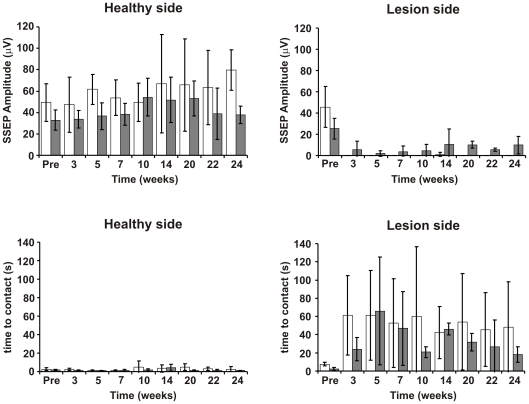
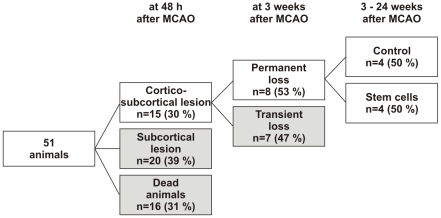
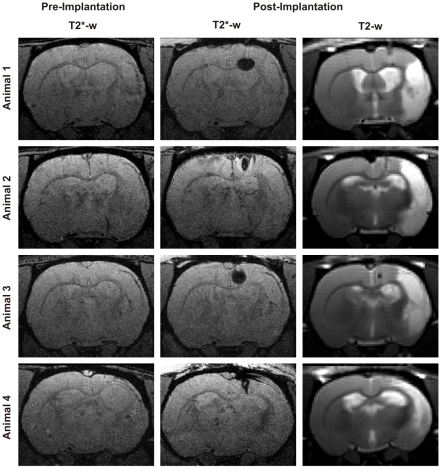
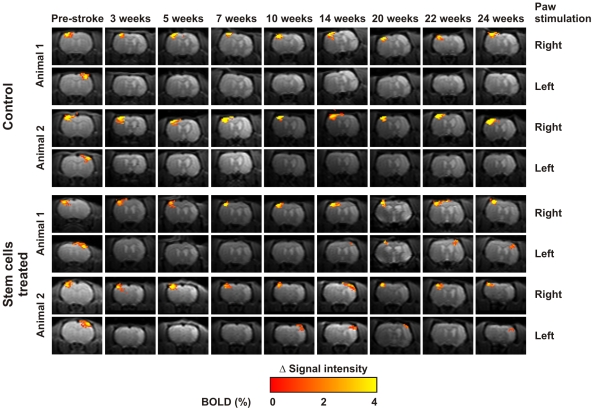
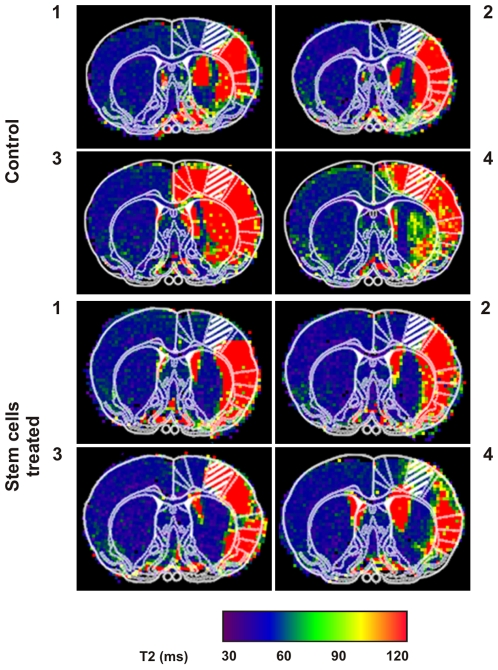
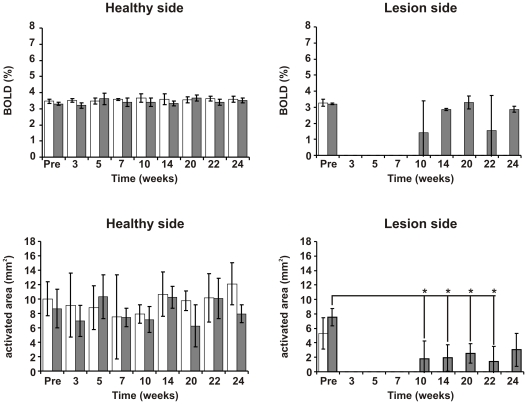
METHODOLOGY/PRINCIPAL FINDINGS: In order to address the underlying mechanisms of stem cell mediated functional improvement, this functional improvement after stroke in the rat was investigated for six months after stroke by use of fMRI, somatosensory evoked potentials by electrophysiology, and sensorimotor behavior testing. Stem cells were grafted ipsilateral to the ischemic lesion. Rigorous exclusion of spontaneous recovery as confounding factor permitted to observe graft-related functional improvement beginning after 7 weeks and continuously increasing during the 6-month observation period. The major findings were i) functional improvement causally related to the stem cells grafting; ii) tissue replacement can be excluded as dominant factor for stem cell mediated functional improvement; iii) functional improvement occurs by exclusive restitution of the function in the original representation field, without clear contributions from reorganization processes, and iv) stem cells were not detectable any longer after six months.
CONCLUSIONS/SIGNIFICANCE: A delayed functional improvement due to stem cell implantation has been documented by electrophysiology, fMRI and behavioral testing. This functional improvement occurred without cells acting as a tissue replacement for the necrotic tissue after the ischemic event. Combination of disappearance of grafted cells after six months on histological sections with persistent functional recovery was interpreted as paracrine effects by the grafted stem cells being the dominant mechanism of cell activity underlying the observed functional restitution of the original activation sites. Future studies will have to investigate whether the stem cell mediated improvement reactivates the original representation target field by using original connectivity pathways or by generating/activating new ones for the stimulus.
干细胞移植的再生策略已被证明在中风的动物模型中是有效的。在这些研究中,通过行为测试评估了干细胞促进功能恢复的效果。然而,这些行为研究并不能深入了解观察到的功能结果改善的机制。
方法/主要发现:为了研究干细胞介导的功能改善的潜在机制,本研究通过功能磁共振成像(fMRI)、电生理学体感诱发电位和感觉运动行为测试,在中风后 6 个月内研究了大鼠中风后的这些功能改善。将干细胞移植到缺血性损伤的同侧。严格排除自发恢复作为混杂因素,允许观察到 7 周后开始并在 6 个月观察期内持续增加的与移植相关的功能改善。主要发现包括:i)与干细胞移植有关的功能改善;ii)组织替代不能作为干细胞介导的功能改善的主要因素;iii)功能改善仅通过原始代表区域的功能恢复来实现,没有明显的重组过程的贡献;iv)移植后 6 个月后不再检测到干细胞。
结论/意义:通过电生理学、功能磁共振成像和行为测试记录了由于干细胞植入而导致的延迟功能改善。这种功能改善发生在缺血事件后,坏死组织没有细胞作为组织替代物的情况下。在组织切片上,移植细胞在 6 个月后消失,但功能仍持续恢复,这一现象被解释为移植干细胞的旁分泌作用是观察到的原始激活部位功能恢复的细胞活动的主要机制。未来的研究将不得不研究干细胞介导的改善是否通过使用原始连接通路或为刺激生成/激活新的连接通路来重新激活原始代表目标场。