Department of Biology, University of Western Ontario, London, Ontario, Canada.
Biol Lett. 2011 Apr 23;7(2):233-6. doi: 10.1098/rsbl.2010.0744. Epub 2010 Sep 29.
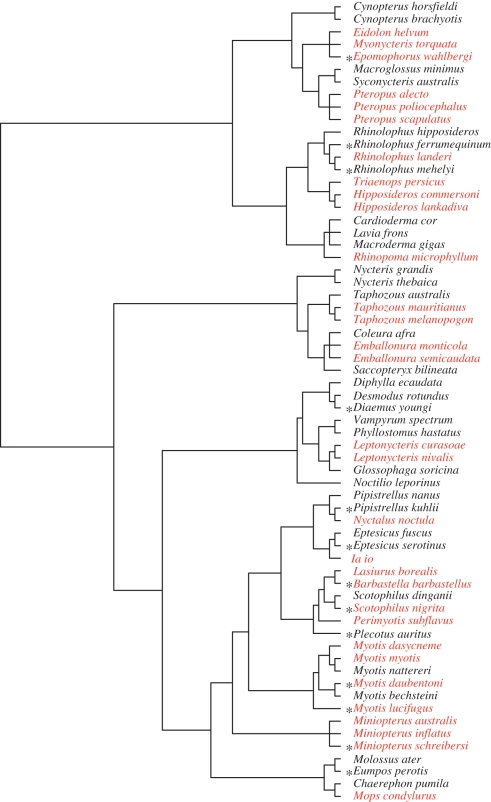
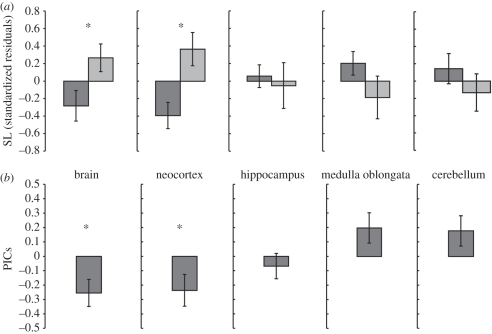
Migratory bird species have smaller brains than non-migratory species. The behavioural flexibility/migratory precursor hypothesis suggests that sedentary birds have larger brains to allow the behavioural flexibility required in a seasonally variable habitat. The energy trade-off hypothesis proposes that brains are heavy, energetically expensive and therefore, incompatible with migration. Here, we compared relative brain, neocortex and hippocampus volume between migratory and sedentary bats at the species-level and using phylogenetically independent contrasts. We found that migratory bats had relatively smaller brains and neocortices than sedentary species. Our results support the energy trade-off hypothesis because bats do not exhibit the same degree of flexibility in diet selection as sedentary birds. Our results also suggest that bat brain size differences are subtler than those found in birds, perhaps owing to bats' shorter migration distances. Conversely, we found no difference in relative hippocampus volume between migratory and sedentary species, underscoring our limited understanding of the role of the hippocampus in bats.
候鸟的大脑比非候鸟小。行为灵活性/迁徙前体假说认为,留鸟的大脑较大,以便在季节性变化的栖息地中具有所需的行为灵活性。能量权衡假说提出,大脑较重,能量消耗大,因此与迁徙不兼容。在这里,我们在物种水平上并使用系统发育独立对比,比较了迁徙和定居蝙蝠的相对脑、新皮质和海马体体积。我们发现,迁徙蝙蝠的大脑和新皮质相对较小,而静止物种则较大。我们的结果支持能量权衡假说,因为蝙蝠在饮食选择方面没有表现出与留鸟相同的灵活性。我们的结果还表明,蝙蝠大脑大小的差异比鸟类的差异更微妙,这可能是由于蝙蝠的迁徙距离较短。相反,我们发现迁徙和定居物种之间的相对海马体体积没有差异,这突显了我们对海马体在蝙蝠中的作用的有限理解。