Department of Biology, University of Maryland, College Park, Maryland, USA.
PLoS One. 2010 May 25;5(5):e10808. doi: 10.1371/journal.pone.0010808.
Natural selection can shape specific cognitive abilities and the extent to which a given species relies on various cues when learning associations between stimuli and rewards. Because the flower bat Glossophaga soricina feeds primarily on nectar, and the locations of nectar-producing flowers remain constant, G. soricina might be predisposed to learn to associate food with locations. Indeed, G. soricina has been observed to rely far more heavily on spatial cues than on shape cues when relocating food, and to learn poorly when shape alone provides a reliable cue to the presence of food.
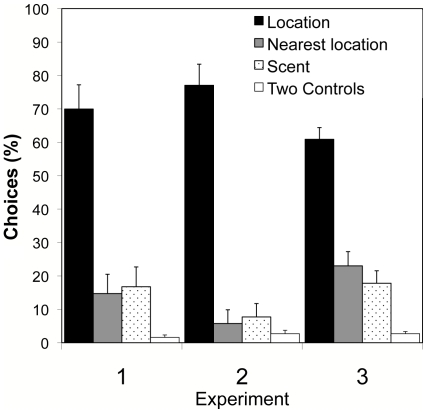
METHODOLOGY/PRINCIPAL FINDINGS: Here we determined whether G. soricina would learn to use scent cues as indicators of the presence of food when such cues were also available. Nectar-producing plants fed upon by G. soricina often produce distinct, intense odors. We therefore expected G. soricina to relocate food sources using scent cues, particularly the flower-produced compound, dimethyl disulfide, which is attractive even to G. soricina with no previous experience of it. We also compared the learning of associations between cues and food sources by G. soricina with that of a related fruit-eating bat, Carollia perspicillata. We found that (1) G. soricina did not learn to associate scent cues, including dimethyl disulfide, with feeding sites when the previously rewarded spatial cues were also available, and (2) both the fruit-eating C. perspicillata and the flower-feeding G. soricina were significantly more reliant on spatial cues than associated sensory cues for relocating food.
CONCLUSIONS/SIGNIFICANCE: These findings, taken together with past results, provide evidence of a powerful, experience-independent predilection of both species to rely on spatial cues when attempting to relocate food.
自然选择可以塑造特定的认知能力,以及一个给定物种在学习刺激和奖励之间的关联时依赖各种线索的程度。由于花蝠 Glossophaga soricina 主要以花蜜为食,而产蜜花的位置保持不变,因此 G. soricina 可能更容易学会将食物与位置联系起来。事实上,人们观察到 G. soricina 在重新定位食物时,比形状线索更依赖于空间线索,而当形状单独提供食物存在的可靠线索时,它的学习效果很差。
方法/主要发现:在这里,我们确定了当有可用的气味线索时,G. soricina 是否会学会使用气味线索作为食物存在的指示。G. soricina 食用的产蜜植物通常会产生独特而强烈的气味。因此,我们预计 G. soricina 会使用气味线索来定位食物来源,特别是花朵产生的二甲基二硫,即使是对它没有先前经验的 G. soricina 来说,它也是有吸引力的。我们还比较了 G. soricina 与相关的食果蝙蝠 Carollia perspicillata 之间对线索和食物来源的关联的学习。我们发现:(1)当先前有奖励的空间线索也可用时,G. soricina 并没有学会将气味线索(包括二甲基二硫)与喂食地点联系起来;(2)无论是食果的 C. perspicillata 还是食花的 G. soricina,在重新定位食物时,对空间线索的依赖都明显高于与感官线索的关联。
结论/意义:这些发现,加上过去的结果,提供了有力的证据,证明这两个物种都有一种强大的、独立于经验的倾向,即在试图重新定位食物时依赖于空间线索。